

Astronomers have long been fascinated by the complex process of planetary system evolution, a journey that spans hundreds of millions of years. For most of human history, we have observed planetary systems either at birth or after they have reached maturity. However, a new study published in Nature Astronomy offers an unprecedented opportunity to understand the “teenage” phase of a planetary system. The study focuses on TOI-2076, a rare and youthful planetary system that lies in the midst of its transformation.
The Adolescent Stage of TOI-2076: A Rare Discovery
TOI-2076, a planetary system orbiting a K-dwarf star, is estimated to be about 210 million years old, an age that makes it an adolescent in cosmic terms. Unlike the well-studied, mature planetary systems like our own, TOI-2076 offers a glimpse into the dynamic and fast-paced evolution that takes place when a planetary system is transitioning from its formative years to its adult phase. This stage, which lasts a mere fraction of the system’s lifespan, is crucial for understanding the long-term development of planetary systems, as noted by Howard Chen, an assistant professor at the Florida Institute of Technology and a co-author of the study, published in Nature Astronomy:
“The transformative period is so short compared to the entire lifespan of the system. That period is really the key in determining how it turns out at its mature state.”
The planetary system is composed of four planets, each exhibiting unique characteristics. The planets, once tightly packed in orbits, are now slowly drifting apart, and the inner planets have experienced significant atmospheric loss due to intense stellar radiation. Observations from the NASA Transiting Exoplanet Survey Satellite (TESS) and ground-based telescopes have provided detailed measurements of the planets’ masses, radii, and orbital dynamics. This data allowed scientists to study how the planets’ atmospheres are evolving in response to the intense radiation from the host star.
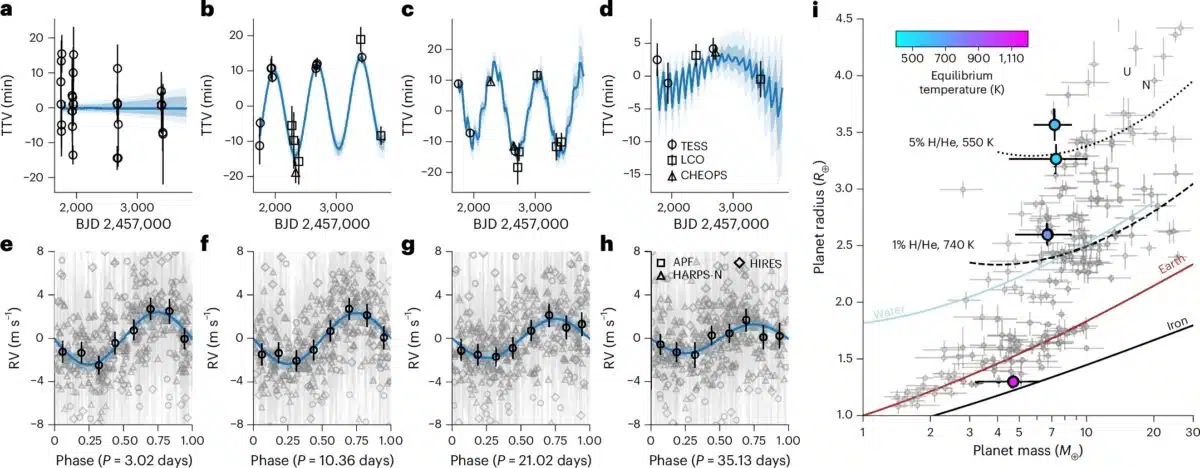 TTVs and RV observations and measured masses and radii of the TOI-2076 planets.
Credit: Nature Astronomy (2026). DOI: 10.1038/s41550-026-02795-9
The Role of Photoevaporation in Shaping Planetary Evolution
At the heart of this transformation lies the process of photoevaporation, where radiation from the host star strips away the planets’ atmospheres. The amount of atmospheric loss depends on the planet’s proximity to the star; planets closer to the star lose more gas, leaving behind a more rock-dominated core, while planets farther from the star retain more of their gaseous envelopes. This evolutionary process, driven by the intense stellar radiation, is what gives TOI-2076 its unique character. The innermost planet in the system has completely shed its atmosphere, revealing only a rocky core, while the outer planets retain their atmospheres to varying degrees.
Chen’s computational models were critical in simulating the effects of photoevaporation on the planets’ atmospheres. By applying his models to the data from TOI-2076, Chen was able to demonstrate that the loss of atmosphere was not a random occurrence, but a predictable result of the planets’ positions and the amount of radiation they received. This realization was a major milestone for Chen and his team.
“For me, the whole point of going into modeling is to be able to connect with observations. You want your models to say something about the real world, but that’s not necessarily the case every time,” Chen said. “To see the model work in the real world and explain what’s happening is pretty powerful.”
A Simulated Timeline for Planetary Adolescence
One of the most valuable contributions of this study is the timeline it provides for planetary systems as they transition through adolescence. Chen’s models suggest that the majority of atmospheric loss in systems like TOI-2076 occurs within the first 100 million years of a system’s life. After this period, the system stabilizes, and the planets settle into their mature configurations. This short but intense phase of atmospheric loss plays a pivotal role in determining the system’s long-term evolution. Chen’s simulations have now provided astronomers with a framework for understanding how planetary systems evolve over time and how different factors, such as mass and distance from the star, influence this process.
The study’s insights into the photoevaporation process and the subsequent spread of planets in a system could also help astronomers predict the future evolution of other young planetary systems. The ability to model the transition from youth to maturity in planetary systems could offer valuable information about the fate of newly discovered exoplanets, allowing researchers to understand how these planets will evolve as they age.
A New Era in the Study of Planetary Systems
The discovery of TOI-2076’s adolescent phase marks an exciting moment in the study of planetary systems. By catching the system in this rare transitional phase, astronomers have gained an unprecedented opportunity to study a previously elusive stage in planetary evolution. This newfound understanding is helping to fill a critical gap in our knowledge, offering insights into how planetary systems evolve over time, from their early stages to their eventual stability.
The findings from TOI-2076 will also have profound implications for the study of exoplanets. As new planetary systems are discovered, scientists will be able to apply the models developed in this study to better understand the evolutionary processes at play. Ultimately, this research brings us one step closer to understanding the life cycle of planetary systems and, by extension, the fate of Earth and our own solar system.