
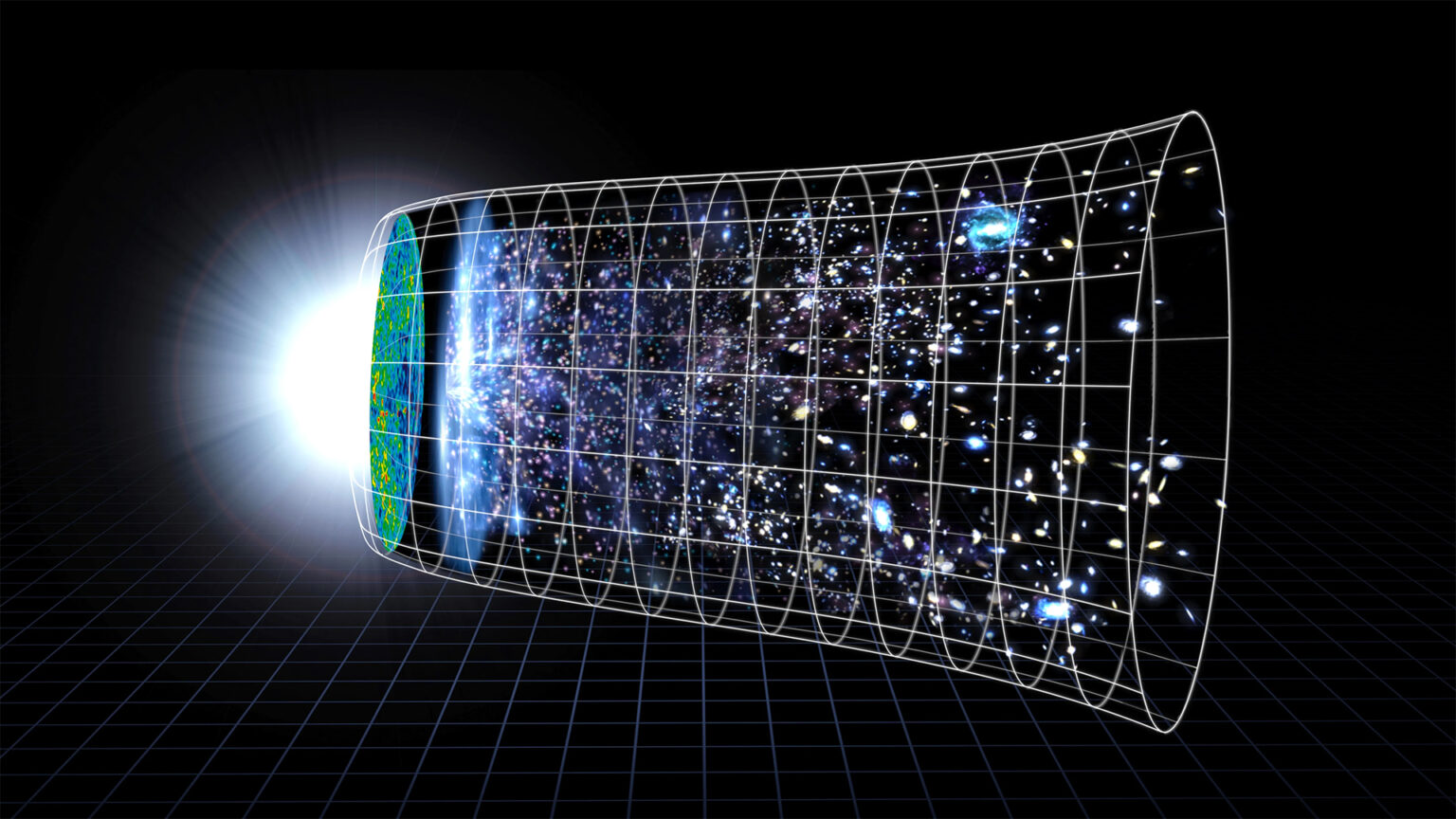
For decades, cosmologists believed they had a coherent framework describing how the Universe works on its largest scales. That framework is known as the Standard Model of Cosmology, or the Lambda Cold Dark Matter (ΛCDM) model. It combines General Relativity, the Big Bang, cosmic expansion, dark matter, and dark energy into a single picture of cosmic evolution.
However, recent findings made with the James Webb Space Telescope (JWST) have led many to wonder if the Standard Model is in need of revision or an entire rethink. To be fair, doubts about whether the ΛCDM model is the correct one are nothing new. As long as it and its constituent theories have existed, there have been those who have espoused alternative ones. As a result, many of these theories have reemerged in recent years for further consideration.
So, where exactly has the Standard Model fallen short, and what new explanations and theories have been suggested to bring theory and observation into a better alignment? Has it been a simple matter of accounting for new data, or do we need to rethink what we think we know about the Universe?
ΛCDM
To break the Standard Model down, you need to account for its foundational principles. They consist of the following:
The Big Bang: the Universe began as a single point in space (singularity) that began to rapidly expand about 14 billion years ago.
Gravity: as described by Einstein’s Theory of General Relativity, where objects with mass alter the curvature of spacetime.
The Hubble-Lemaitre Constant: the Universe has been expanding since the beginning
Dark Matter: about 85% of the Universe consists of mass that does not interact with other matter in visible light
Dark Energy: the rate of cosmic expansion has been increasing for the past 4 billion years
To delve into these in detail, it helps to tackle them chronologically – that is to say, in the order of when they were theorized. The timeline for this begins in the early 20th century and extends through the 1990s.
General relativity
In 1905, theoretical physicist Albert Einstein published a seminal paper regarding his Special Theory of Relativity (SR). According to Einstein, the speed of light was constant in all reference frames, while time and distance were relative to the observer. His theory further envisioned time and space as a single 4-dimensional framework (spacetime). This theory reconciled the laws of Classical Physics (aka Newtonian Physics) with electromagnetism.
By 1915, Einstein extended his theory to account for gravity, resulting in his Theory of General Relativity. Einstein envisioned gravity as a field created by objects with mass, which alters the curvature of spacetime around them. This affected the flow of time for observers within a gravitational field.
By 1919, his theory was confirmed as scientists with the Eddington Experiment observed light from a distant star tracing the curvature of the Sun’s gravitational field. GR would also go on to predict black holes, gravitational waves, gravitational lensing, and the expansion of the Universe.
Hubble-Lemaitre Constant
However, Einstein’s theories would have implications that he himself was not too happy with. In accordance with GR, scientists theorized that the Universe was likely expanding. Einstein rejected this idea and proposed the “Cosmological Constant,” a force which “held back gravity” and kept the Universe in a state of eternal balance. He represented this force in his equations with the character lambda (Λ).
However, Einstein would eventually be convinced by American astronomer Edwin Hubble. Lemaitre first presented Einstein with evidence of cosmic expansion through detailed calculations, but it was Hubble’s observations at the Mount Wilson Observatory that convinced him.
These observations confirmed that most neighboring galaxies were receding from the Milky Way. Furthermore, the greater their distance, the faster they were receding. In honor of these two astronomers, cosmic expansion came to be known as Hubble’s Law (or the Hubble-Lemaitre Law) while the rate of expansion was named the Hubble Constant (or Hubble-Lemaitre Constant).
Ironically, the study of cosmic expansion would later exonerate Einstein to a point, and the rate of expansion would be represented by his chosen character, Λ.
Big Bang cosmology
The discovery of cosmic expansion led to the “Great Debate” among scientists, who were of two minds on the subject. On one side, there were those (like Lemaitre) who argued that this expansion implied that the Universe once occupied a much smaller volume of space. The “Big Bang” model, as it came to be known, also theorized that the Universe began in a hot, dense state, that started to rapidly expand at the beginning of time.
On the other side, there were those who argued that while the Universe is expanding, its average density remains constant because matter is continuously being created. Proponents of this “Steady State” model also theorized that the Universe had no beginning and no end.
By the 1960s, the debate was largely settled with the discovery of the Cosmic Microwave Background (CMB). This discovery fit the Big Bang model perfectly, in that it confirmed a key prediction where the rapid expansion of the cosmos would have left behind “relic radiation” that would be detectable in all directions. From the CMB, scientists were also able to get a sense of how old the Universe was, which is currently estimated at 13.8 billion years.
Dark matter
Alas, there was a bit of a snag, which emerged during the 1960s and 70s – nicknamed the “Golden Age of General Relativity.” It was during this time that astronomers were able to view farther into the cosmos (up to 4 billion light-years) and make detailed observations of other galaxies. By 1975, famed American astronomer Vera C. Rubin (for whom the Rubin Observatory is named) made a startling discovery while measuring the rotational curves of these galaxies.
In short, they were rotating too quickly based on the amount of visible mass they contained. This suggested that either Einstein was wrong, or galaxies contained matter that did not interact with “normal matter” via electromagnetic forces – i.e., didn’t appear in visible light. Since General Relativity has been validated nine ways from Sunday, this discovery led to the theory of “Dark Matter.”
Based on extensive observations of galaxies, their lensing effects, and their rotational curves, scientists estimate that DM accounts for 85 percent of the Universe’s mass. For decades, scientists debated whether this matter was “hot” or “cold,” whether it was composed of high-energy, fast-moving particles or of low-energy, slow-moving particles. The most commonly accepted theory is that DM is cold, which has become part of the Standard Model.
Dark energy
By the 1990s, with the deployment of the Hubble Space Telescope, scientists were able to see much farther than they had with conventional telescopes. Whereas the limit of observable objects was 4 billion light-years, Hubble expanded that to 10 billion (and then more than 13 billion) light-years. But ultimately, the purpose of this telescope was to measure the Hubble-Lemaitre Constant (hence it’s name).
What Hubble observed caused another big shakeup in the astronomical community. When the Universe was young (ca. 1 billion years after the Big Bang) to roughly 10 billion years after, cosmic expansion appeared to be consistent. However, from that point to the present, the rate of expansion was clearly accelerating. So not only is the Universe expanding, but it is speeding up!
This led scientists to reconsider Einstein’s Cosmological Constant, i.e., a force that “held back gravity.” But this force, which they dubbed “Dark Energy,” was significantly stronger than gravity. This had significant implications for then-accepted models of cosmology.
Whereas scientists had previously thought that cosmic expansion would eventually slow and the Universe would start to contract. But based on Hubble’s observations, they now suspected that the Universe would continue to expand indefinitely.
In addition to “Dark Energy,” scientists referred to this expansionary force as the Cosmological Constant. In honor of Einstein, this force was represented by a Λ in their equations. Scientists now had all of the parameters of the Standard Model.
As Carl Sagan said, “One of the distinctions and triumphs of the advance of science has been the overspecialization of our worldview.” This sums up the history of cosmology perfectly. With every discovery, our Universe has grown exponentially, and our place within it has become less central and special. At the same time, we have come to appreciate how precious life and consciousness are.
At each interval, our understanding of the laws that govern the Universe has evolved to account for new evidence. And with the deployment of next-generation instruments like Hubble and Webb, we’ve once again reached a point of inflection. The resulting new theories that have emerged are leading to a more complete picture of how the Universe formed, evolved, and gave rise to life as we know it.