
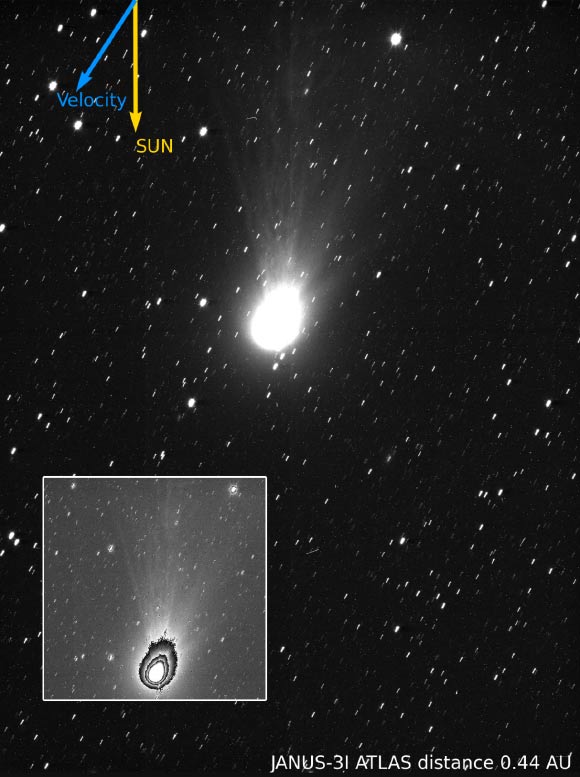
The JANUS science camera aboard ESA’s Jupiter Icy Moons Explorer (Juice) has captured new images of the interstellar object 3I/ATLAS.
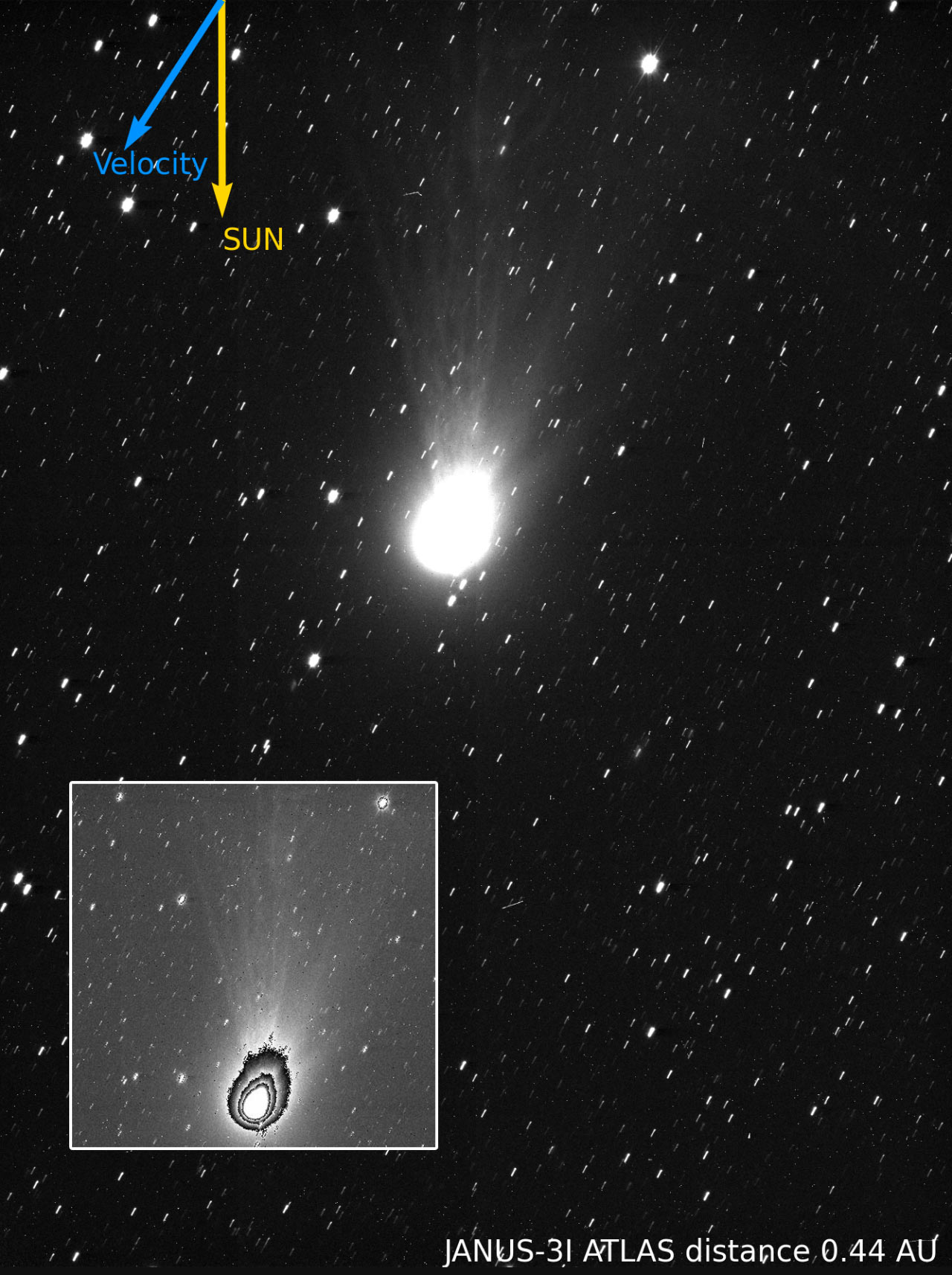
This image of the interstellar comet 3I/ATLAS was captured by the JANUS camera aboard ESA’s Juice spacecraft on November 6, 2025, just seven days after the comet made its closest approach to the Sun. At the time, Juice was about 66 million km (41 million miles) away from the comet. The inset in the image shows the same data, but processed to highlight the coma structure. The arrows in the top left indicate the direction in which the comet was moving (blue) and the relative direction of the Sun (yellow). Image credit: ESA / Juice / JANUS.
3I/ATLAS was first spotted on July 1, 2025, by the NASA-funded ATLAS survey telescope in Rio Hurtado, Chile.
The interstellar comet — also cataloged as C/2025 N1 (ATLAS) and A11pl3Z — appears to have entered the Solar System from the direction of the constellation Sagittarius.
The object follows the most dynamically extreme orbit ever measured in the Solar System, underscoring its interstellar origins and the extraordinary speed.
On October 30, 2025, 3I/ATLAS reached perihelion, its closest point to the Sun.
It came within 1.4 AU (210 million km, or 130.5 million miles) of our home star — just inside the orbit of Mars.
Throughout November 2025, the Juice spacecraft used five of its science instruments — JANUS, MAJIS, SWI, PEP and UVS — to observe 3I/ATLAS.
Together, they collected information that will reveal how the comet was behaving and what it is made of.
“During the months that followed the observations, Juice was on the opposite side of the Sun to Earth,” said members of the Juice team.
“It was using its main high-gain antenna as a heat shield, and its smaller medium-gain antenna to send back data to Earth at a lower rate.”
“This meant that we had to wait until last week to receive the data,” they explained.
“We are now working hard to analyze them.”
In total, the JANUS camera took more than 120 images of 3I/ATLAS across a large wavelength range.
The researchers are taking a closer look at all these images to understand what they reveal about the comet.
They are also studying spectrometry data, investigating data on the comet’s composition and particle data.
“[The newly-released JANUS image] displays jets coming out of the nucleus of 3I/ATLAS opposite to the direction of the Sun,” said Harvard University’s Professor Avi Loeb.
“This is surprising since pockets of ice on the surface of a rock are supposed to be warmed up by sunlight on the Sun-facing side, creating jets that are initially directed at the Sun.”
“It resembles images taken by amateur astronomers from Earth around the same time.”