
The race to replace the International Space Station is heating up. Launched in 1998, the ISS is the longest running global space project, and has stood as the epicenter of global cooperation in low Earth orbit. Scheduled to be deorbited into the Pacific Ocean by SpaceX in 2030, NASA’s decision to replace the station with a commercial alternative has escalated an already burgeoning space race, in which nation states and tech conglomerates compete to populate low Earth orbit, the lunar surface, and Mars with critical infrastructure. In the midst of this competition, one startup, Max Space, believes it can deliver a technical advantage over its competitors.
Max Space dubs itself “space real estate pioneers,” and specializes in expandable habitats that enable “a future where space is not just a frontier but a thriving base for humanity.” According to the company, these inflatable modules drastically reduce construction times while making deployments safer and more predictable. Max Space claims that its space habitats can expand up to 20 times their size once in orbit. The advantages of such a system are obvious when compared to the decade-long deployment of the ISS, which took over 40 launches to assemble roughly 1 million pounds of hardware. Hoping to scale its module up to a 10,000 cubic meters, Max Space believes that its technology will make space installation deployments more predictable and, in turn, more cost effective.
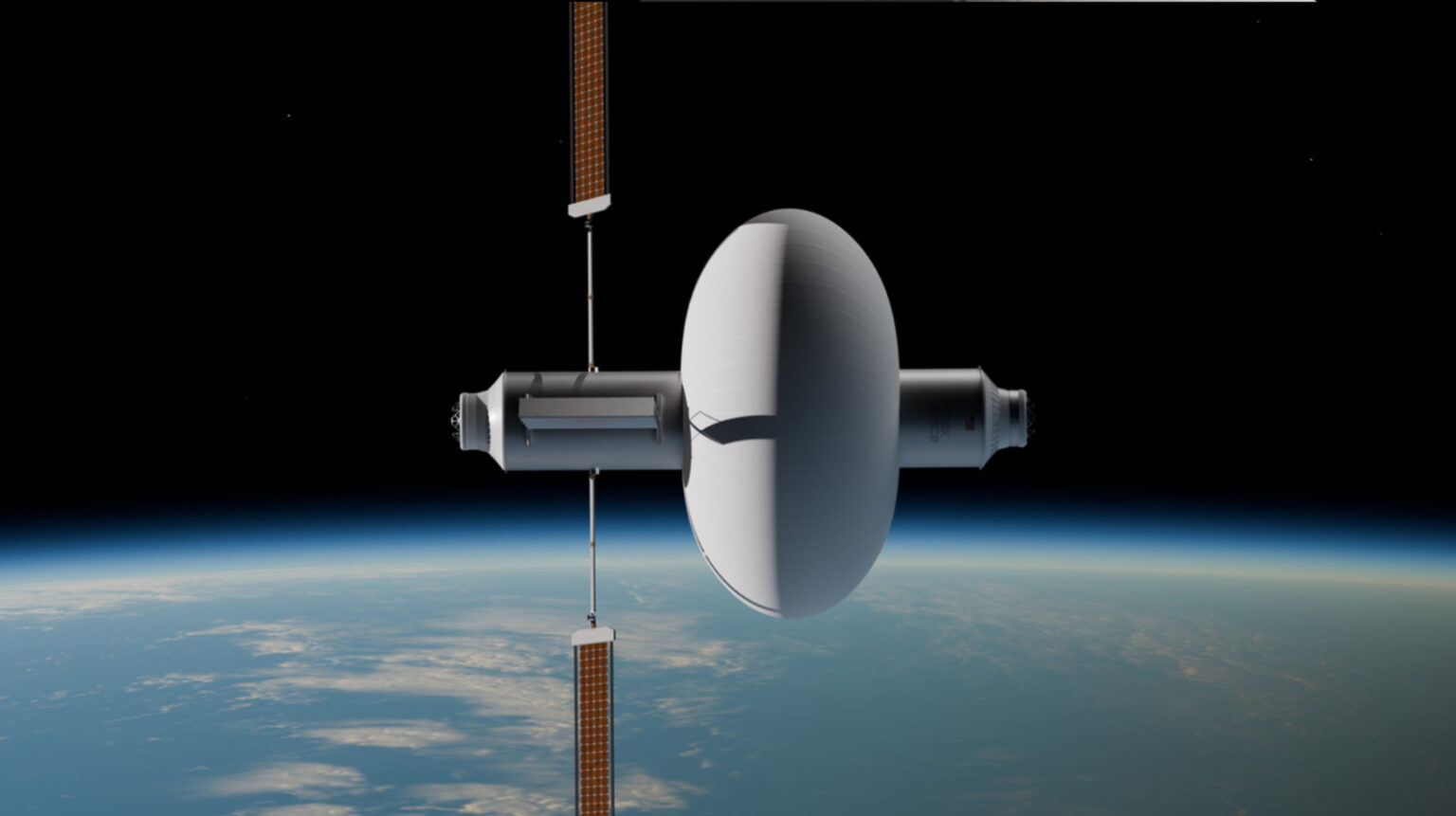
Max Space’s Thunderbird station
The first station in Max Space’s pipeline is an expandable habitat known as the Thunderbird, which maximizes its habitable volume through its “morphic interior structure.” CEO Saleem Miyan likens the configurable structure to moveable furniture, telling Space News that it creates a customizable internal environment which “allows us to create usable volume, personalized space for astronauts, and a large amount of space that can be readily leveraged for large-scale manufacturing in orbit.” With over 12,300 cubic feet of pressurized volume, the station will be roughly one-third the size of the ISS. It will include over 60 payload lockers, private quarters, reconfigurable common spaces, an observation gallery, and research stations. The Thunderbird is designed to support four fulltime crew members and up to eight visitors.
A big advantage of Thunderbird is its ability to be launched atop smaller spacecraft, such as SpaceX’s Falcon 9 rocket. Similar commercial stations will likely need multiple launches or larger spacecraft, like SpaceX’s Starship. According to Max Space, the Thunderbird can be used in Earth orbit as well as lunar and Martian missions, and it hopes to launch the vessel by 2029.
Before the Thunderbird can reach low Earth orbit, however, Max Space will need to hit several key milestones. The next major test is set for February 2027, when Max Space hopes to launch Mission Evolution, the company’s first space launch, which will send a 175-cubic-foot expandable prototype into low Earth orbit atop a SpaceX Falcon 9. Having signed its initial launch agreement with SpaceX, the milestone will be critical for testing the strength of the station, as well as interrogating the quality of its internal environmental control and life support systems.
The future of commercial space stations
Max Space hopes to feature prominently in NASA’s Commercial Low Earth Orbit Destinations project, which will see the ISS replaced by commercial options. According to NASA, the agency will likely award multiple Space Act Agreements for the project’s early stages, creating an opening for startups like Max Space to collaborate with the agency without entering a procurement contract. As Miyan stated in an interview (via Space News) “That CLD proposal gave us an incentive to strategically look at how we would bring forward the roadmap, and so that’s exactly what we’ve done.”
Ultimately, Max Space hopes to parlay its technology into a pipeline of stations, including larger lunar stations. Potential products on the company’s roadmap include a lunar station 30 times larger than Thunderbird, a gargantuan space station measuring over over 350,000 cubic feet designed for lunar and Mars colonization projects. In pursuit of these goals, Max Space has signed partnership agreements with a breadth of partners, including commercial space giant SpaceX, industrial design firm Omi, mission designers Astro Digital, and aerospace-centric defense firms Redwire and Voyager.
Of course, Max Space is far from the only company pursuing inflatable habitats. NASA’s Foundation Surface Habitat concept, a key cog of the agency’s lunar Artemis Base Camp plans, will likely include inflatable habitats. Commercial competitors like Lockheed Martin and Sierra Space are also looking to establish themselves as leaders in the market. To date, however, Max Space is the only firm to schedule a launch date for its expandable module.