
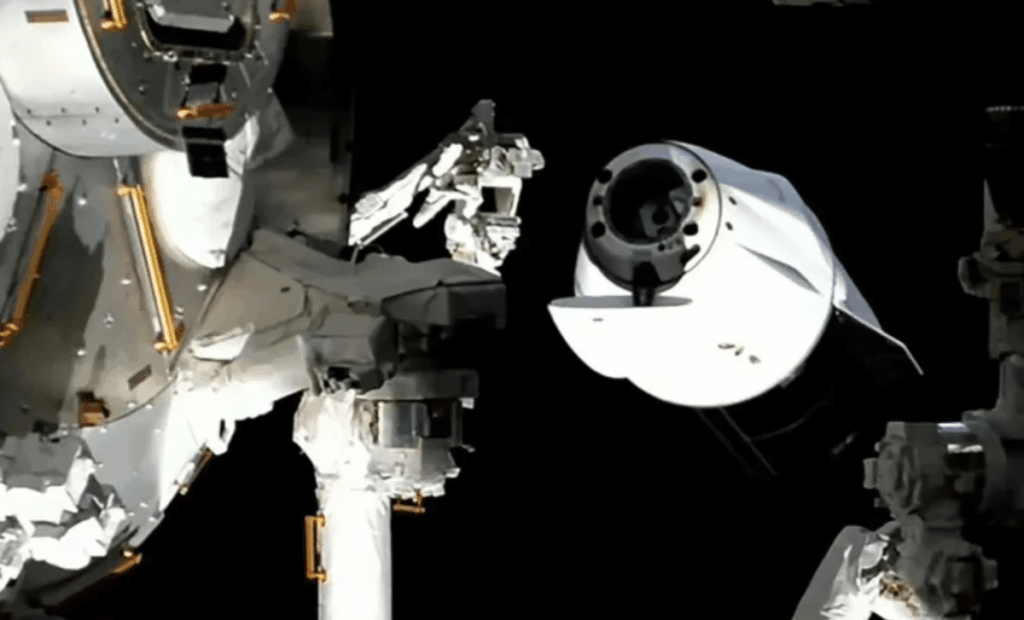
On February 26, 2026, SpaceX’s Dragon cargo capsule undocked from the International Space Station (ISS), concluding its monumental six-month mission that began on August 25, 2025. As detailed by Space.com, the Dragon capsule’s mission was significant not only for its resupply duties but also for its new role in boosting the ISS, ensuring the station’s long-term stability and orbit.
Reboosting the ISS: A Critical Task for SpaceX Dragon
One of the most pivotal aspects of the Dragon capsule’s mission was its ability to perform reboosts for the ISS, a task that has traditionally been carried out by Russia’s Progress freighters. The ability to boost the ISS’s altitude is essential for counteracting the drag caused by the Earth’s atmosphere, which slowly pulls the station downward. Without regular reboosts, the ISS could eventually lose altitude and be at risk of re-entering Earth’s atmosphere prematurely.
Splashdown of Dragon confirmed, completing SpaceX’s 33rd Commercial Resupply Services mission to the @Space_Station!
— SpaceX (@SpaceX) February 27, 2026
NASA officials emphasized the importance of this task in a statement released on February 23, 2026: “It introduced a new capability to reboost the space station, helping maintain its altitude and counter atmospheric drag, which is critical for safe operations and the long-term sustainability of the orbital complex.” This innovation is a testament to the Dragon capsule’s versatility and reusability, as it continues to evolve to meet the needs of space exploration. By incorporating this function into its design, SpaceX has proven that commercial space ventures can effectively handle mission-critical tasks traditionally managed by government-operated programs.
A History of Successful Reboosts: The Dragon Capsule’s Contribution
Throughout its time docked to the ISS, the Dragon capsule performed a total of six reboost maneuvers. These reboosts took place over the course of 2025, with the final maneuver occurring on January 23, 2026, just weeks before the capsule undocked. As SpaceX’s CRS-33 mission progressed, the capsule demonstrated its ability to execute complex space operations, all while carrying out its primary resupply mission for NASA.
“During its time docked to the station, Dragon performed six reboosts — five in 2025 and a final maneuver on Jan. 23 — before preparations for its departure began,” NASA officials added.
This series of reboosts is not just a technical achievement but a reminder of how the space station’s altitude must be carefully managed to ensure its ongoing functionality. With the upcoming changes to the ISS partnership, where Russia may withdraw from certain duties, the Dragon capsule’s role becomes increasingly important.
Why Reboosting Matters: The Long-Term Sustainability of the ISS
The ISS serves as a research laboratory in low Earth orbit, providing a platform for scientists to conduct experiments that would be impossible in gravity-bound environments. However, as it orbits the Earth, the station constantly experiences drag from the thin remnants of Earth’s atmosphere, which gradually causes it to lose altitude. If not corrected, this can result in the station re-entering Earth’s atmosphere, where it would burn up. Reboosting maneuvers are therefore critical for ensuring the ISS stays in its proper orbit.
NASA’s acknowledgment of this new capability underlines the growing importance of ensuring that the ISS remains operational well into the next decade. As the ISS approaches its planned deorbiting in late 2030, maintaining its altitude and stability will be key to supporting ongoing research and international collaborations. SpaceX’s contribution is a clear indication of how private space ventures are increasingly stepping into roles once reserved for government space agencies.
Dragon’s Impact Beyond Reboosting: Bringing Research Back to Earth
In addition to the reboosting function, the Dragon capsule’s mission was also about returning valuable scientific experiments to Earth. These included critical studies such as the Euro Material Aging experiment, which exposed 141 samples to the harsh conditions of space to study how materials degrade over time. This research could have far-reaching implications for the future of space travel, as it may lead to stronger materials for spacecraft construction.
Another experiment, Thailand’s Liquid Crystals study, observed the behavior of materials used in electronics under microgravity conditions. The results of these experiments could help advance technology not only for space missions but also for improving electronics here on Earth. These returns emphasize the dual nature of space missions, where both resupply and research go hand-in-hand to provide insights that can drive technological innovations.
The Role of Commercial Space Ventures: A Shift in Space Operations
The success of the CRS-33 mission signals a significant shift in how space operations are carried out. Traditionally, NASA and its international partners, such as Russia, handled the resupply and maintenance of the ISS. However, with the increasing involvement of private companies like SpaceX, new opportunities are emerging for commercial spacecraft to handle critical tasks. This transition offers increased flexibility and sustainability, especially as international partnerships evolve.
SpaceX’s ability to handle tasks traditionally managed by government space agencies shows how private companies can fill important roles in the ongoing operation of the ISS and future space missions. As commercial space operations expand, this model could serve as a blueprint for how space programs will function in the coming decades.