
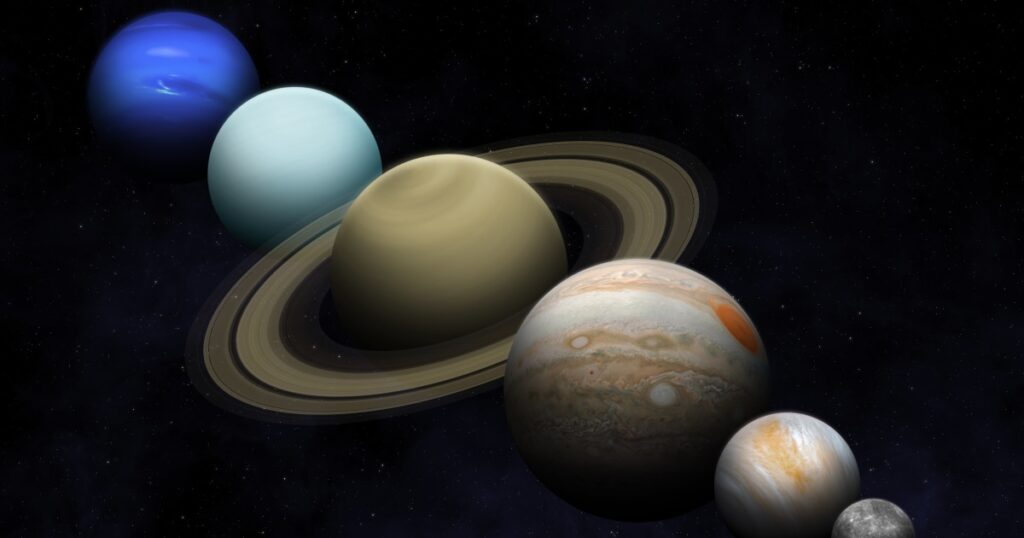
The latest “planet parade” is set to cap off February by lighting up the night sky. Jupiter, Saturn, Venus, Neptune, Uranus and Mercury will appear to line up.
While this one isn’t quite the full parade of all seven planets in the solar system outside of Earth like the one in 2025, it’s a rare chance to get a look at distant celestial bodies.
Here’s what to know about the event.
What Is a ‘Planet Parade’?
The term “planet parade” is used as an informal way to refer to planets being able to be seen simultaneously along a line in the sky, according to NASA.
Planets are hundreds of thousands of times closer to the Earth than stars, which means we can essentially see planets shifting position while stars appear to be fixed in the same spot. Since the planets orbit the sun in the same plane, they can look like they are aligned in a row in the sky.
When Is February 2026’s Parade of Planets?
The event will occur on the night of Feb. 28 into March 1.
Which Are the Easiest Planets to See?
Compared to the 2025 parade of planets, much fewer planets will be able to be seen clearly this time.
“The only planet you have an easy chance of seeing is Jupiter,” Michael Shanahan, the director of the Liberty Science Center Planetarium in New Jersey, tells TODAY.com. “Just look up anytime from dusk to about 3:30 a.m., find the brightest dot, and that will be Jupiter.”
What Are the Hardest Planets to See?
It will be difficult see Mercury, Venus and Saturn before they set between 6:30 and 7 p.m. on Feb. 28, according to Shanahan.
“They might be visible with binoculars,” he said. “All are very low in the West in the early evening.”
The best time to see those three planets is around 6:15 p.m.
Neptune will be too faint to see without a telescope, while Saturn sets very early, according to Shanahan.
Uranus will set around 10 p.m., but also can’t be viewed without a telescope. Mars won’t be able to be seen at all because it will be lost in the sun’s light.
When Is the Next Parade of Planets?
The next time five planets will be visible to the naked eye and all seven planets will be able to be seen is on Sept. 8, 2040, when they will be clustered above the setting sun, according to Shanahan.
What Is the Next Must-See Celestial Event?
A total lunar eclipse is coming up on March 3 right before sunrise to start your day with the beautiful and eerie sight of the moon turning dark red or blood color.
Lunar eclipses occur when the Earth’s shadow falls on the moon.
This one will be visible in parts of North America, Australia, New Zealand and eastern Asia.
The partial phase in which the moon can be seen starting to darken will begin at 4:50 a.m. ET, according to the Liberty Science Center.
The phase of the eclipse sometimes known as the blood moon due to its reddish color will occur at 6:04 a.m. ET. The moon will stay in that phase until it sets around 6:29 a.m.