
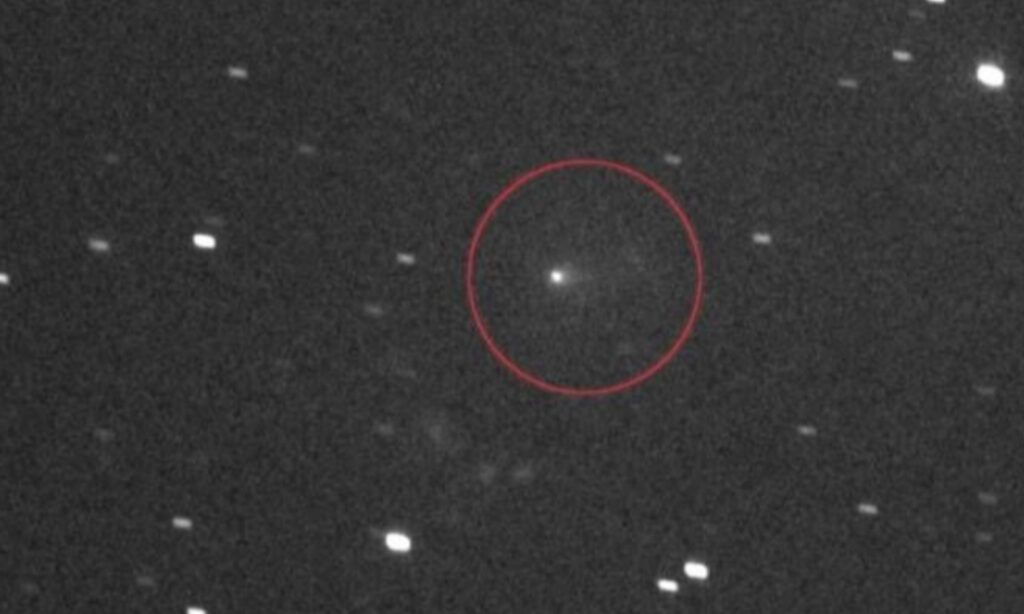
Astronomers say that 3I/ATLAS, a comet that entered our solar system from interstellar space, is not sending out any radio signals that would suggest it is an alien spacecraft.
That finding pushes back against speculation that the object could be artificial and sets a clear standard for how scientists will examine the next visitor from beyond our solar system.
A comet under scrutiny

On December 18, 2025, the Green Bank Telescope (GBT) tracked 3I/ATLAS for a directed radio listen.
Using that stream of data, Benjamin Jacobson-Bell, a radio astronomer with Breakthrough Listen, tested whether the comet hid any transmitter.
In one interview, Jacobson-Bell said the team expected a natural comet, yet checked anyway to close the loophole.
“The evidence was against 3I/ATLAS being one such probe, but we would have been remiss not to check,” Jacobson-Bell said.
Searching for alien clues
Signal hunters call those clues technosignatures, signs of technology from another civilization, and they treat them as an audit trail.
In radio work, the cleanest clue is a single tone that holds steady while background noise rises and falls.
Astronomers describe that pattern as narrowband, packed into a thin slice of frequencies, and natural sources rarely mimic it.
Because comets do not make such tones on their own, even one real detection would deserve fast, skeptical follow-up.
Listening across radio bands
Across one to 12 gigahertz, the team listened for razor-thin lines that would not match any normal comet physics.
Sweeping such a wide range reduces the chance that a transmitter hides in the one spot nobody checked.
Instead of chasing every blip, their software focused on signals that stayed narrow while the comet moved.
A wide scan cannot catch a transmitter that turns on later, but it blocks the easy claim of bad tuning.
Detection limits explained
At closest approach on December 19, 2025, the search could have spotted a steady transmitter down to 0.1 watt.
That limit assumes the signal spreads outward in all directions, so a dish on Earth gets only a tiny share.
“We all would have been thrilled to find technosignatures coming from 3I/ATLAS, but they’re just not there,” said Jacobson-Bell.
Anything weaker than that, or beamed away from Earth, could still slip past this single pass.
Sorting signal from noise
Even so, a protected region helps, and the National Radio Quiet Zone limits many transmitters near Green Bank in West Virginia.
Inside that zone, the telescope still hears radio-frequency interference, unwanted radio noise made by people, drifting in from beyond the boundary.
To avoid false alarms, the team filtered out signals that showed up when the dish pointed away from the comet.
Those checks can never prove absolute silence, but they keep the search from being fooled by our own hardware.
Comet behavior checked
Long before the radio listen, skywatchers watched 3I/ATLAS brighten and sprout a coma, a cloud of gas and dust.
Sunlight warmed its surface ice, and escaping gas dragged dust outward, creating tails and jets with familiar chemistry.
That behavior pointed to a natural body, but it did not explain how loud or quiet the comet might be on the radio.
By adding a radio check, scientists separated appearance from emission and reduced the room for wishful thinking.
Why probe stories stick
Probe talk flares up because robotic exploration avoids the heavy cost of carrying life between stars.
A flyby craft can record images and chemistry, then send a compressed summary home, without needing food or air.
Human engineers have discussed tiny, fast spacecraft, and that makes the idea of an interstellar probe less far-fetched.
Still, natural comets set the baseline, so any claim of design needs multiple, independent lines of evidence.
Future interstellar discoveries
New surveys will soon spot more fast movers. Rubin Observatory is building the Legacy Survey of Space and Time (LSST), a ten-year project that will repeatedly scan the entire southern sky to catch faint, moving objects as they pass through our solar system.
Night after night, LSST will capture hundreds of images for ten years, giving repeated looks at the same sky.
Repeated passes help astronomers catch faint visitors early, when follow-up telescopes can still track them easily.
As the list grows, researchers can compare many objects and spot which ones break the usual comet playbook.
Faster radio responses
With more targets arriving, teams can schedule radio listening early, before sunlight changes an object’s surface or path.
Fast follow-up lets observers tie optical behavior to radio silence, shrinking the number of stories that fit.
Once LSST flags a newcomer, Breakthrough Listen can repeat the same search quickly and share clear limits openly.
Each careful nondetection feels less dramatic, yet it strengthens the standard for calling anything a technology signal.
What the quiet means
Silence from 3I/ATLAS did not answer big questions about life elsewhere, but it showed how speculation can meet data.
As LSST finds more interstellar visitors, astronomers can run this same test quickly and move on when nothing transmits.
The study is published in arXiv.
—–
Like what you read? Subscribe to our newsletter for engaging articles, exclusive content, and the latest updates.
Check us out on EarthSnap, a free app brought to you by Eric Ralls and Earth.com.
—–