
February 27, 2026
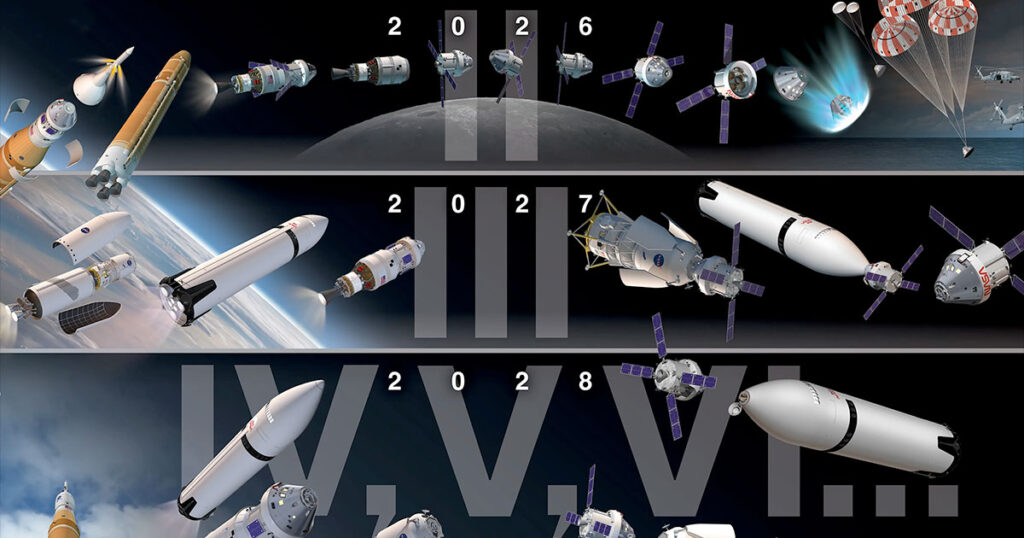
— As NASA continues to press forward with sending its first crew of astronauts to fly by the moon in more than 50 years, it is also making changes to its Artemis schedule, increasing its cadence from one lunar mission every three years to at least one annually.
With the Artemis II launch now targeted for April, pending the repair of a helium flow issue with the mission’s Space Launch System (SLS) upper stage, NASA’s leadership is looking to address safety and budget concerns by adding an additional mission to its manifest before attempting a landing on the moon in 2028.
“We have got a lot of really talented folks that have been working hard on the Artemis II campaign, and whether they’re going to want to stick around for three more years after this mission is complete is a question mark. This is just not the right pathway forward,” said NASA Administrator Jared Isaacman during a press briefing from Kennedy Space Center in Florida on Friday (Feb. 27).”
“I’d say also, when you are experiencing some of the same issues between launches, you probably got to take a close look at your process for remediation,” he said. “We’ve got issues with low flight rate.”
To address that, NASA is looking to lock down the development of the Space Launch System and standardize future builds under what is mostly its current, or Block 1, configuration. The program will also insert a new mission to advance the skills needed for a moon landing before proceeding to the lunar south pole.
“We didn’t go right to Apollo 11,” Isaacman said, referring to the steps taken to land the first humans the moon. “We had a whole Mercury program, Gemini and lots of Apollo missions, before we ultimately landed. Right now, our program is essentially set up with an Apollo 8 and then going right to the moon. And that is not a pathway to success.”
Instead, NASA’s Artemis III mission, which had been planned as the first Artemis moon landing in 2028, will now lift off in 2027 to test linking up with either or both of NASA’s contracted human landing system (HLS), SpaceX’s Starship or Blue Origin’s Blue Moon, depending on their readiness, during a flight into Earth orbit. Artemis III many also test out components of Axiom’s lunar spacesuits, if they are ready in time.
The crew for the Artemis III Earth-orbit rendezvous mission has yet to be named, nor were astronauts assigned to the original 2028 landing mission.
“We are looking back to the wisdom of the folks that designed Apollo,” said Amit Kshatriya, NASA Associate Administrator. “The entire sequence of Artemis flights needs to represent a step-by-step build-up of capability, with each step bringing us closer to our ability to perform the landing missions. Each step needs to be big enough to make progress, but not so big that we take unnecessary risk given previous learnings.”
“We will take a similar approach to in-space, landing and surface EVA operations as well, as we evolve the mission sequence in the spirit of the Apollo mindset, which was obsessed with system reliability and crew safety as the keys to mission success,” said Kshatriya.
To accomplish the accelerated pace, Isaacman and Kshatriya said the agency’s workforce will be expanded and that they will be addressing with the industry the need to cancel some of the previous contracts awarded. Without a Block 2 SLS, the exploration upper stage (EUS) is likely to be canceled, as may be the second mobile launcher and the planned Gateway lunar orbit science platform.
According to Isaacman, NASA has the support of its commercial partners, as well as the administration and Congress to adopt this new path.
“I don’t think I heard a single objection … everyone understands what’s at stake here,” he said. “We don’t have a lot of schedule margin here. The implications of coming up short go well beyond space.”
“I’m grateful to Administrator Isaacman for taking this bold step and moving quickly to assure we have the support and resources needed to launch Artemis astronauts to the moon every year,” said Lori Glaze, acting associate administrator for exploration systems development at NASA Headquarters in Washington. “Our team is up to the challenge of a successful Artemis II mission, and soon thereafter, enabling a more frequent cadence of moon missions.”