
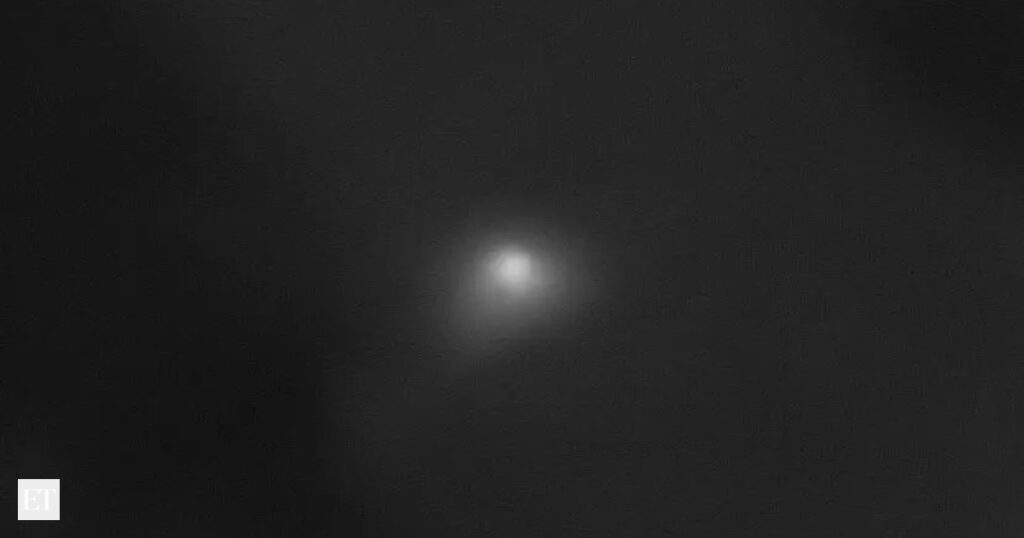
A newly released space image has reignited discussion about one of the most unusual objects to pass through our solar system. Scientists recently captured a striking view of the interstellar comet 3I/ATLAS ejecting dust and gas as it traveled through space.
The image was taken by a European spacecraft, offering scientists a closer look at the mysterious object that has intrigued astronomers since its discovery. While most researchers consider it a natural comet, one prominent astrophysicist has raised the possibility that it might be something far more unusual.
The debate has drawn attention across the scientific community, with new data continuing to fuel curiosity about the object’s true nature, as per a report by The Daily Star.
ALSO READ: Mercury retrograde begins February 26: What to expect and how to avoid common pitfallsWhat did the new 3I/ATLAS image reveal?A newly released image of 3I/ATLAS shows the object surrounded by gas and dust as it moved through the solar system. Live Events
The photograph was captured by the Jupiter Icy Moons Explorer, operated by the European Space Agency. Using its science camera system, the spacecraft documented the comet shortly after its closest pass by the Sun.
According to ESA, the comet’s small nucleus cannot be seen directly in the image, but the surrounding features are clearly visible. The agency explained that the object is encircled by a bright halo of gas called a coma, while a long tail of dust stretches outward.The agency described the observation, noting, “The tiny nucleus of the comet (not visible) is surrounded by a bright halo of gas known as the coma. A long tail stretches away from the comet, and we see hints of rays, jets, streams and filaments.”
The image was captured on November 6, 2025, only seven days after the comet reached its closest point to the Sun. At the time, the spacecraft was roughly 66 million kilometers away from the object.
Scientists say the spacecraft’s JANUS camera recorded more than 120 images of the comet across different wavelengths, allowing researchers to analyze the object in greater detail, as per a report by The Daily Star.
Why did some scientists suggest it might be artificial?
The unusual characteristics of 3I/ATLAS have sparked speculation among some scientists. Among them is Avi Loeb, who has suggested that the object might not be entirely natural.
Loeb pointed to several anomalies associated with the interstellar visitor. One of the most notable involves the object’s trajectory. It follows a retrograde orbit that aligns within about five degrees of the ecliptic plane, which he estimates has only a 0.2 percent chance of occurring randomly.
Its route through the solar system is also notable because it passes near planets including Mars, Venus, and Jupiter.
Another unusual observation is the object’s so-called “anti-tail,” a sunward jet extending more than 310,000 miles, which differs from the typical direction of a comet’s tail, as per a report by The Daily Star.
Avi Loeb and colleagues described the possibility in a scientific paper, writing, “The consequences, should the hypothesis turn out to be correct, could potentially be dire for humanity, and would possibly require defensive measures to be undertaken (though these might prove futile).”
He has also pointed to chemical observations showing that the gas plume appears rich in nickel while containing little iron and only about four percent water.
Early observations also noted an absence of typical comet activity, which led Loeb to speculate the object might be “powered” or “guided.”
Why do most scientists still call it a comet?
Despite the speculation, most researchers continue to treat 3I/ATLAS as a natural comet with unusual but explainable features.
Organizations including the NASA and the European Space Agency maintain that the object fits within known cometary behavior, even if some of its properties appear uncommon, as per a report by The Daily Star.
ALSO READ: Nancy Guthrie’s case update: Sheriff Nanos believes the victim was held near home-here’s what he meant
Avi Loeb himself has acknowledged that the most likely explanation is still that the object formed naturally.
Still, scientists continue to examine the images and data collected by the spacecraft to better understand how this rare interstellar visitor behaves as it travels through our solar system.
FAQsWhat is 3I/ATLAS?
3I/ATLAS is an interstellar object believed to be a comet that passed through the solar system after being discovered in 2025.
Why are some scientists debating its origin?
A few researchers, including Avi Loeb, say its unusual trajectory and chemical features raise questions, though most scientists believe it is a natural comet.