
Are we hitching our wagon to the wrong star?
Harvard scientist Avi Loeb has slammed a seemingly far-fetched proposal to intercept interstellar comet 3I/ATLAS with a spacecraft, claiming that we’re putting energy in the wrong places.
“Is that what we need to invest our resources in?” the astrophysicist, who has repeatedly floated theories on the space rock’s so-called alien origins, told The Post. He compared it to an unhealthy romantic obsession, inquiring, “Before you decide about a long-term commitment, you should ask yourself, ‘Is this really the object that I want to marry?’”
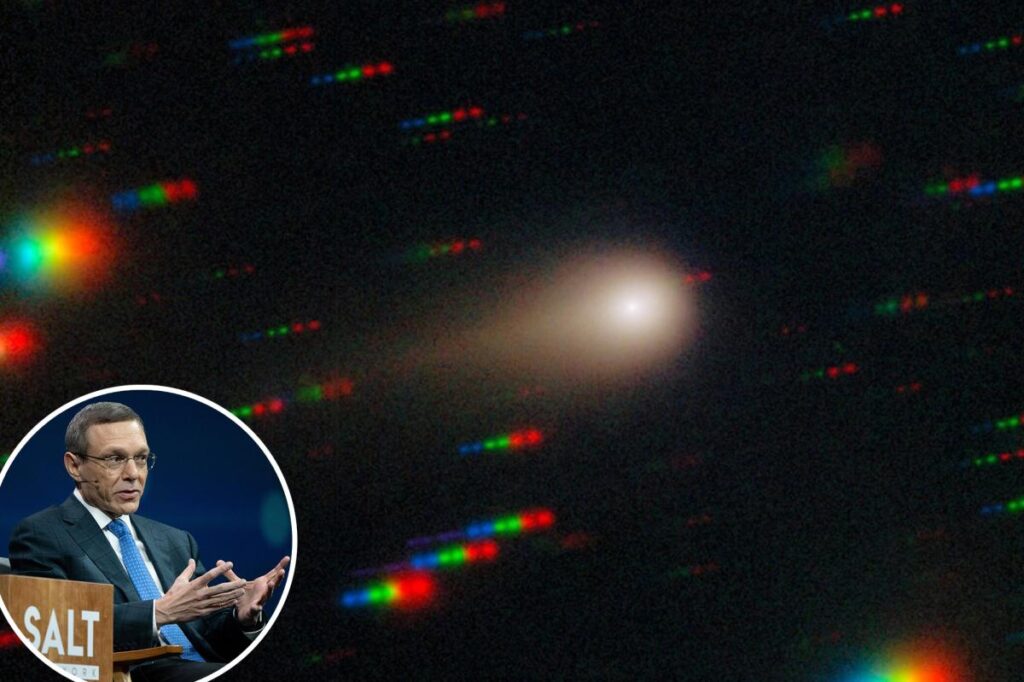
Observations of Comet 3I/ATLAS taken using the Gemini South Observatory. International Gemini Observatory/NOIRLab/NSF
The researcher was referring to a yet-to-be published paper that claimed it was possible to catch up to ATLAS with a probe, allowing us to hitch a ride and explore solar systems other than our own.
Unfortunately, we’d have to act fast. According to the study authors, who include former NASA staffer and Space Initiatives chief scientist Marshall Eubanks, the interception mission would have to launch in 2035 with the hopes of catching up to the intergalactic interloper by 2085, Space.com reported.
To achieve this sci-fi-esque feat, scientists would need to harness a phenomenon known as the Oberth effect, which involves receiving a speed boost from the Sun’s gravitational field.
This would require the ATLAS interceptor to rev up its engines at periapsis – the object’s closest point to said gravitating entity, in this case our solar accelerant.
While seemingly far-fetched, Eubanks observed that “every launch uses the Oberth effect,” although he noted there’s no record of their proposed variation involving “a major rocket burn at closest approach in a flyby.”
3I/ATLAS observations by NASA’s SPHEREx showing the infrared light emitted by its contents. NASA/JPL-Caltech
Indeed, the probe would have to fly perilously close to the sun like an interstellar Icarus. This would require outfitting our hypothetical hitcher with a sun shield, much like with NASA’s Parker Solar Probe when it came within 3.7 million miles of our light source in 2023. The solar-powered interceptor, meanwhile, would have to get much closer, and like Parker, perform several fly-bys of Venus afterward to attain the right velocity.
If researchers are able to pull this maneuver off, the 3I/ATLAS interceptor would likely become the fastest spacecraft ever, “by a good measure,” said Eubanks.
“Is that what we need to invest our resources in?” wondered Loeb. REUTERS
However, Loeb believed that the juice wasn’t worth the squeeze. “This timescale sounds very long,” scoffed the researcher, claiming that most of us will “not be alive” by the time the probe theoretically reached ATLAS.
By that point, per Loeb, we would’ve detected “hundreds of interstellar objects” that we could pursue rather than chasing ATLAS, which will fly-by Jupiter in March before exiting our solar system forever.
He calculated that there could be as many as 35 million interstellar objects “roughly the size of a person that are within the orbit of the Earth around the south.” “Given a large sample, we might see anomalous objects that look technological, in which case, definitely visit those,” he declared.
Loeb said that it’d be better to prioritize devising technology to analyze and intercept them rather than stalking ATLAS across the cosmos. He claimed that the powerful telescopes like the Vera C. Rubin Observatory, which began issuing real-time alerts this week, could be used to aid in this recon efforts while we could develop propulsion technologies to reach them.
Even Eubanks admitted that our resources could be better spent, declaring, “Maybe, after, say ten interstellar objects have been found, 3I will seem commonplace, and it won’t seem worthwhile to mount an expedition to chase it.”
The European Space Agency is already planning to debut its Comet Interceptor mission by 2028 and “park” it in space, so it can potentially intercept a visitor from beyond.
Loeb likened our ATLAS attachment to dating.
“You go to a bar and you see someone attractive and you say, ‘okay, well, I need to learn more about that person,’” he said. “By the time you move, the person left out the door into the dark street. Now, the point is, there are many other people in the bar.”
“You should date many more people to increase your sample,” he urged, before quipping, “never get married after a first date.”