
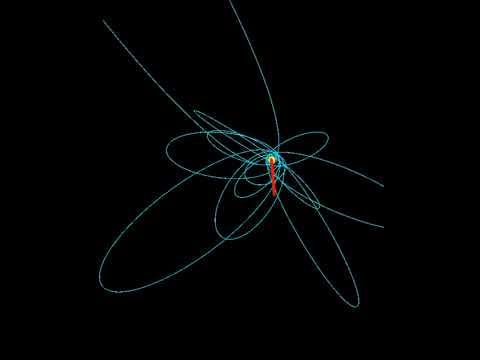
This is a follow-up to my first post where I aligned a 3,600-year period with anomalous climate events and historical observations of "catastrophic comets" by Romans and Chinese in 60 AD, and earlier as Marduk/Typhon/Seth in Sumer and Egypt:
This time, I ran a simulation to see how Nibiru affects the Solar System.
Initially, when calculating the orbit based on very vague chronicles from 60 AD, I speculatively relied on the mechanism used by Brown and Batygin to explain the anomalous orbits of Extreme Trans-Neptunian Objects (ETNOs) by Planet Nine, assuming its farthest point was in a specific location as the highest probability for Planet Nine.
I ran a simulation mimicking how a planet with this orbit affects trans-Neptunian objects, forcing them into anomalously elongated orbits and clustering them in a certain way. This also created clusters of objects—sometimes similar, but mostly random and not like those in reality. This means the exact mechanism from Batygin and Brown’s Planet Nine hypothesis does not work for Nibiru's orbit.
Furthermore, the Planet Nine hypothesis is criticized because not all ETNOs are accounted for; there are more than shown in my illustration and potentially even more in all directions. There are also other mechanisms through which they might cluster.
Therefore, I restarted the orbit calculation. Based on ancient descriptions of the 60 AD comet, I redefined the window for its passage. Instead of focusing on the perihelion, I directed the farthest part of the orbit to avoid encounters with ETNOs as much as possible. Consequently, Nibiru's orbit became perpendicular to the plane of the solar system.
This provides a simple and logical mechanism: by lingering at its farthest point for a long time, Nibiru disturbs ETNO orbits, breaking the flat balance of the solar system. The fact that the ETNO orbit clusters discussed in the Planet Nine hypothesis are closer to the solar system's plane is explained by the gravity of the entire disk (including the giant planets) holding them there. There are fewer orbits near Nibiru because it quickly scatters them. In the video, this looks like an umbrella. Mechanisms considered in standard theories also play a role here.
This orbital inclination gives maximum stability to Nibiru and the other planets; its orbit pierces the solar system like a needle, creating very brief gravitational disturbances. The giant planets, which could destabilize Nibiru and eject it from the solar system, remain as far away as possible.
To verify this, I ran an N-body simulation accounting for all giant planets, plus Mars and Earth. This is the first graph in the video and is included in the updated article.
The top line is Nibiru’s orbit, showing how close it gets to Earth and how its period changes. Nibiru's mass here is 7 Earth masses. The second orange line is Mars' eccentricity, showing how elongated its orbit becomes; the bottom line similarly shows Earth's eccentricity.
The large waves on these lines are natural Milankovitch cycles responsible for ice ages and caused by the influence of other planets. Adding Nibiru hardly affects them, but you can see sharp peaks or dips during close encounters that don't exist in the standard cycle line.
However, these peaks do exist in paleoclimate temperature graphs, and scientists try to find other explanations for them. Nibiru actually explains these anomalies, which was the point to be proven.
In this simulation, I intentionally reduced Mars' eccentricity; in reality, its orbit stretches further. I wanted to simulate how Nibiru did this, but it takes too long to wait, though it works fine with other inclinations.
Essentially, the hypothesis is that Nibiru was captured in the asteroid belt. Its perihelion gradually shifted, first distorting Mars' orbit, then approaching Earth and intensifying ice ages, etc.
I limited the simulation duration to 1 million years. I tried different configurations; in some, Nibiru lasted longer, in others less, but this duration is sufficient in any case.
The area of the sky where Nibiru should be according to the new orbit is poorly studied, as it is in the Southern Hemisphere where there are fewer telescopes.
Here is the updated article with images:
by pavlokandyba