
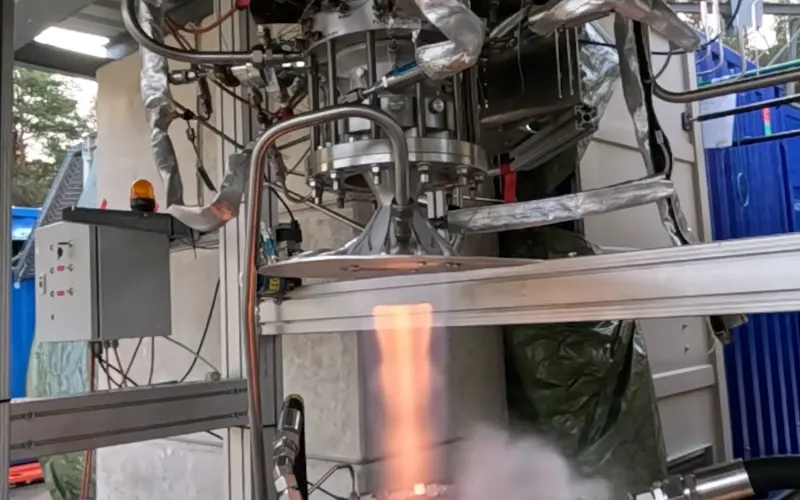
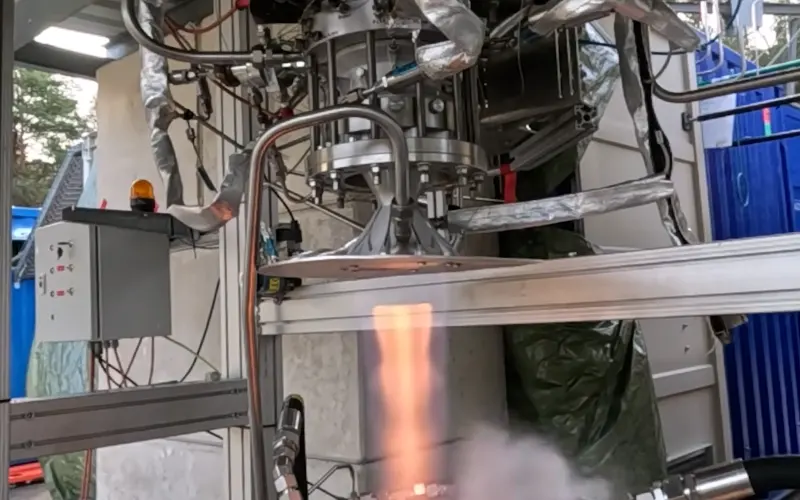
 Credit: ArianeGroup
ArianeGroup announced on 25 February that it had successfully completed a months-long test campaign of its Greta rocket engine and secured a European Space Agency contract to continue its development.
Greta is an evolution of the Berta rocket engine, which was also developed by ArianeGroup under an ESA Future Launchers Preparatory Programme contract and first test-fired in 2019. While Greta is an evolution of Berta, this first iteration of the design is still intended for operational use and is currently the baseline for the ASTRIS kick stage, an optional third stage being developed by ArianeGroup under a separate ESA contract for use aboard the Ariane 6 launch system.
ArianeGroup was awarded a €3 million follow-on contract in 2022 to develop Greta, which was originally known as Berta Green. Like Berta, Greta is a 5 kN-class engine, with the most significant shift in its design from its predecessor being the use of hydrogen peroxide and ethanol as propellants, a “more sustainable alternative.” It features a 30 cm-high combustion chamber produced using additive manufacturing, built up in layers by melting metal powders with a laser.
On 25 February, ESA announced that ArianeGroup had conducted a hot fire test campaign of the Greta engine from July to November 2025 at the company’s facilities in Trauen, Germany. According to the announcement, the engine was fired multiple times over the five months, each lasting over 40 seconds.
While Berta is expected to be equipped on the ASTRIS kick stage, Greta does not appear to have any immediate application, with ESA stating that it “could be used on lunar landers or on kick stages.” Despite this, ArianeGroup has been awarded a follow-on contract on 6 February to continue the development of Greta, with a “full engine demonstrator” expected to be tested at the end of 2027.
Keep European Spaceflight Independent
Your donation will help European Spaceflight to continue digging into the stories others miss. Every euro keeps our reporting alive.