
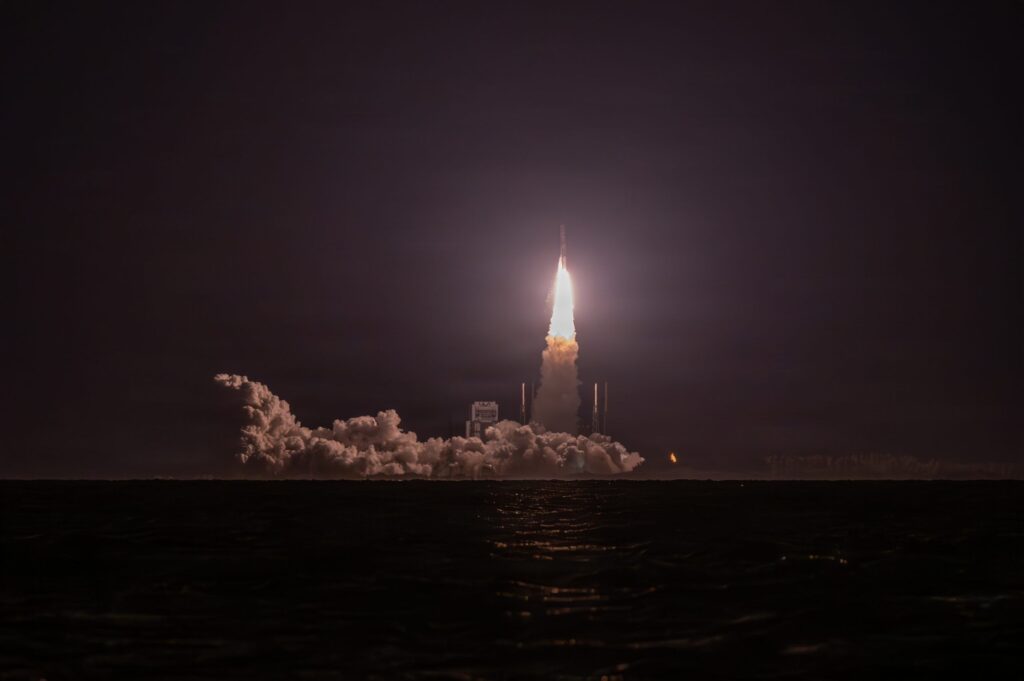
AURORA, Colo.—The Space Force is pressing pause on all military launches on United Launch Alliance’s Vulcan rocket as officials investigate a recent anomaly they say could take “many months” to resolve.
That means launch plans for a GPS III satellite slated to fly on the brand new rocket next month are in flux, according to Col. Eric Zarybinsky, program executive officer for assured access to space.
“I’m going to look for every flexibility I have to make sure that I can deliver warfighter capability as quickly as possible,” Zarybinsky told reporters at AFA’s Air Warfare Symposium here. “I’ve got a number of tools in my toolkit to do that, but until this anomaly is all over, we will not be launching National Security Space Launch missions on Vulcan.”
The anomaly occurred Feb. 12 during the Space Force’s USSF-87 mission, which carried two satellites for the service’s Geosynchronous Space Situational Awareness Program and a training and demonstration satellite Combat Forces Command will use to train Guardians to perform maneuver operations. While the launch was successful, ULA observed an issue involving one of the vehicle’s four solid rocket motors following liftoff. The company’s Vice President for Atlas and Vulcan programs Gary Wentz later characterized it as a “significant performance anomaly.”
The anomaly may be similar to an issue ULA experienced during a Vulcan test launch in October 2024, when a nozzle on its second stage booster cracked during flight, though officials have not confirmed a link. That mishap caused significant delays to Vulcan’s certification to fly national security payloads, a milestone it ultimately achieved last March.
Vulcan had been scheduled to launch seven national security payloads this year. Aside from the GPS III mission, the Space Force’s first Next-Generation Overhead Persistent Infrared satellite is supposed to fly in May.
Zarybinsky said his team is weighing several different options for getting military and intelligence payloads on orbit, but hasn’t made any moves to switch payloads to other rockets—be that ULA’s Atlas V or SpaceX’s Falcon 9.
The Space Force has some recent experience shifting missions between SpaceX and ULA rockets through an effort called Rapid Response Trailblazer. The service has flown two RRT missions, both involving GPS III satellites.
Col. Andrew Menschner, deputy commander at SSC, told reporters that because GPS satellites are qualified to fly on multiple vendors’ rockets, it’s easier to move those payloads.
“The ability to switch from one provider to another is present in those vehicles that just isn’t in some of the other families of vehicles,” he told reporters in a Feb. 25 briefing.
ULA did not immediately respond to a request for more details on the status of its investigation. The anomaly is a setback for the firm, which is coming off of a challenging 2025. Despite a plan to conduct 20 launches last year, 10 of them on Vulcan, it flew just six times and only once on Vulcan. Then in January, its CEO Tory Bruno, who oversaw Vulcan’s development, announced suddenly that he was leaving the firm for Blue Origin, a direct competitor.
Company officials told reporters earlier this month that they had hoped to turn a corner this year, launching Vulcan between 18 and 22 times. In a briefing just days before the USSF-87 launch, ULA’s interim CEO John Elbon said the company is “laser focused” on increasing Vulcan’s cadence in 2026.
“We have a backlog of over 80 missions and combined with that a strong commitment from our board that’s focused on moving us forward into the future,” Elbon said Feb. 10. “We’re just confident in the bright future ahead of us.”