
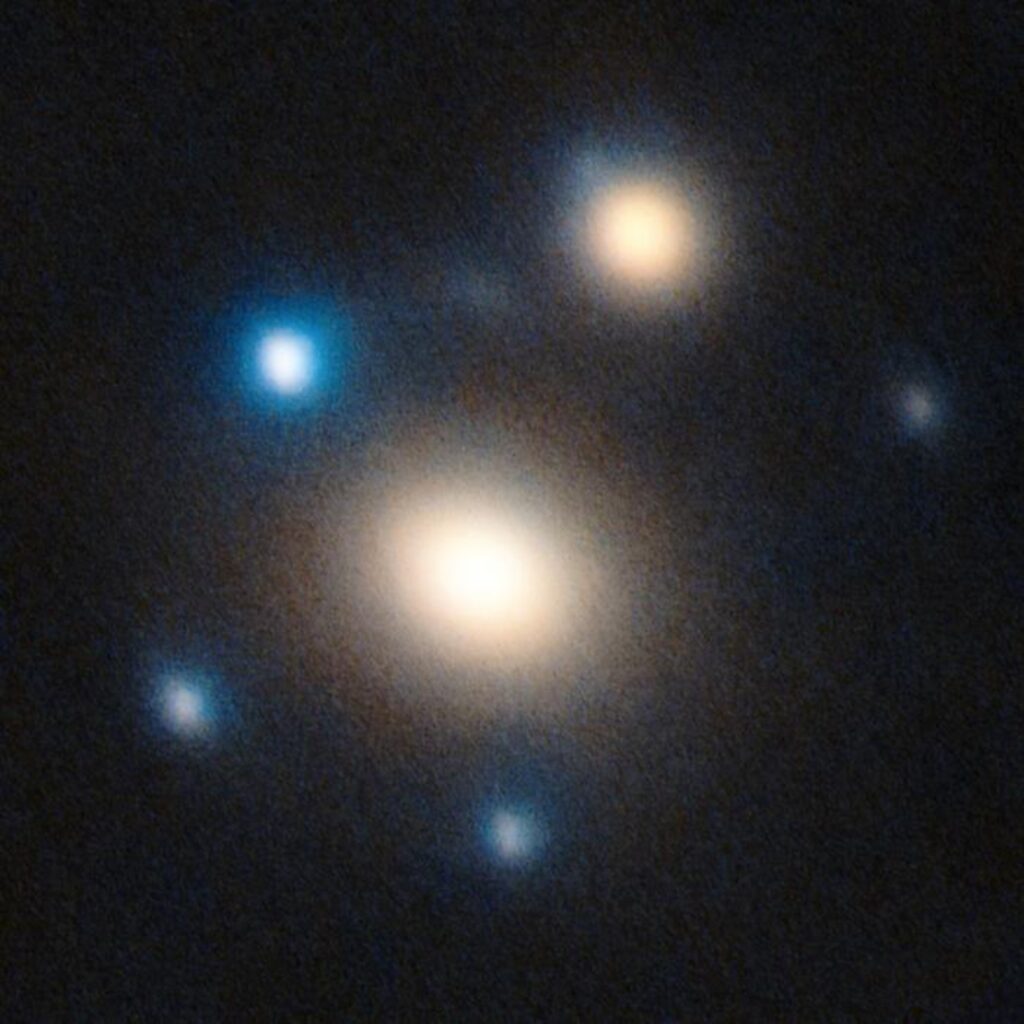
Astronomers have observed a distant supernova, known as SN 2025wny or “SN Winny,” whose light was bent by the gravity of two foreground galaxies, producing five visible images.
Because each of the images brightens at a slightly different time, scientists can use the delays between them to measure how fast the universe is expanding today.

In a high-resolution color image, SN 2025wny appears five times around a pair of foreground galaxies that bend its light into separate paths.
By resolving those multiple images and tracing their precise positions, Dr. Sherry Suyu and colleagues at the Technical University of Munich (TUM) documented the configuration that makes the system suitable for timing measurements.
The arrangement is unusually clean, with two individual galaxies producing five distinct copies instead of the two or four more commonly seen in such systems.
That relative simplicity places the focus squarely on measuring the arrival-time differences between the images, the crucial next step for turning the geometry into a value for the universe’s expansion rate.
The role of gravitational lensing
As the light from SN Winny traveled toward Earth, the gravity of two intervening galaxies warped it into different routes, creating multiple visible copies of the blast.
This effect, known as gravitational lensing, occurs when massive objects bend and magnify light from more distant sources.
Light traveling along each route covered a slightly different distance, creating time delays, gaps between arrivals of the images. For SN 2025wny, the expected time delays fell in the range of days to weeks.
Measure those gaps well enough, and the delays translate into an estimate of the Hubble constant, today’s expansion rate per unit distance.
The addition of a fifth image strengthened the analysis, since each position helps map the foreground galaxies’ gravity from a different angle.
Updated lens models matched the observed locations and confirmed that the extra point truly belongs to SN Winny, tightening constraints on the system’s mass and geometry.
Instead of a messy galaxy cluster, the system relied on two ordinary galaxies whose mass pattern stayed smooth and regular.
That simplicity should make later timing measurements less sensitive to modeling guesswork, though small stars can still tweak brightness.
Sharper images cut errors
Clearer pictures of the foreground galaxies mattered as much as the supernova itself, because the mass sits in their stars and dark matter.
An adaptive optics system, hardware that corrects blur from Earth’s atmosphere, let the team separate galaxy light from the nearby copies.
On Mount Graham in Arizona, the Large Binocular Telescope provided that sharpness and delivered detailed color views of the lens pair.
Better separation reduces uncertainty in the lens mass, which sets how long each light path takes.
An extreme explosion
Measurements of the light tagged the blast as a superluminous supernova, an explosion far brighter than normal ones, even at great distance.
Light from such an event can travel for billions of years, yet the lens kept it bright enough for today’s telescopes.
Because much of its light falls in the ultraviolet, the team matched it to rare superluminous supernovae of the Type I class seen at similar distances.
Scientists determined that SN 2025wny lies more than 10 billion light-years away.
The Hubble tension
Cosmologists call the long-running gap between two expansion-rate estimates the Hubble tension.
Nearby galaxies anchored one approach, using pulsing stars to calibrate distance-marker supernovae and read expansion from their recession speeds.
Data from the Planck satellite, which mapped faint sky microwaves, drove the second estimate of today’s expansion rate.
Because that approach leans on a full cosmology model, fresh timing from SN Winny can stress-test both sides at once.
Lensing avoids old steps
Instead of chaining many calibration steps, the lensing delay method ties the expansion rate to geometry and timing in one system.
Time delays depend on how much mass is packed into the two foreground galaxies that are bending the supernova’s light, so accurate models matter as much as good clocks.
Small stars add microlensing, extra bending from individual stars, which can change brightness and complicate delay measurements.
Even with those hurdles, lensing delays bring new errors into view, rather than recycling the same ones again.
Monitoring continues worldwide
Nightly brightness changes in each image will provide the delays, so astronomers are watching the light fade and rise over months.
Frequent monitoring across several telescopes built a clean brightness record for the brightest image, then extended to the fainter ones.
Space observatories can dodge atmospheric blur and track the host galaxy, helping separate the supernova from the background glow.
Once the delays are measured, the same lens models can turn them into a Hubble constant estimate with new error sources.
The search for similar systems
Only a small number of strongly lensed supernovae are known so far, so each new case carries outsized weight.
“The chance of finding a superluminous supernova perfectly aligned with a suitable gravitational lens is lower than one in a million.” said Suyu.
Winny’s extreme brightness and slow evolution made it easier to catch, especially when distance and lensing stretched the event.
Find enough similar systems, and this separate way of measuring the universe’s expansion rate could reveal whether the disagreement points to new physics or hidden errors.
SN Winny brings together a rare stellar explosion, a clean gravitational lens, and precise timing into a measurement that stands apart from traditional methods.
If continued monitoring yields accurate delays and the lens models remain stable, the result could sharpen the debate over the universe’s expansion to a single decisive number.
The study is published in the journal Astronomy & Astrophysics.
Image Credit: SN Winny Research Group
—–
Like what you read? Subscribe to our newsletter for engaging articles, exclusive content, and the latest updates.
Check us out on EarthSnap, a free app brought to you by Eric Ralls and Earth.com.
—–