
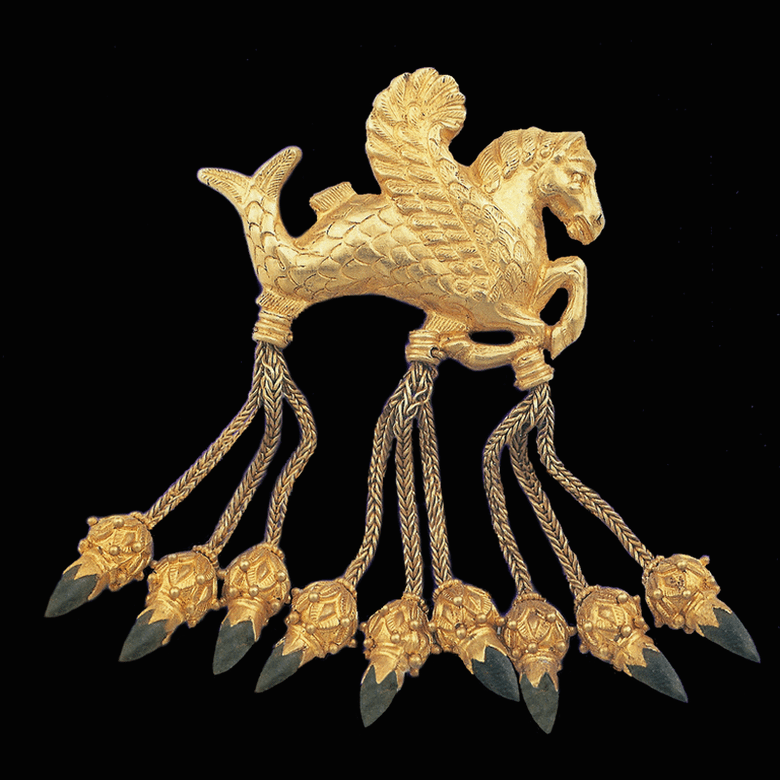
The 'Lydian Hoard' contains some of the most intricate gold work of the ancient world, but the 'Winged Seahorse' brooch stands out. It’s 2,500 years old, made of solid gold, and belonged to King Croesus.
There is a haunting level of detail in these ancient 'mythological' hybrids. While these are found throughout the ancient world—Griffins, Chimeras, Sphinxes—the consistency of the designs is striking. If ancient art functioned as a reflection of the observed world, what was the true origin of this specific 'Winged Seahorse'?
It raises a difficult question: Is it just a coincidence that multiple cultures, separated by vast distances, all conceived similar hybrid creatures? Or were these depictions inspired by something that is now extinct, or perhaps 'out of place' according to our current understanding of history?
The obsession with merging land, sea, and air animals into a single, functional form remains one of the great enigmas of ancient iconography.
by bortakci34
1 Comment
Adding some critical context: This is a key piece of the legendary ‘Lydian Hoard’. Its journey is a saga of international smuggling and high-level legal battles.
After being looted in the 1960s, it ended up in the Metropolitan Museum of Art (The Met) in NYC. It took a massive 6-year legal war for Turkey to force the Met to return the treasure in 1993. But the mystery didn’t end there. In 2006, the original was stolen AGAIN from a local museum by the museum’s own director and replaced with a fake.
The original (shown here) has the deep, authentic texture of ancient Lydian gold, while many photos circulating online are actually of the crude replica used during the heist. Why has this specific brooch been the target of so much drama, international theft, and high-level museum cover-ups? Is it just the gold value, or is there something about this ‘Winged Seahorse’ iconography that makes it so persistent in the world of illicit antiquities?