
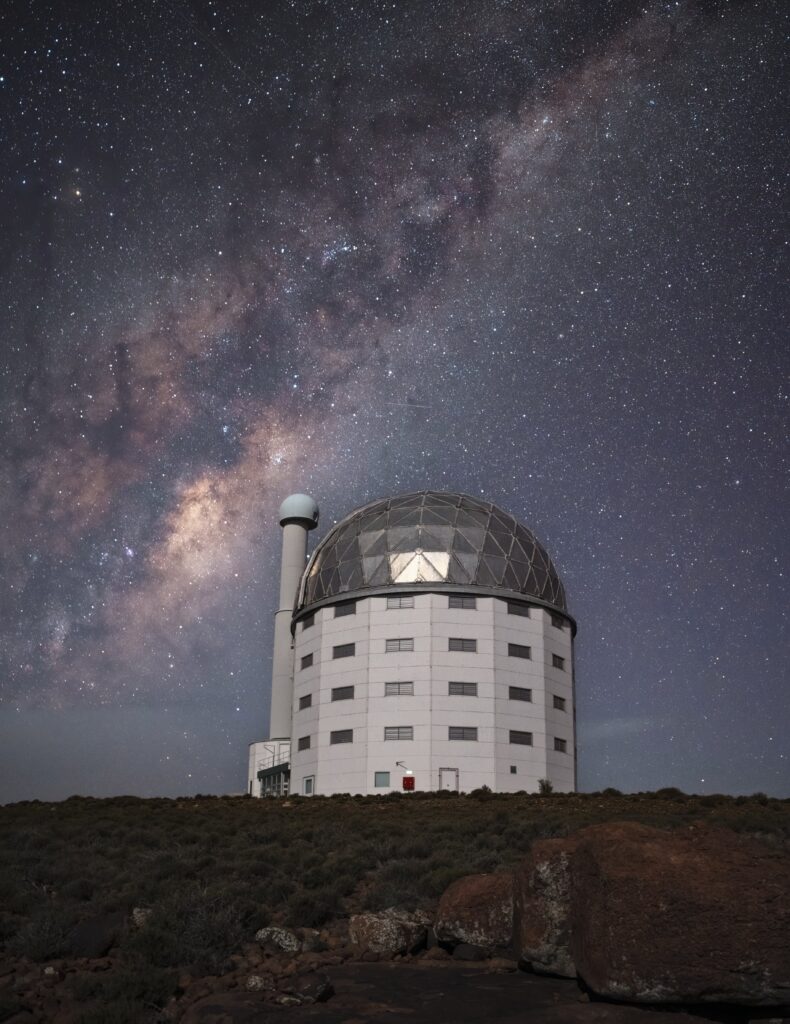

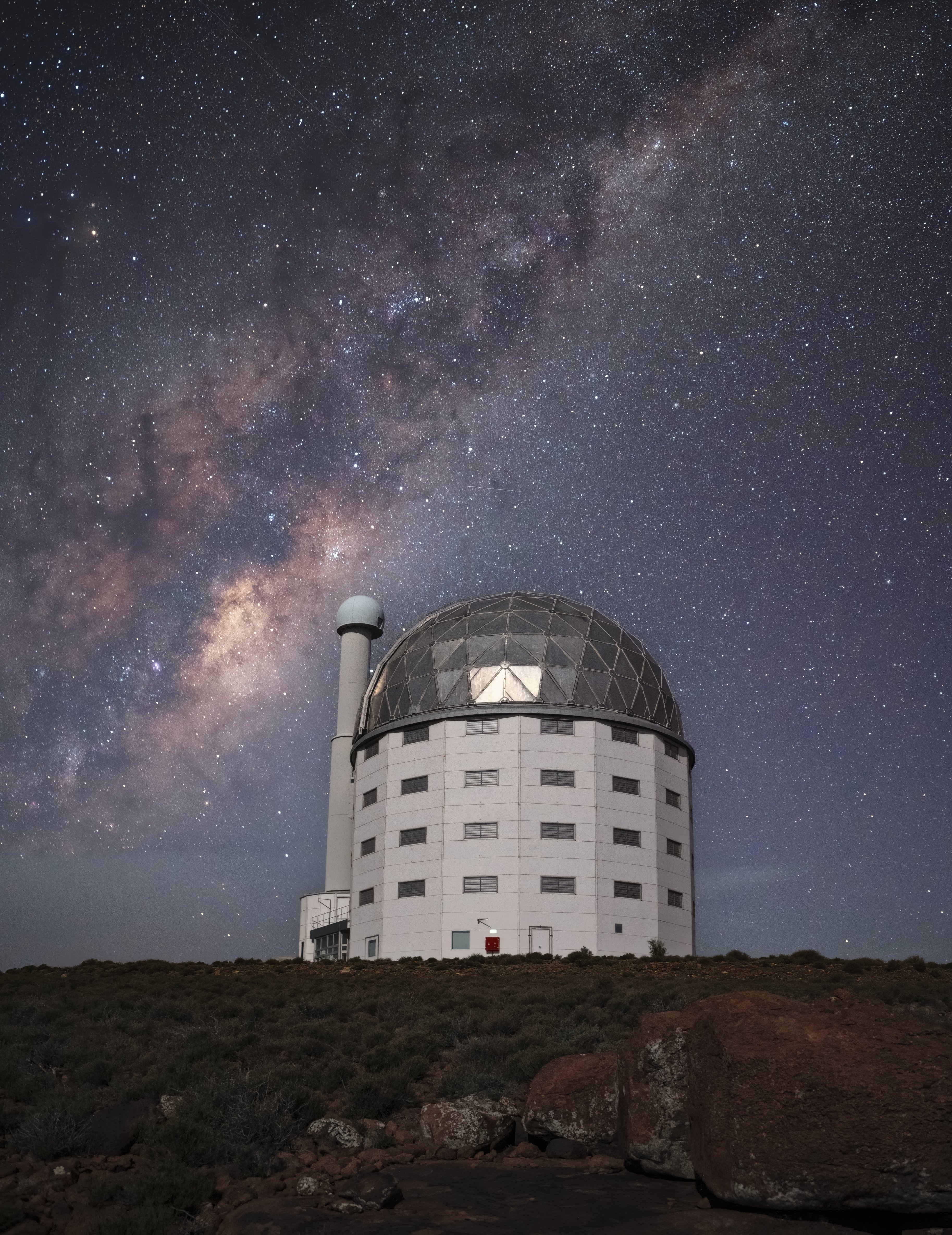
 Source: SAAO
The Southern African Large Telescope (SALT) is set to begin observing selected astronomical alerts issued by the Vera C Rubin Observatory, highlighting a key milestone in South Africa’s participation in a new era of time-domain astronomy. The Rubin Observatory, based in Chile, is conducting one of the most ambitious sky surveys ever undertaken. Using its powerful 8.4-metre Simonyi Survey Telescope, it repeatedly scans the southern sky, detecting transient and variable events, from exploding stars (supernovae) to flaring black holes and potentially hazardous near-Earth asteroids. These discoveries are rapidly distributed worldwide as “alerts,” enabling partner facilities to carry out detailed follow-up observations.
SALT, located at the National Research Foundation’s South African Astronomical Observatory (NRF-SAAO) at Sutherland in the Northern Cape, is exceptionally well-positioned to respond to these alerts. As the largest single optical telescope in the southern hemisphere, with an 11-metre segmented primary mirror, SALT combines light-gathering power with state-of-the-art spectroscopic instruments. This makes it particularly effective at determining the physical nature, distances, and chemical properties of newly discovered objects.
SALT’s Strategic Edge in Global Transient Observations
While Rubin Observatory excels at discovering and flagging new or changing objects across vast areas of sky, SALT’s strength lies in detailed spectroscopic follow-up, analysing the light from these sources to reveal what they are and how they evolve. Together, the two facilities form a powerful partnership: discovery and diagnosis. In addition to SALT’s spectroscopic capabilities, the South African Astronomical Observatory has developed an advanced rapid-response capacity through its Intelligent Observatory (IO) programme. The fully automated 1-metre Lesedi telescope at Sutherland operates robotically and is already engaged in time-domain science, routinely observing variable and transient objects.
Lesedi is designed to respond quickly to astronomical alerts, providing early photometric characterisation of newly discovered events. This rapid-response capability complements SALT’s detailed spectroscopic investigations. Together, they form a coordinated system in which Rubin Observatory discoveries can be identified, monitored, and then analysed in depth using SALT’s powerful instrumentation.
South Africa’s geographic location provides a significant strategic advantage. SALT shares access to the same southern sky observed by Rubin, allowing rapid follow-up of transient events shortly after they are detected. This responsiveness is crucial for phenomena that fade or evolve quickly, sometimes within hours or days.
“This is an exciting moment for South African astronomy,” said Prof Rosalind Skelton, NRF-SAAO Managing Director. “Rubin Observatory is transforming how we discover dynamic events in the Universe, and SALT is ideally equipped to investigate them in detail, building on an existing highly successful transient programme. Our ability to respond quickly to these alerts ensures that South Africa will play a leading role in the scientific return from this global endeavour.”
The collaboration strengthens opportunities for South African researchers and students to work at the forefront of international astronomy, contributing to discoveries that may reshape our understanding of the dynamic Universe. Further updates on the observations and their outcomes will follow as data are analysed