
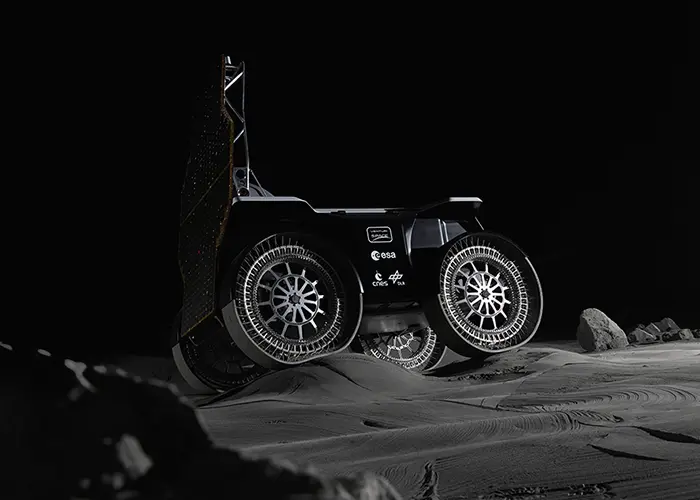
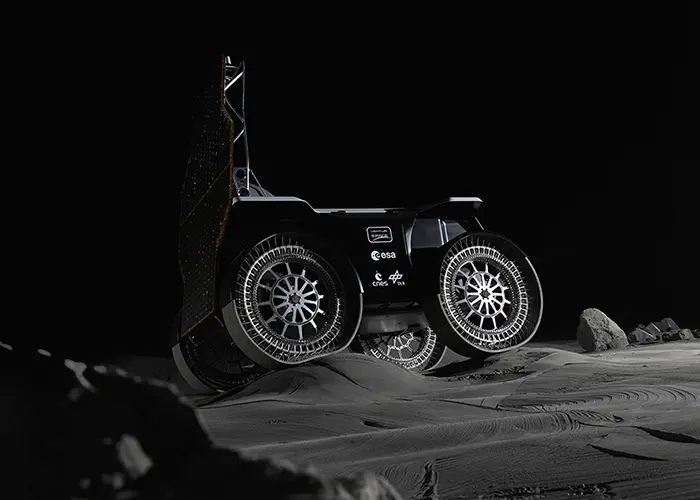
The European Space Agency (ESA) has signed a contract with Venturi Space for a risk-reduction study focused on key technologies for the next generation of lunar rovers, as Europe advances its long-term ambitions for sustained surface operations on the Moon.
The study, which began on 1 January 2026, centres on three critical areas for future lunar mobility systems: mobility capability, power supply systems and thermal regulation. The objective is to mature technologies that could equip heavier, logistics-capable rovers intended to support future robotic and crewed missions under ESA’s lunar exploration roadmap.
Venturi Space will conduct a series of dedicated test campaigns using its MONA LUNA rover as a technology demonstrator. Systems under evaluation include hyper-deformable wheels, a suspension system, high-performance batteries and the egress system — the mechanism enabling a rover to safely descend from a lander onto the lunar surface.
The technologies are being developed with future large-scale lunar operations in mind. ESA expects upcoming rovers to weigh several tonnes, reflecting the shift toward infrastructure support, cargo transport and crew assistance roles in sustained lunar missions.
Testing will take place at the LUNA facility, a joint ESA–DLR analogue site designed to simulate lunar surface conditions. The LUNA building enables qualification of hardware and operational concepts in an environment representative of the Moon’s terrain and lighting conditions, providing a controlled setting for risk-reduction activities before flight hardware is committed.
A central technical challenge addressed by the study is surface mobility across the Moon’s loose, abrasive regolith and highly uneven terrain. Suspension systems and hyper-deformable wheels must maintain traction and stability while withstanding temperature swings of up to 400°C between lunar day and night. In parallel, electrical power and thermal management systems are being assessed for their ability to endure the prolonged cold of lunar nights, which can last approximately 14 Earth days.
The contract also includes the design and testing of a representative model of ESA’s European Argonaut lander geometry. This will allow validation of mechanical interfaces and operational procedures associated with rover deployment. The egress phase — the transition from lander to surface — is considered a critical step in mission success, requiring precise alignment between lander structure and rover systems.
Daniel Neuenschwander, ESA’s Director of Human and Robotic Exploration, said the partnership reflects a broader strategy of increased collaboration with industry as the European space sector expands.
“In order to strengthen European agility and capabilities, agencies and institutions are establishing new partnerships with industry,” he said. “For this study, the European Space Agency has adopted an approach consistent with this strategy by developing a test and risk-reduction campaign based on technologies already under development at Venturi Space.”
Venturi Space, founded as an extension of the Monaco-based electric mobility company Venturi, has positioned itself in recent years as a developer of lunar mobility systems. The company is a strategic partner of U.S.-based Venturi Astrolab, contributing wheel and battery technologies to the FLIP and FLEX lunar rover programmes. FLEX has been pre-selected by NASA for crewed Artemis missions, while FLIP is slated for deployment in 2026.
The ESA study does not represent a flight contract but rather a structured step toward increasing technology readiness and aligning industrial developments with European mission requirements. As lunar exploration shifts from short-duratio