
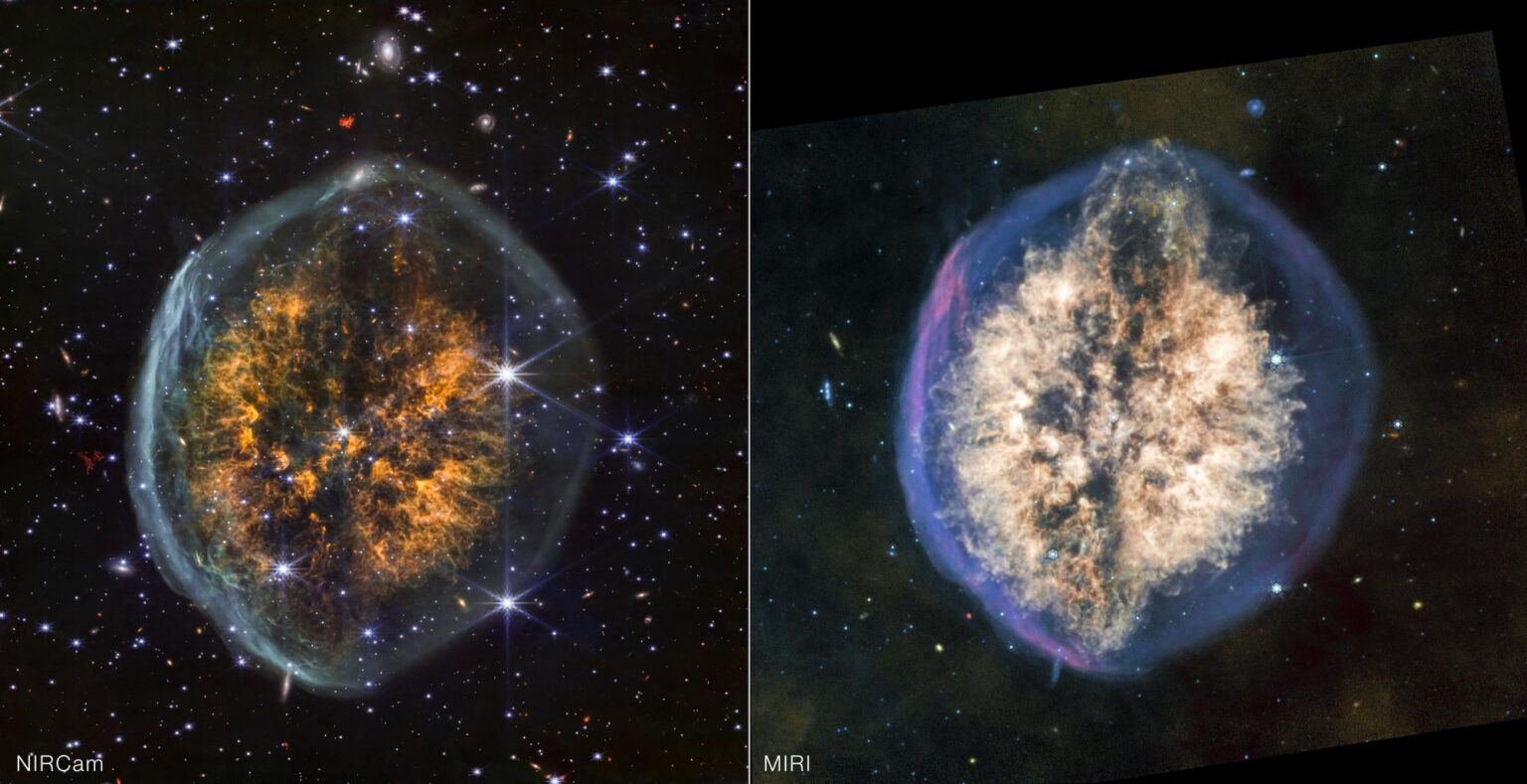
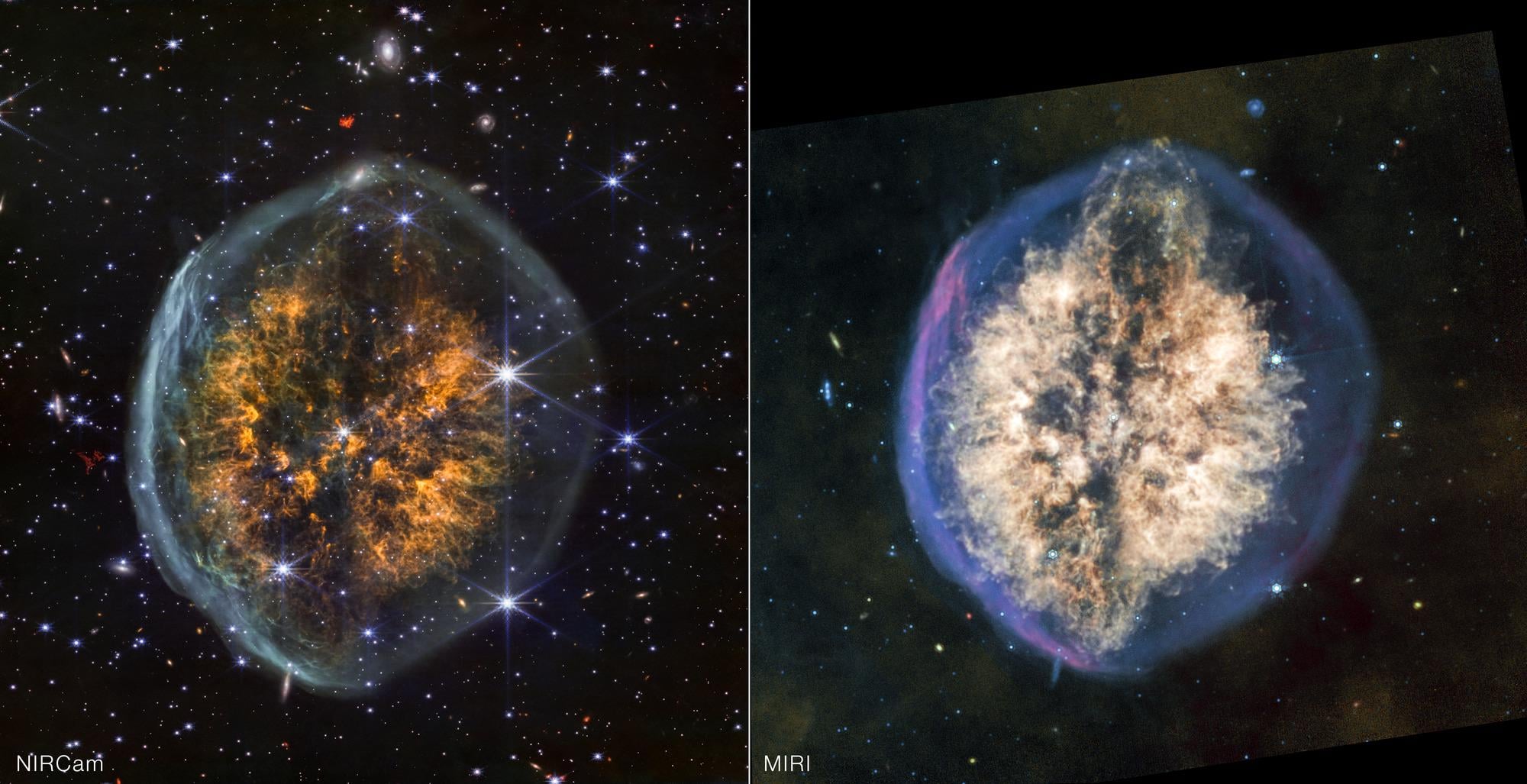
The nebula appears to have distinct regions that capture different phases of its evolution — an outer shell of gas that was blown off first and consists mostly of hydrogen, and an inner cloud with more structure that contains a mix of different gases. Both Webb’s NIRCam (Near-Infrared Camera) and MIRI (Mid-Infrared Instrument) show a distinctive dark lane running vertically through the middle of the nebula that defines its brain-like look of left and right hemispheres. Webb’s resolution shows that this lane could be related to an outburst or outflow from the central star, which typically occurs as twin jets burst out in opposite directions. Evidence for this is particularly notable at the top of the nebula in Webb’s MIRI image, where it looks like the inner gas is being ejected outward.
While there is still much to be understood about this nebula, it’s clear that it is being created by a star near the end of its fuel-burning “life.” In their end stages, stars expel their outer layers. It’s a dynamic and fairly fast process, in cosmic terms. Webb has captured a moment in this star’s decline. What ultimately happens will depend on the mass of the star, which is yet to be determined. If it’s massive enough, it will explode in a supernova. A less massive Sun-like star will continue to shed layers until only its core remains as a dense white dwarf, which will cool off over eons.
Credit: NASA, ESA, CSA, STScI; Image Processing: Joseph DePasquale (STScI)
by Busy_Yesterday9455