
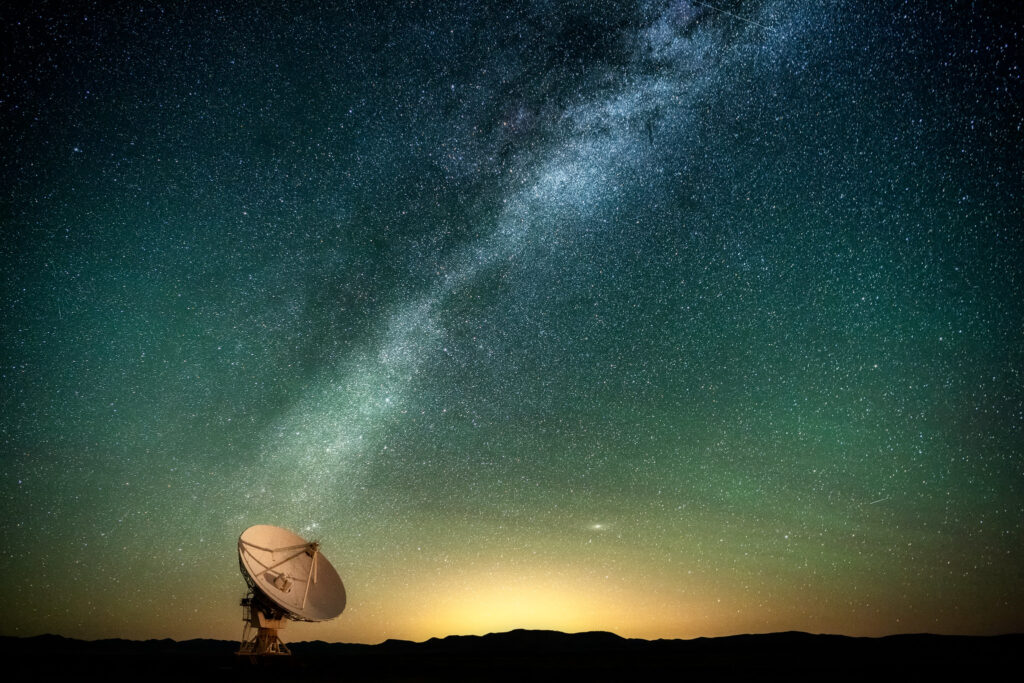
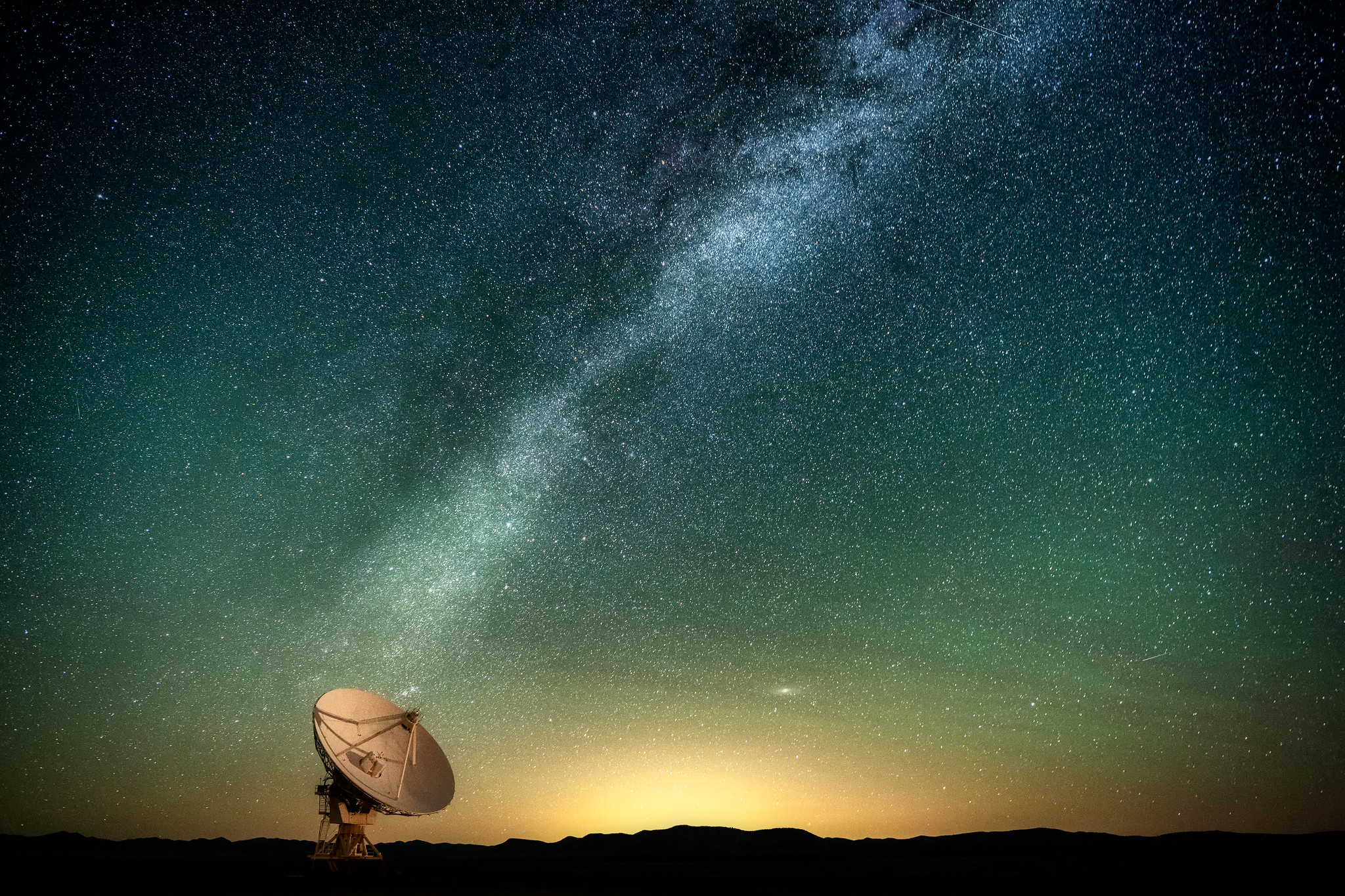
The Milky Way over a radio telescope. Credit: Diana Robinson – CC BY-NC-ND 2.0 via Flickr
Scientists in China have introduced a new artificial intelligence (AI) model that could change how astronomers study the stars. The AI tool allows researchers to combine and compare data gathered from different telescopes, solving a problem that has challenged space science for years.
Telescopes around the world collect light from stars and break it into detailed patterns. These patterns, often called stellar fingerprints, reveal important clues such as a star’s temperature, chemical makeup, and surface features. By studying this information across millions of stars, astronomers can trace how the Milky Way formed and changed over time.
However, each telescope captures data in its own way. Differences in design, measurement style, and detail level make it difficult to merge findings from separate space missions. As a result, valuable information often remains divided, limiting broader discoveries.
The newly developed AI model changes that. Researchers say it acts as a bridge, allowing different datasets to speak the same language and work together in a unified system.
The model, known as SpecCLIP, was developed by researchers from the National Astronomical Observatories of the Chinese Academy of Sciences, the University of Chinese Academy of Sciences, and partner institutions. The findings were reported by Science and Technology Daily and published in the Astrophysical Journal.
Large sky surveys such as China’s LAMOST telescope and Europe’s Gaia satellite gather enormous amounts of stellar information. Yet the tools use different standards and levels of detail. That makes direct comparison unreliable and slows progress in large-scale studies.
SpecCLIP addresses this issue by learning how to recognize similarities between star data collected by different instruments. Instead of forcing scientists to manually adjust measurements, the AI identifies patterns on its own and places them into a shared format.
Huang Yang, an associate professor involved in the project, described the system as working like a translator. It converts measurements from separate telescopes into a common representation. That process allows astronomers to align data more accurately and analyze stars across missions without losing important details.
Expanding the search for rare and distant stars
The new system offers more than simple data alignment. Unlike many traditional tools designed for a single task, SpecCLIP can perform several jobs at once. It can estimate a star’s basic features, measure its chemical elements, and search for other stars with similar traits.
These abilities are especially valuable in the search for rare ancient stars. Some of the oldest stars contain very low amounts of heavy elements and preserve clues about the earliest days of the Milky Way. Finding them requires sorting through massive datasets. The AI model can quickly scan large collections of star records and flag unusual objects that deserve closer study.
The system of an AI tool for different telescopes has already supported major research efforts. In the Earth 2.0 mission, which looks for planets that may resemble Earth, SpecCLIP helps scientists better understand the stars that host those planets. Clearer knowledge of host stars improves the search for worlds that could support life.
Experts say the project reflects the growing role of artificial intelligence in space research. Modern telescopes generate more data than humans can easily manage. AI tools such as SpecCLIP allow scientists to combine, compare, and analyze information on an unprecedented scale.
By bringing together scattered sky surveys, the model opens new paths for studying the galaxy’s structure and history. Researchers believe the approach could support future missions and deepen understanding of how stars and planets form across the universe.