

The magnetic field of the Milky Way has long been a subject of mystery, with its crucial role in shaping the structure and behavior of our galaxy largely hidden from view. A recent study takes a major step in understanding this invisible force by presenting a detailed map of the galaxy’s magnetic field, revealing unexpected and fascinating twists in how it flows through the vast expanse of space. Conducted by Dr. Jo-Anne Brown and her team, this research opens new avenues for understanding not just the Milky Way’s magnetic structure but also how this field has evolved over time.
Unveiling the Hidden Power of the Milky Way’s Magnetic Field
Magnetic fields in galaxies are far from a mere scientific curiosity; they are essential to the very existence of these cosmic systems. The Milky Way’s magnetic field, though invisible to the naked eye, plays a critical role in maintaining the galaxy’s stability. “Without a magnetic field, the galaxy would collapse in on itself due to gravity,” says Dr. Jo-Anne Brown, a professor in the Department of Physics and Astronomy at the University of Calgary. This statement underscores the importance of understanding the structure and behavior of magnetic fields in galaxies, as they help to balance gravitational forces that would otherwise lead to the collapse of stars, planets, and other cosmic elements.
The new data collected by Dr. Brown and her team enables scientists to map this previously hidden force in unprecedented detail. By gathering detailed information on the magnetic field’s orientation, strength, and distribution, researchers can better model how the magnetic field functions today and predict how it will evolve. This is a crucial step in the journey to understand the forces that shape galaxies.
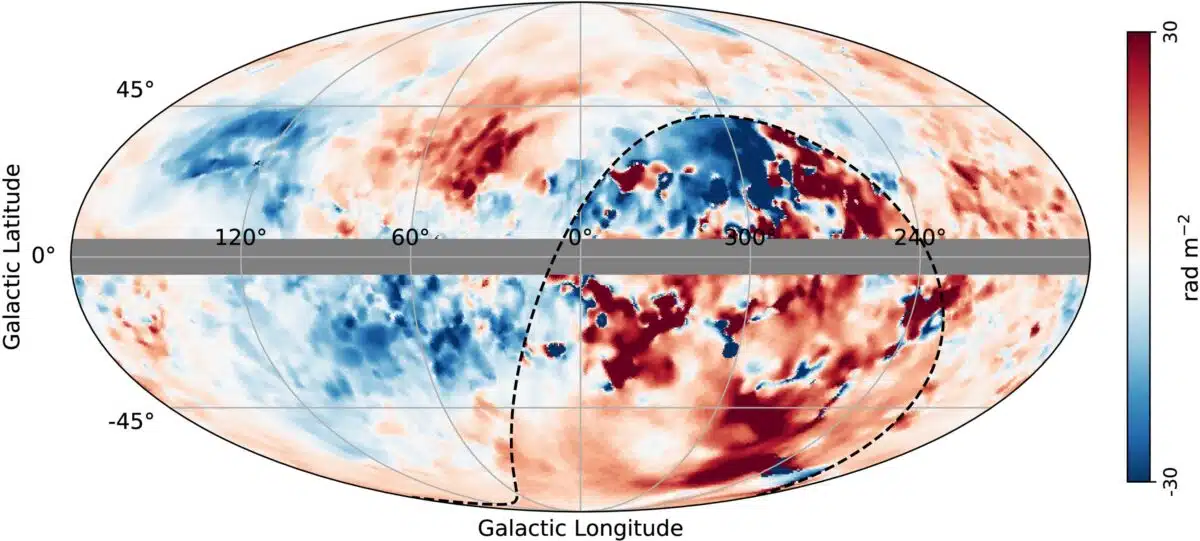 DRAGONS and STAPS FD M1 combined. The STAPS data were convolved to the DRAGONS spatial resolution of 2
45. The dashed line indicates the boundary between the two datasets. We have masked out the Galactic plane, within ∣b∣ < 5°, where instrumental effects make the data unreliable.
Credit: The Astrophysical Journal
Faraday Rotation: Tracing the Galaxy’s Magnetic Footprints
To unravel the secrets of the Milky Way’s magnetic field, the team employed a technique known as Faraday rotation. This phenomenon occurs when radio waves, traveling through space, are influenced by electrons and magnetic fields. The effect causes the waves to shift, revealing critical information about the magnetic field that lies in their path.
“You can think of it like refraction. A straw in a glass of water looks bent because of how light interacts with matter,” explains Rebecca Booth, a PhD candidate working alongside Brown. “Faraday rotation is a similar concept, but it’s electrons and magnetic fields in space interacting with radio waves.”
By carefully analyzing the changes in radio signals caused by Faraday rotation, the team has been able to trace the invisible magnetic lines of force that permeate the Milky Way.
This method allows astronomers to map the galaxy’s magnetic field with a level of precision that was previously unattainable. According to Dr. Anna Ordog, the lead author of the first study published in The Astrophysical Journal , “The broad coverage really lets you get at the details about the magnetic field structure.” This ability to capture the finer points of the magnetic field structure is a key factor in improving our understanding of the Milky Way’s inner workings.
Mapping the Diagonal Magnetic Reversal in the Sagittarius Arm
One of the most surprising findings from this study involves the magnetic field in the Sagittarius Arm of the Milky Way. This region exhibits an intriguing anomaly: the magnetic field runs in the opposite direction compared to the rest of the galaxy. Typically, the Milky Way’s magnetic field runs in a clockwise direction, but in the Sagittarius Arm, it runs counterclockwise. Dr. Brown reflects on the team’s initial confusion about this reversal:
“If you could look at the galaxy from above, the overall magnetic field is going clockwise. But, in the Sagittarius Arm, it’s going counterclockwise. We didn’t understand how the transition occurred. Then one day, Anna brought in some data, and I went, ‘O.M.G., the reversal’s diagonal!’”
This revelation led to the creation of a new three-dimensional model that explains how the magnetic field in this part of the galaxy changes direction. The diagonal reversal provides new insights into the dynamic and complex nature of the Milky Way’s magnetic structure, challenging previous assumptions and offering new questions to explore. By developing a better understanding of these magnetic reversals, astronomers can gain a clearer picture of the processes that govern the evolution of galaxies.