

The award of a construction contract for a gravitational wave observatory in rural Maharashtra marks a turning point — not just for Indian science, but for humanity’s ability to decode the cosmos
In the dry scrubland of Hingoli district, in eastern Maharashtra, something extraordinary is about to happen. On February 24, Larsen & Toubro, India’s largest engineering conglomerate, announced it had secured a contract from the Department of Atomic Energy to build LIGO-India — a ₹2,600 crore observatory designed to detect ripples in the fabric of spacetime itself.
The contract, classified by L&T as “significant” (its internal designation for orders between ₹1,000 crore and ₹2,500 crore), covers the full engineering, procurement, and construction of what will become one of the most sensitive scientific instruments ever built on Indian soil.
Two L&T divisions — Heavy Civil Infrastructure and Heavy Engineering — will jointly build vibration-proof precision buildings, then manufacture and install the observatory’s defining feature: an 8-kilometre L-shaped steel tube maintained at a vacuum deeper than interplanetary space. The completion deadline is 48 months. If all goes to plan, by the end of this decade, a stretch of Maharashtra farmland will be listening to black holes colliding a billion light-years away.
But the L&T contract, significant as it is, is really just the visible tip of a much larger story — one that stretches back over a century to a prediction Albert Einstein himself doubted would ever be confirmed, and forward to a future in which gravitational waves may answer questions about the universe that light alone cannot.
Gravitational waves are among the most counterintuitive predictions in all of physics. Einstein’s general theory of relativity, published in 1915, described gravity not as a force but as the curvature of spacetime caused by mass and energy.
A natural consequence was that accelerating masses should produce ripples in this curvature — waves propagating outward at the speed of light, stretching and squeezing space as they pass through it. Einstein published the prediction in 1916. He then spent years unsure whether these waves were physically real or merely mathematical artefacts.
The question remained unresolved for decades, largely because the problem was one of scale. Gravitational waves from astrophysical events — merging black holes, colliding neutron stars, exploding supernovae — are astonishingly feeble by the time they reach Earth. A pair of black holes spiralling into each other a billion light-years away will, upon arrival, distort distances here by roughly one part in 10²¹. To put that in proportion: it is equivalent to measuring the distance to the nearest star and detecting a change smaller than the width of a human hair.
For most of the twentieth century, the idea of building an instrument sensitive enough to register such a signal seemed closer to fantasy than physics.
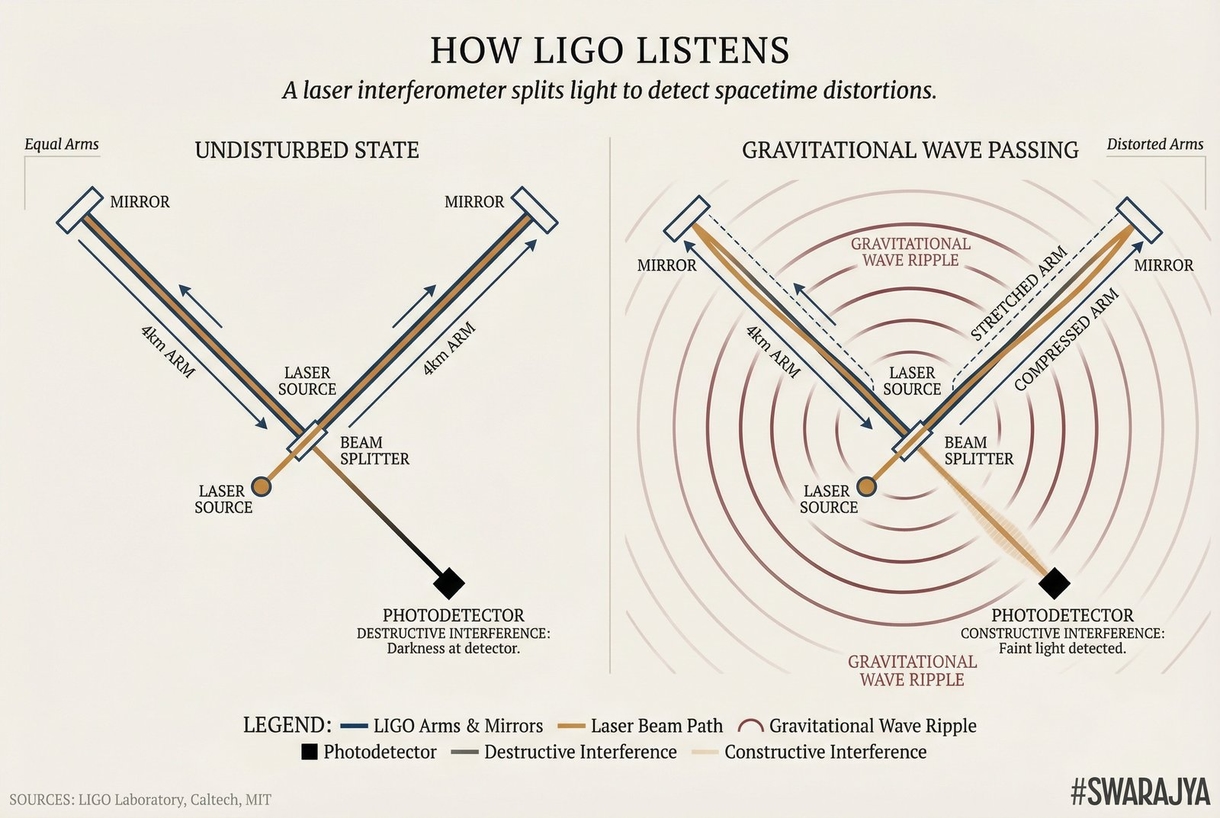
How LIGO Listens — A laser interferometer splits light to detect spacetime distortions
The concept that eventually proved workable was laser interferometry. The principle is elegant. Split a laser beam in two, send each half down a long perpendicular arm, bounce them off mirrors, and recombine them. If nothing disturbs the arms, the returning light waves cancel each other out perfectly — destructive interference produces darkness at the detector. But if a gravitational wave passes through, it will stretch one arm by a tiny fraction while compressing the other. The recombined beams will no longer cancel perfectly, producing a faint, telltale flicker.
This is the operating principle behind LIGO — the Laser Interferometer Gravitational-Wave Observatory — a pair of detectors in the United States that transformed this elegant thought experiment into working hardware. Each LIGO detector has two 4-kilometre arms arranged in an L shape. The laser light bounces back and forth roughly 280 times within optical cavities, effectively extending the measurement path to over 1,100 kilometres. Power recycling boosts the circulating laser intensity to 750 kilowatts. Multi-stage pendulum suspensions isolate the mirrors from ground vibrations by a factor of 100 million. And advanced quantum optics techniques — “squeezed light” — reduce noise below the fundamental quantum limit.
The result is an instrument that can detect changes in arm length of 10⁻¹⁷ centimetres — roughly 10,000 times smaller than the diameter of a proton.
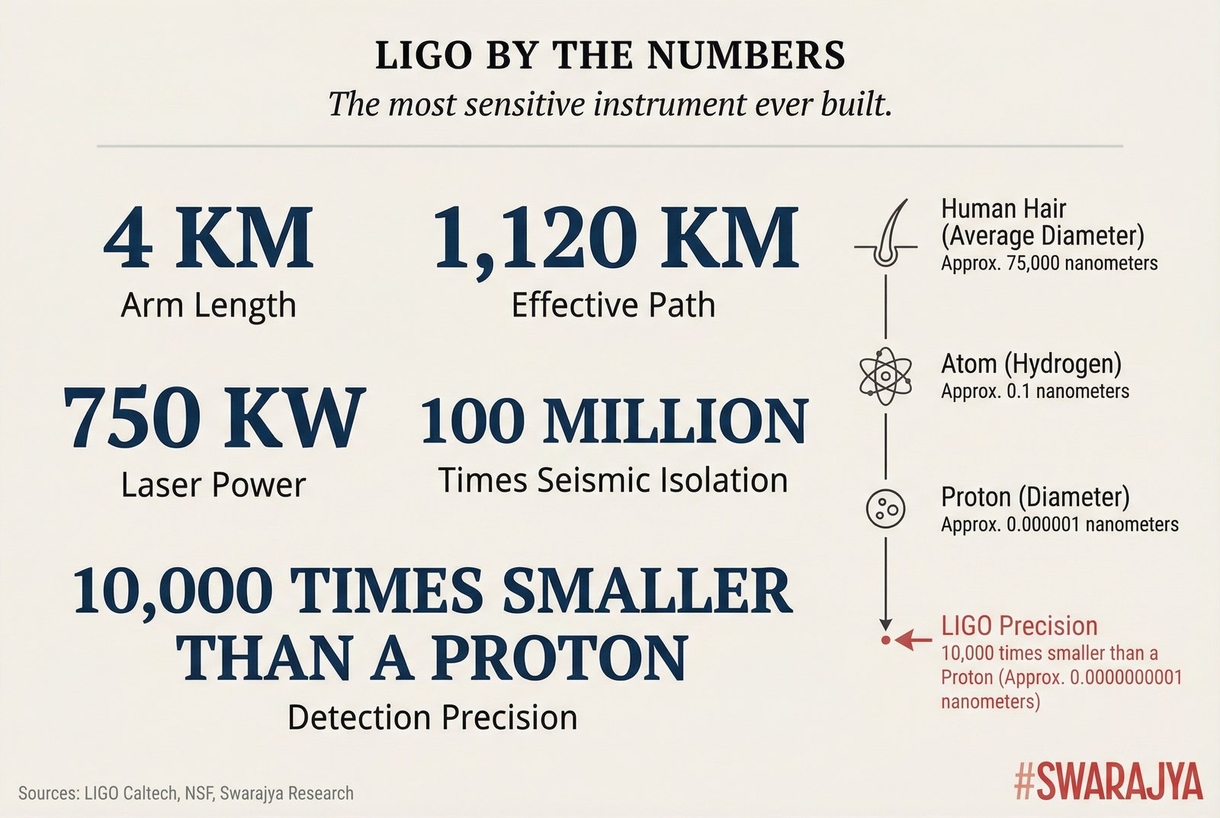
LIGO by the Numbers — The most sensitive instrument ever built
On September 14, 2015, at 5:51 a.m. Eastern time, both LIGO detectors — one in Hanford, Washington, the other in Livingston, Louisiana, separated by 3,000 kilometres — registered a signal within seven milliseconds of each other. The waveform matched the theoretical prediction for two black holes, roughly 29 and 36 times the mass of the sun, spiralling into each other at close to the speed of light and merging 1.3 billion light-years away.
In the final fraction of a second before coalescence, the system radiated more energy in gravitational waves than all the stars in the observable universe were emitting in light. The event, designated GW150914, was announced the following February and earned Rainer Weiss, Kip Thorne, and Barry Barish the 2017 Nobel Prize in Physics.
The discovery was epochal — the first direct confirmation of a prediction Einstein had made 99 years earlier. But what followed proved just as revolutionary.
In August 2017, LIGO and its European partner Virgo, an interferometer near Pisa, detected a different kind of signal: the gravitational waves from two neutron stars spiralling together. Designated GW170817, this event was simultaneously observed as a short gamma-ray burst by the Fermi space telescope just 1.7 seconds after the gravitational wave signal arrived. Within hours, optical, infrared, and X-ray telescopes around the world had located and begun observing the aftermath — a “kilonova” glowing with the radioactive decay of freshly synthesised heavy elements.
That single event inaugurated what physicists call multi-messenger astronomy. It confirmed that neutron star mergers are cosmic forges where elements heavier than iron, including gold and platinum, are created. It provided an independent measurement of the Hubble constant, the rate at which the universe is expanding. And it verified, to extraordinary precision, that gravitational waves travel at the speed of light — exactly as general relativity predicted.
In the years since, the pace of discovery has been relentless. The fourth observing run, O4, which concluded in November 2025, was the longest and most productive yet, running for approximately two and a half years and recording some 250 candidate signals — roughly one merger every two to three days. The cumulative gravitational wave catalogue now contains nearly 400 confirmed events.
The detectors keep getting sharper. LIGO’s binary neutron star detection range in O4 reached approximately 550 million light-years, more than double the range of the first observing run. Notable discoveries include what may be the highest-mass binary black hole merger ever observed, with a final black hole exceeding 225 solar masses, and several objects falling in the mysterious “mass gap” between the heaviest known neutron stars and the lightest known black holes — a zone whose population carries clues to how massive stars die.
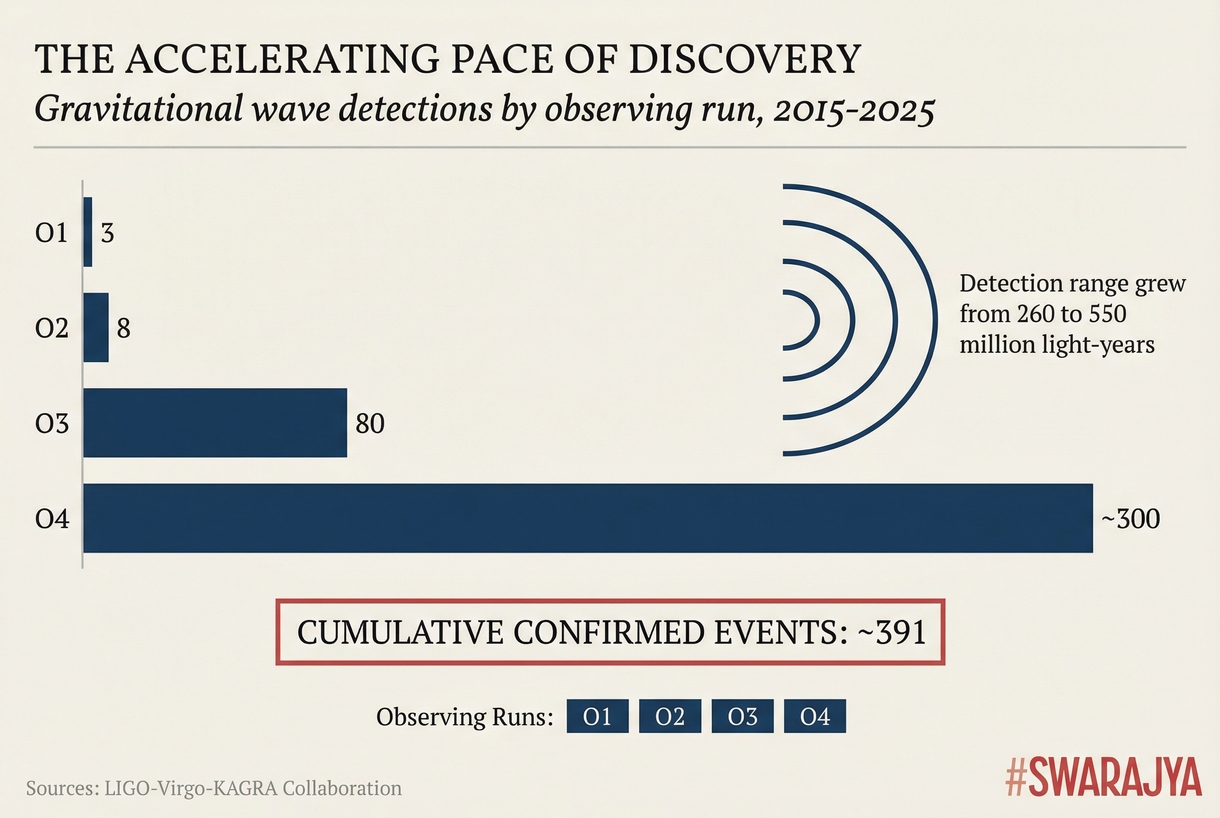
The Accelerating Pace of Discovery — Gravitational wave detections by observing run, 2015–2025
Yet for all this progress, the existing network has a stubborn weakness. Detecting a gravitational wave is one thing. Knowing where it came from is quite another.
A single detector cannot localise a source at all — it can only confirm that a wave passed through. Two detectors, like the pair in the United States, can use the difference in arrival times to constrain the source to a broad ring on the sky. Adding Virgo in Italy allows triangulation, narrowing the search area. Adding KAGRA, an underground detector in Japan’s Kamioka mine, helps further. But even with four detectors, the network’s geometry has significant blind spots, and localisation for many events remains imprecise — often spanning hundreds of square degrees of sky.
This matters enormously for multi-messenger astronomy. When gravitational waves reveal a neutron star merger, the optical and X-ray counterparts fade fast — sometimes within hours. Pointing telescopes at a search area of 500 square degrees is an exercise in frustration. Pointing them at 10 square degrees is science.
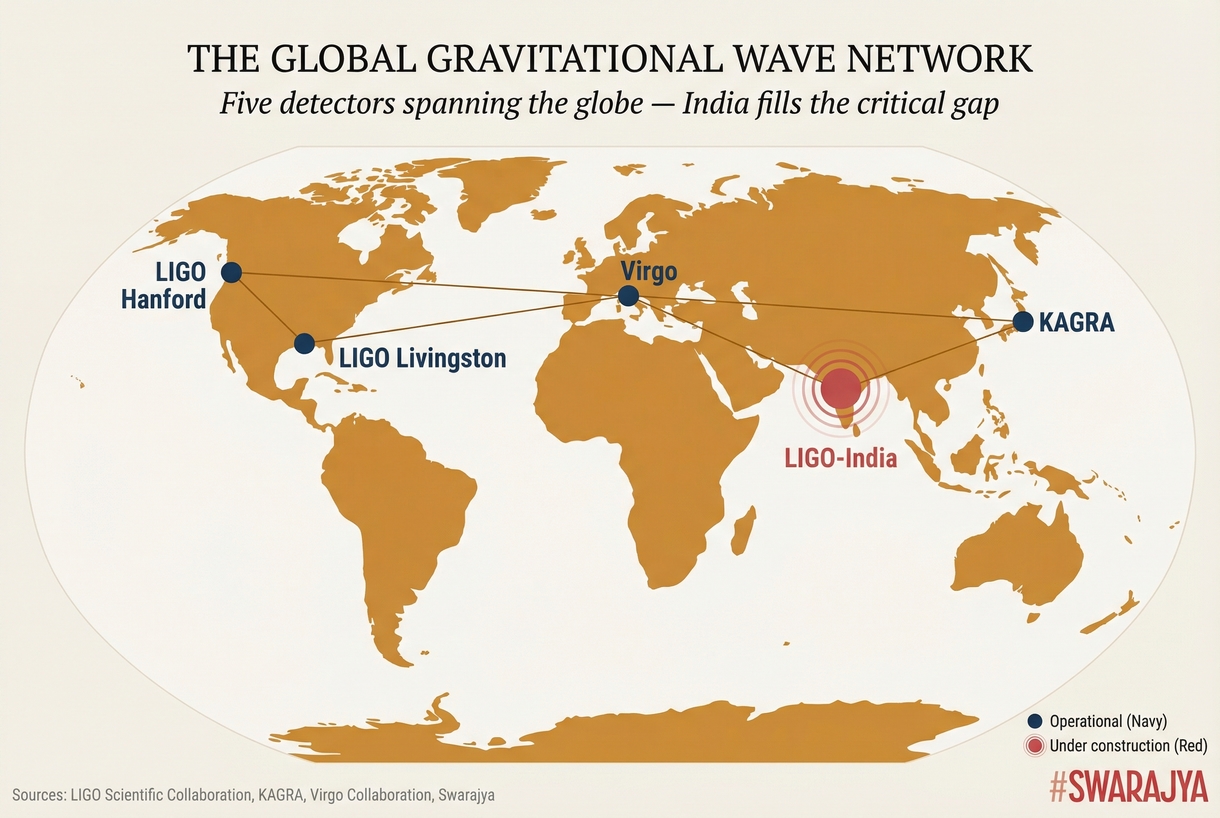
The Global Gravitational Wave Network — Five detectors spanning the globe
This is the gap LIGO-India is designed to fill. Its position in the Indian subcontinent places it on the opposite side of the globe from the American detectors, creating much longer baselines and a completely different detector-plane orientation. As Caltech physicist Rana Adhikari told Nature India, the addition of LIGO-India improves source localisation by an order of magnitude — potentially shrinking search areas to 10 square degrees or less, and in optimal configurations approaching a single square degree.
The physics behind this is straightforward: gravitational wave detectors work by measuring time-of-arrival differences and signal amplitude ratios between sites, and the wider the geographic spread and the more varied the detector orientations, the more precisely the network can triangulate. With five detectors spanning the globe, the ambiguities that plague smaller networks largely dissolve.
Beyond localisation, LIGO-India provides critical redundancy. Individual detectors frequently go offline for maintenance, calibration, or environmental disturbances. A five-detector network dramatically increases the fraction of time that at least three or four detectors are operating simultaneously — the minimum needed for reliable sky mapping. A 2024 paper on arXiv examining future detector configurations found that networks without LIGO-India showed inadequate sky localisation capabilities even when paired with next-generation instruments. The Indian detector is not merely a current-generation supplement but a long-term structural necessity.
Somak Raychaudhury of Ashoka University, speaking to Nature India, put it plainly: the goal is to know not just that two black holes collided, but where, when, and what else was going on.
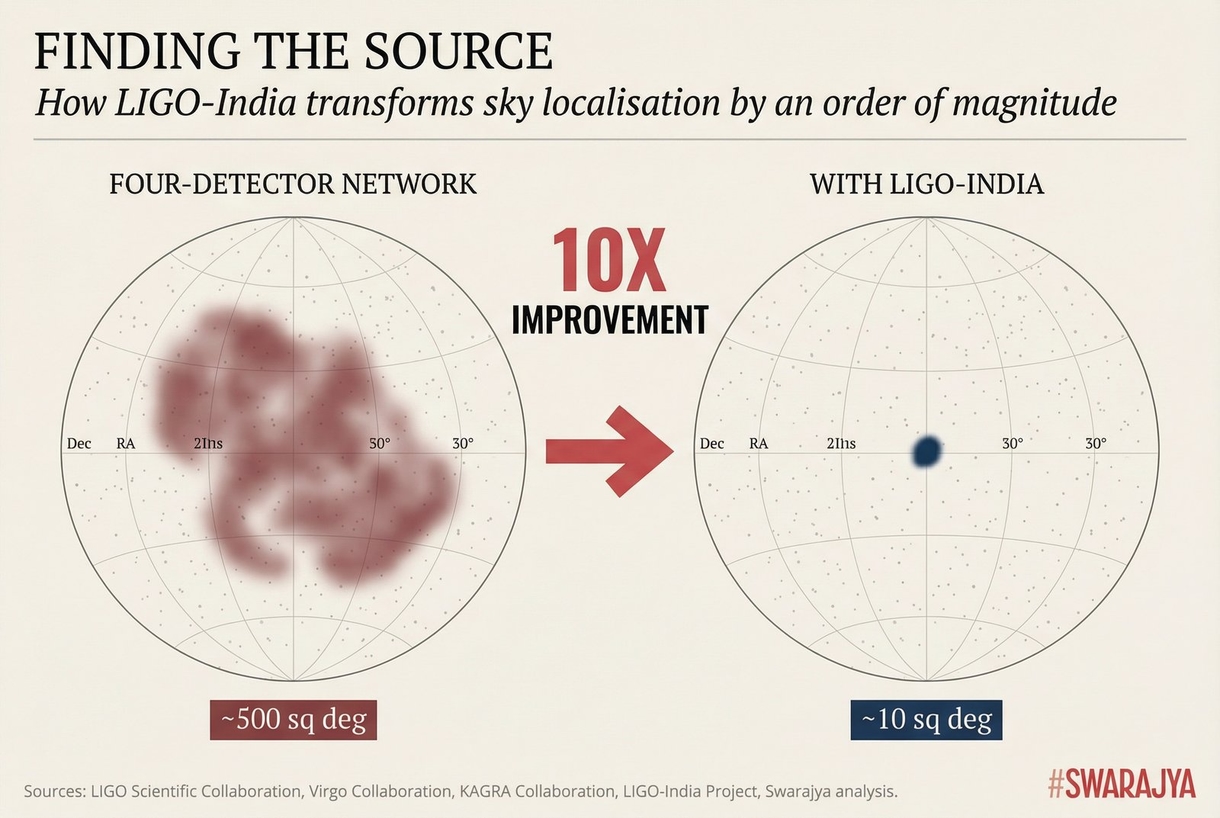
Finding the Source — How LIGO-India transforms sky localisation by an order of magnitude
The project’s significance for India extends well beyond the detector itself. At ₹2,600 crore — roughly $320 million — LIGO-India is among the country’s largest domestic investments in pure science, exceeding both the stalled India-based Neutrino Observatory and India’s contribution to the Thirty Metre Telescope project.
The funding is shared between the Department of Atomic Energy and the Department of Science and Technology on the Indian side, with the US National Science Foundation, through the LIGO Laboratory operated by Caltech and MIT, contributing detector hardware and technical expertise valued at approximately $80 million.
The division of responsibilities is deliberately designed to build Indian capability. The United States provides the complete interferometer — the mirrors, suspensions, laser, and readout systems — originally fabricated for the decommissioned second detector at Hanford. India provides everything else: the site, all civil infrastructure, the ultra-high vacuum system, and all labour for installation, commissioning, and long-term operations.
This means Indian engineers and scientists must master ultra-high vacuum fabrication at industrial scale, precision metrology at the micrometre level, advanced seismic isolation, and complex interferometer control systems. The Institute of Plasma Research in Gandhinagar has already fabricated and tested prototype beam-tube segments. The Raja Ramanna Centre for Advanced Technology in Indore is developing related detector technologies.
And the IndIGO consortium — the Indian Initiative in Gravitational-wave Observations, founded in 2009 and now encompassing more than 70 scientists across over 60 Indian institutions — serves as the intellectual backbone of the effort, coordinating research at IUCAA Pune, multiple IITs and IISERs, TIFR, and a growing network of universities. Indian researchers were not latecomers to this field: Indian scientists contributed to the landmark GW150914 discovery paper, and dozens of students have trained at Caltech through the LIGO SURF fellowship programme. As LIGO-India science spokesperson Sanjit Mitra told Nature India, the project is about building scientific capacity across the country — not merely constructing a single instrument.
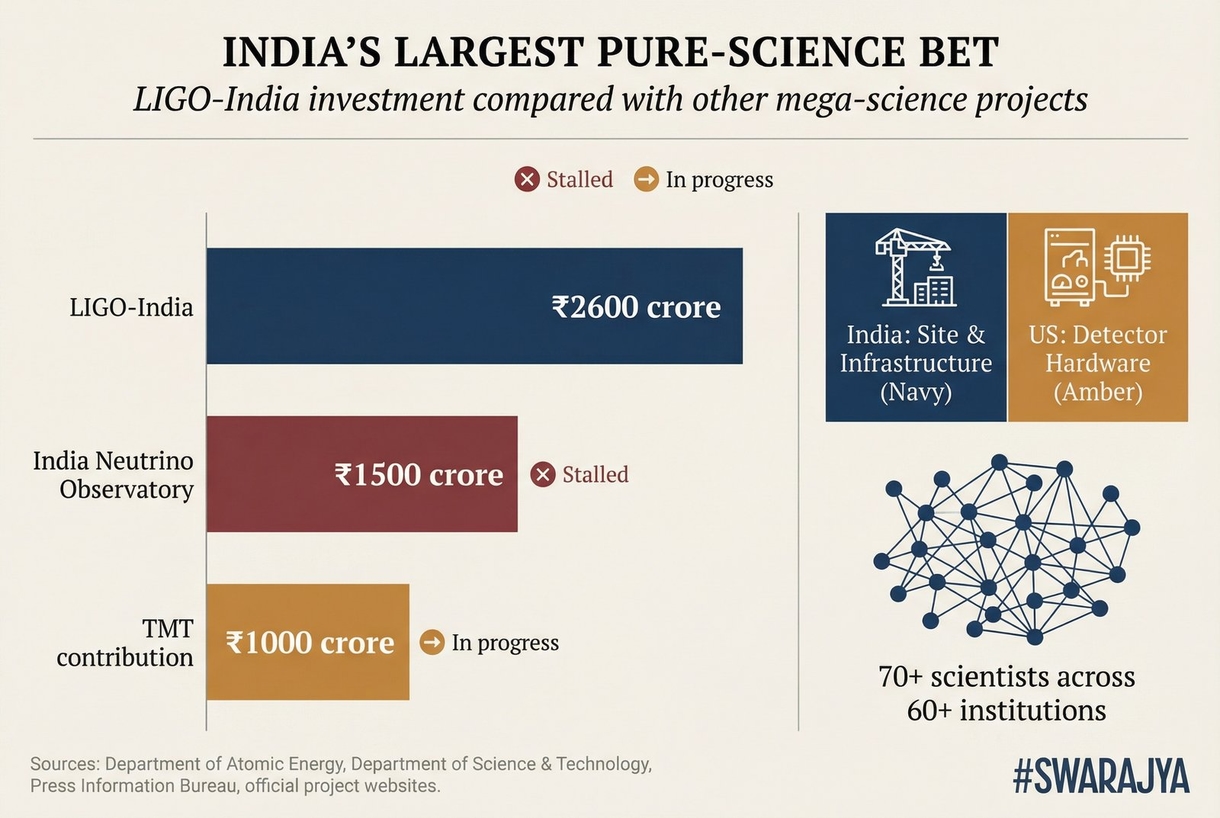
India’s Largest Pure-Science Bet — LIGO-India investment compared with other mega-science projects
The long road to this point — the concept was first flagged as a mega-science priority in 2011, an MoU was signed in 2016, and full Cabinet approval came only in April 2023, followed by a foundation stone laid by Prime Minister Modi in May that year — speaks to the difficulty of sustaining political will for projects whose payoffs are measured in knowledge rather than quarterly returns. That the project has survived this long gestation is itself a signal of something shifting in India’s approach to fundamental research.
LIGO-India will begin operations at a moment when gravitational wave astronomy is transitioning from discovery to precision science. Three next-generation instruments are already in advanced planning stages.
The Einstein Telescope, a triangular underground facility with 10-kilometre arms planned for construction in Europe, promises roughly 10 times the sensitivity of current detectors and would be capable of observing black hole mergers from the universe’s first few hundred million years — an era no electromagnetic telescope can probe. Cosmic Explorer, a proposed American instrument with 40-kilometre arms, would detect neutron star mergers across essentially the entire observable universe. And LISA, a space-based European Space Agency mission consisting of three spacecraft separated by 2.5 million kilometres, will open an entirely new frequency window when it launches around 2035, detecting supermassive black hole mergers and thousands of compact binary systems within the Milky Way.
Together with the current network, these observatories will tackle some of the deepest open questions in physics. Gravitational wave “standard sirens” offer an independent path to resolving the Hubble tension — the persistent disagreement between different methods of measuring the universe’s expansion rate. Tidal signatures in merging neutron stars reveal how matter behaves at densities far beyond what any laboratory can reproduce. And the stochastic gravitational wave background — a faint hum from the superposition of all unresolved sources — may carry imprints of cosmic inflation, phase transitions in the early universe, or exotic objects like cosmic strings.
LIGO-India, incorporating the latest Advanced LIGO technology from the outset and planned for A+ sensitivity upgrades in the mid-2030s, is designed to remain scientifically productive well into this next-generation era. LIGO Laboratory executive director David Reitze, in a statement marking India’s Cabinet approval in 2023, called it a development that would benefit not only India but the entire international gravitational wave community.
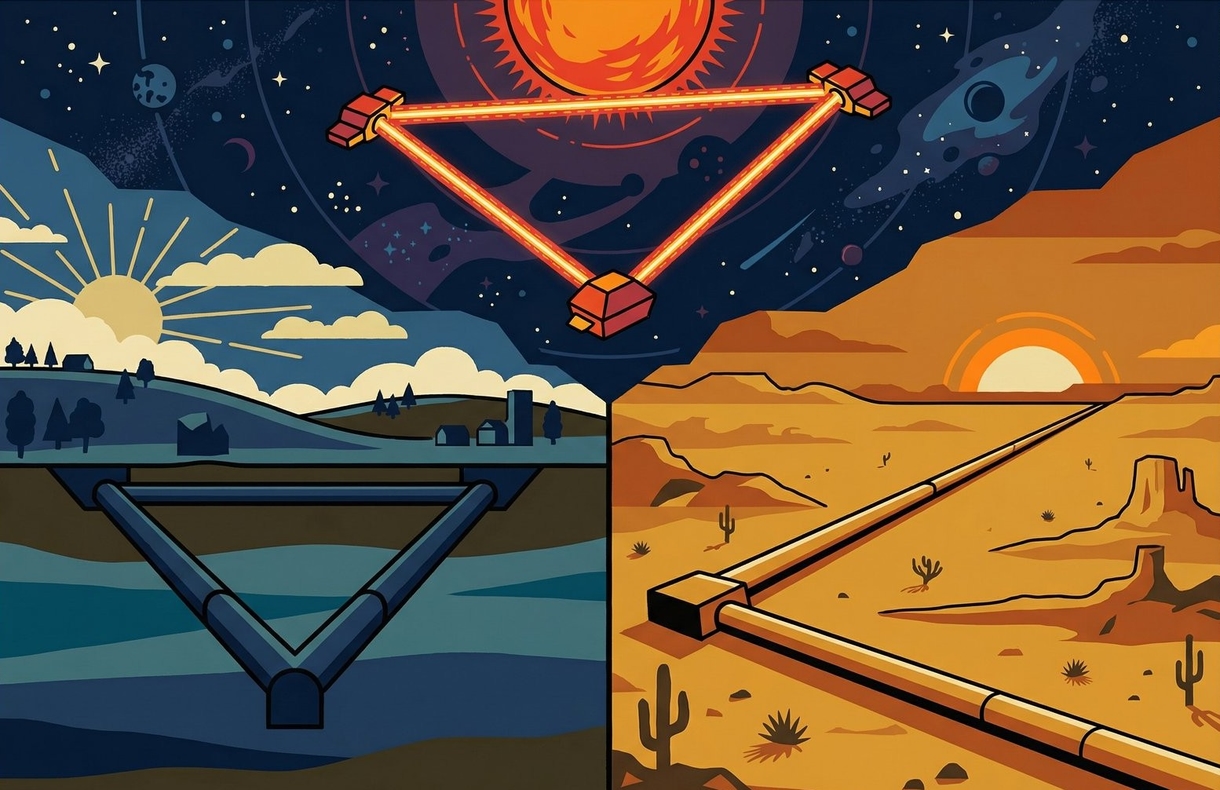
The Next Generation — Einstein Telescope, Cosmic Explorer, and LISA
When L&T’s construction crews break ground in Hingoli, they will be building far more than a set of tunnels and vacuum tubes. They will be completing a global instrument — a planet-sized antenna tuned to the faintest signals in nature.
With nearly 400 gravitational wave events already catalogued and detection rates doubling with each observing run, the science has outgrown its infrastructure. The existing detectors, clustered in the Northern Hemisphere, can hear the universe but cannot always tell where the sound is coming from. LIGO-India fixes that.
Its geographic position transforms the network’s ability to pinpoint cosmic collisions, turning blurry patches of sky into precise coordinates where telescopes can catch the fleeting light of dying stars and newborn elements. For India, the project represents a wager that building world-class scientific infrastructure — training a generation of precision engineers, mastering ultra-high vacuum technology, embedding the country in the most ambitious international physics collaboration of the century — will pay dividends that compound long after the last gravitational wave event of this decade has been catalogued.
It is, by any measure, one of the most remarkable things a country can choose to build: an instrument designed not to produce anything, but to listen — to the collisions of black holes, the death spirals of neutron stars, and perhaps, eventually, to echoes of the universe’s first moments. The fact that it is being built at all is a testament to the stubborn human conviction that understanding the cosmos is worth the effort and the expense. The L&T contract simply makes it real.