
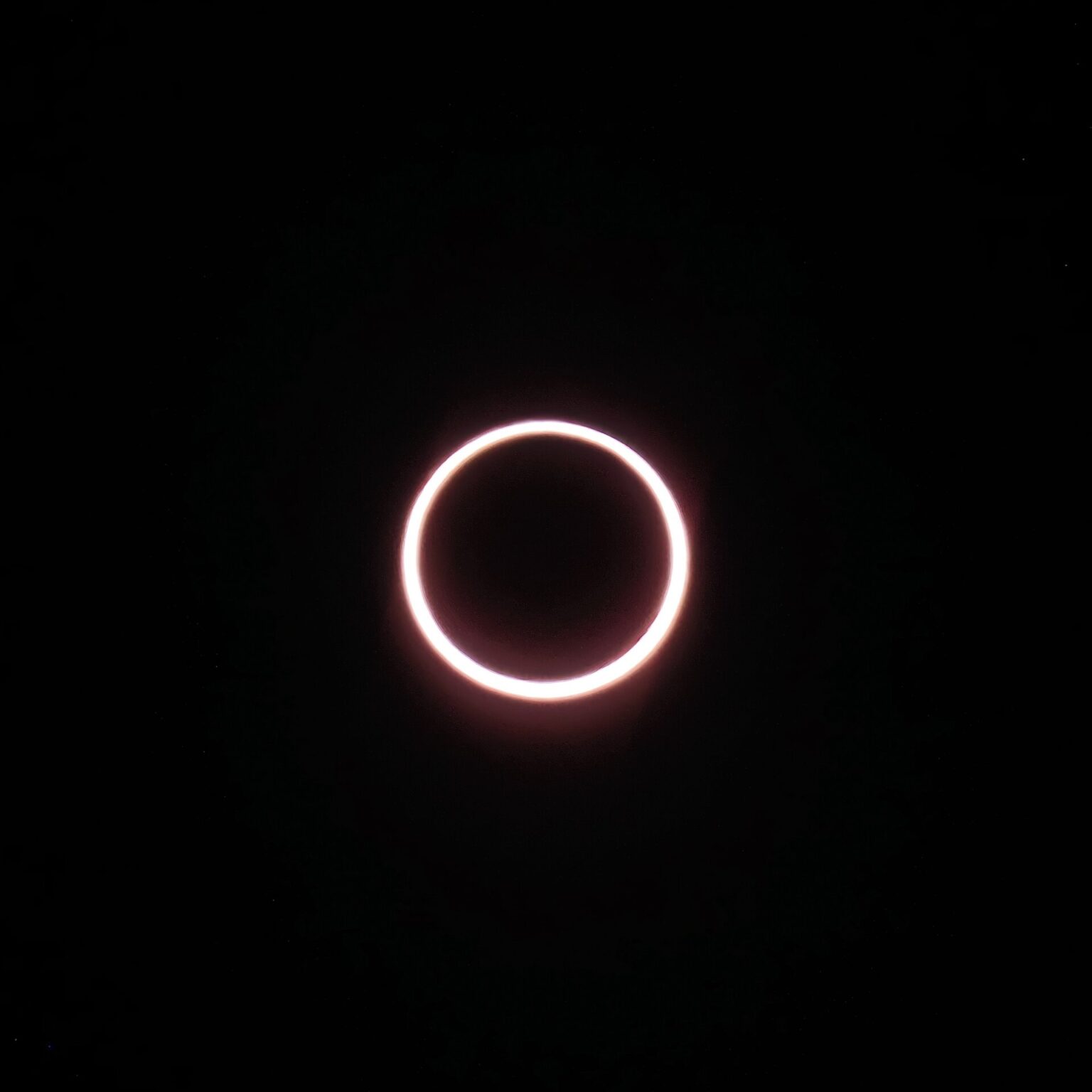
A ‘ring of fire’ solar eclipse seen from Concordia research station in Antarctica on 17 February 2026.
Peaking at 19:47 local time (12:47 CET), the Moon passed directly in front of the Sun’s centre, leaving only a thin, glowing annulus of sunlight visible. Astronomers call this moment annularity, and it lasted just two minutes, though the full partial eclipse spanned around two hours.
Only a narrow path on Earth can witness an annular eclipse in its entirety, and today the crew at Concordia were among the very few located within that corridor. While a partial eclipse could be seen from other regions, only this small slice of Antarctica experienced the Sun transformed into a perfect ring of fire over the icy plateau.
ESA’s Proba-2 spacecraft also witnessed the eclipse from Earth orbit. Three upcoming solar eclipses – on 12 August 2026, 2 August 2027, and 26 January 2028 – will be visible from Europe.
Operated by the French and Italian Antarctic research programmes, Concordia sits 1100 km inland at an altitude of 3200 m. It is currently summer at the station: today, the Sun stayed above the horizon for nearly 20 hours, with temperatures reaching a comparatively mild –29 °C. But soon the light will fade: from May to August, the Sun will not rise at all, plunging the station into four months of continuous darkness where temperatures can fall below –80 °C. During this polar winter, the crew must live in complete isolation and full autonomy.
These extreme conditions make Concordia one of the best analogues on Earth for long-duration spaceflight, including future crewed missions to the Moon and Mars. For this reason, ESA sends a medical doctor every year to the station to study how humans adapt to disrupted daylight cycles, isolation and confinement.
Despite the challenges, Concordia often rewards its crew with views found nowhere else on Earth.
You can find out more about the medical doctors who winter over at Concordia station on our blog.