
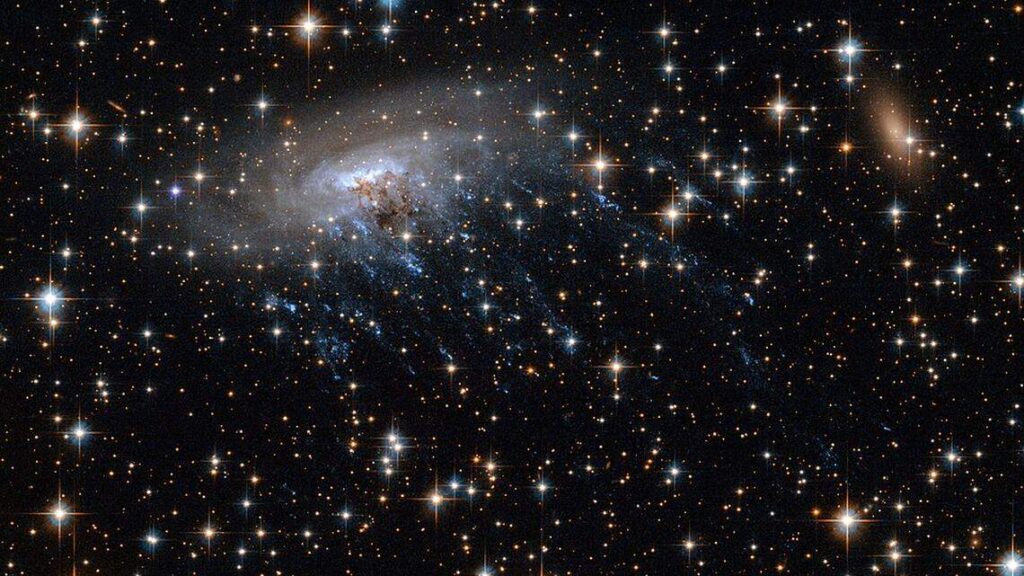
This new Hubble image shows spiral galaxy ESO 137-001, framed against a bright background as it moves through the heart of galaxy cluster Abell 3627.
ESA/Hubble
ESA/Hubble
A team of astrophysicists from the University of Waterloo has spotted the most distant jellyfish galaxy ever observed, using data from the James Webb Space Telescope.
The light reaching us from this galaxy started its journey 8.5 billion years ago, long before our own Earth existed — and the discovery is rewriting what scientists thought they knew about the early universe.
If you’ve got curious kids at home, or you’re a curious grown-up yourself, this is the kind of story that makes the universe feel a little more mysterious.
What Is a Jellyfish Galaxy?
The name is as wonderful as it sounds. A jellyfish galaxy is a type of galaxy found in dense clusters that appears to be “dripping” gas, forming long, tentacle-like tails of newborn stars trailing behind it.
Picture a galaxy zooming through a crowded neighborhood of other galaxies. The space between those galaxies isn’t empty — it’s filled with hot, dense gas.
As the galaxy plows through, the force pushes against it and tears away its own gas, stretching it out into trailing tentacles.
Scientists call this process ram-pressure stripping. Inside those tentacles of stripped gas, brand-new stars are being born — not inside a galaxy, but in the wispy trails left behind it.
The newly discovered galaxy has a normal disc structure with bright blue knots within its gas trails. Those blue knots are very young stars, and their presence suggests stars are forming outside the main galaxy within the gas.
The James Webb Space Telescope Delivers Again
This find was made using data from the James Webb Space Telescope (JWST), which launched on December 25, 2021. The JWST is the largest, most powerful infrared space observatory ever launched, designed by NASA, ESA, and CSA to study every phase of cosmic history.
It orbits the sun one million miles from Earth, using a 6.5-meter gold-coated mirror to peer through dust and observe the very first galaxies formed after the Big Bang.
That mirror is roughly the size of a backyard trampoline. It’s sitting out there in the darkness of space, quietly collecting light that has been traveling across the universe for billions of years.
This telescope allowed the University of Waterloo team to spot something no one had documented before.
Looking Back 8.5 Billion Years
When we look at distant objects in space, we’re literally looking back in time. Light takes time to travel, so the farther away something is, the older the light we’re seeing.
This newly discovered jellyfish galaxy, named COSMOS2020-635829, has a redshift of z = 1.156, meaning astronomers are seeing it as it existed about 8.5 billion years ago. That makes it the most distant jellyfish galaxy ever observed.
Thumbnail images of COSMOS2020-635829 for the four JWST filters used in this work. Dr. Ian Roberts Roberts et al. (The Astrophysical Journal)
For a dinner-table comparison: our own sun and solar system are roughly 4.6 billion years old. So this galaxy’s light started its journey toward us nearly 4 billion years before our solar system even existed.
The galaxy was identified in the COSMOS field (Cosmic Evolution Survey Deep field), a region frequently studied because it is far from the Milky Way’s plane. It has minimal interference from stars and dust, provides a clear view of distant galaxies, and is visible from both hemispheres.
The findings are published in The Astrophysical Journal.
What the Scientists Discovered
Dr. Ian Roberts, a Banting Postdoctoral Fellow at the Waterloo Centre for Astrophysics in the Faculty of Science, led the search that uncovered this galaxy.
“We were looking through a large amount of data from this well-studied region in the sky with the hopes of spotting jellyfish galaxies that haven’t been studied before,” Roberts said in a news release. “Early on in our search of the JWST data, we spotted a distant, undocumented jellyfish galaxy that sparked immediate interest.”
The team made three additional discoveries that are challenging what we know about the universe.
“The first is that cluster environments were already harsh enough to strip galaxies, and the second is that galaxy clusters may strongly alter galaxy properties earlier than expected,” Roberts said, per the release.
“Another is that all the challenges listed might have played a part in building the large population of dead galaxies we see in galaxy clusters today. This data provides us with rare insight into how galaxies were transformed in the early universe,” he added.
The forces that tear gas away from galaxies and create those jellyfish tentacles were at work much earlier in the history of the universe than scientists expected.
The universe was shaping and transforming galaxies in dramatic ways billions of years sooner than researchers thought.
A Story Worth Sharing
In 2026, scientists are still finding entirely new things about the universe — things that rewrite our understanding of how everything around us came to be.
A telescope launched on Christmas morning four years ago is showing us a galaxy that looks like a sea creature, trailing baby stars in its wake, from a time before our own planet existed.
So tonight, if you’re looking for something to talk about over dinner or before bedtime, try this: somewhere out in space, a galaxy is swimming through the cosmos like a jellyfish, and the light from its journey has been traveling toward us for 8.5 billion years.
We just finally had the right telescope, and the right team of curious scientists, to see it.
And if your kids ask, “What else is out there that we haven’t found yet?” — that might be the best question of all.
Production of this article included the use of AI. It was reviewed and edited by a team of content specialists.

Miami Herald
Ryan Brennan is a content specialist working with McClatchy Media’s Trend Hunter and national content specialists team.