
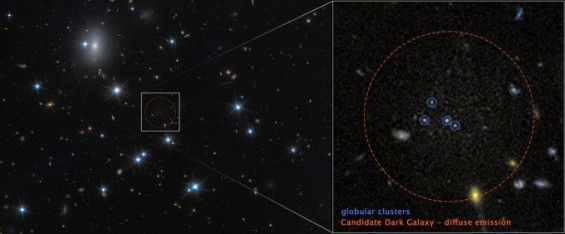
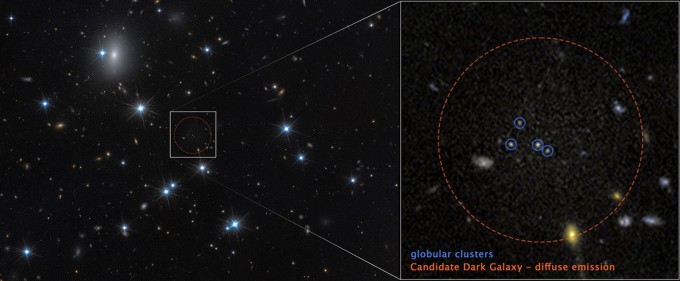
A dark galaxy candidate (orange circle) discovered in the Perseus galaxy cluster, 300 million light-years from Earth (one light-year is the distance light travels in a year). The dense arrangement of four globular clusters (blue circles) served as a clue. Credit: NASA, ESA, Dayi Li, Joseph DePasquale
Astronomers have discovered a rare ‘dark galaxy’ candidate estimated to be 99.9% dark matter by mass.
NASA and the European Space Agency (ESA) announced on the 18th (local time) that the Hubble Space Telescope has discovered a dark galaxy candidate, ‘CDG-2’, estimated to have 99.9% of its components as dark matter. The research, led by Dayi Li of the University of Toronto, Canada, was first published last June in ‘The Astrophysical Journal Letters’.
According to the Standard Model of cosmology, the universe is composed of 68.3% dark energy, 26.8% dark matter, and 4.9% ordinary matter. Dark matter is invisible to the eye and telescopes but has mass and exerts gravity, which explains the movements of celestial objects. Scientists theorize that dark matter clumped together first, then attracted ordinary matter to form stars and galaxies.
The research team discovered the dark galaxy candidate CDG-2 by analyzing high-resolution images of space taken by the Hubble Space Telescope. The clue was the discovery of four densely packed globular clusters within the Perseus galaxy cluster, located 300 million light-years from Earth (one light-year is the distance light travels in a year).
Globular clusters are celestial objects where tens of thousands to millions of stars are densely gathered in a spherical shape, and they do not easily disperse due to strong gravity. The discovered globular clusters were analyzed to be held by strong surrounding gravity, meaning they act as a signal for tracking the dark galaxy.
It is estimated that up to 99.9% of its mass is dark matter, suggesting it could be the galaxy with the highest proportion of dark matter discovered to date. The analysis suggests that materials like hydrogen gas, which form new stars, were stripped away due to gravitational interactions with other nearby galaxies.
According to the analysis, CDG-2 emits light equivalent to 6 million sun-like stars. This is in stark contrast to conventional galaxies, which contain hundreds of billions of stars and are much brighter. The findings are expected to help improve understanding of dark galaxies whose fates diverged from those of bright galaxies like the Milky Way.
For ‘CDG-1’, a dark galaxy candidate proposed by the research team in 2022, follow-up studies found no supporting evidence.
Reynier Peletier, a professor at the University of Groningen in the Netherlands who was not involved in the study, told the international journal ‘Science’, “To prove that the discovered clusters are indeed globular clusters, we need to obtain their spectroscopic information, which is a very difficult technique.” He added, “There is also a possibility that they are galaxies that just appear to be clustered together from our line of sight.”
– doi.org/10.3847/2041-8213/adddab
Copyright ⓒ DongA Science. All rights reserved.