
Young stars are known for their powerful radiation and strong winds. They can shape their gaseous surroundings, both promoting and inhibiting other stars from forming, depending on the circumstances. Their strong winds also have another effect: the stars inflate gaseous bubbles around themselves.
Our Sun did the same thing and created one of these bubble. Its scientific name is heliosphere. The heliosphere is filled with hot gas, relative to the ISM. This hot gas inflates the heliosphere as it expands into the surrounding ISM.
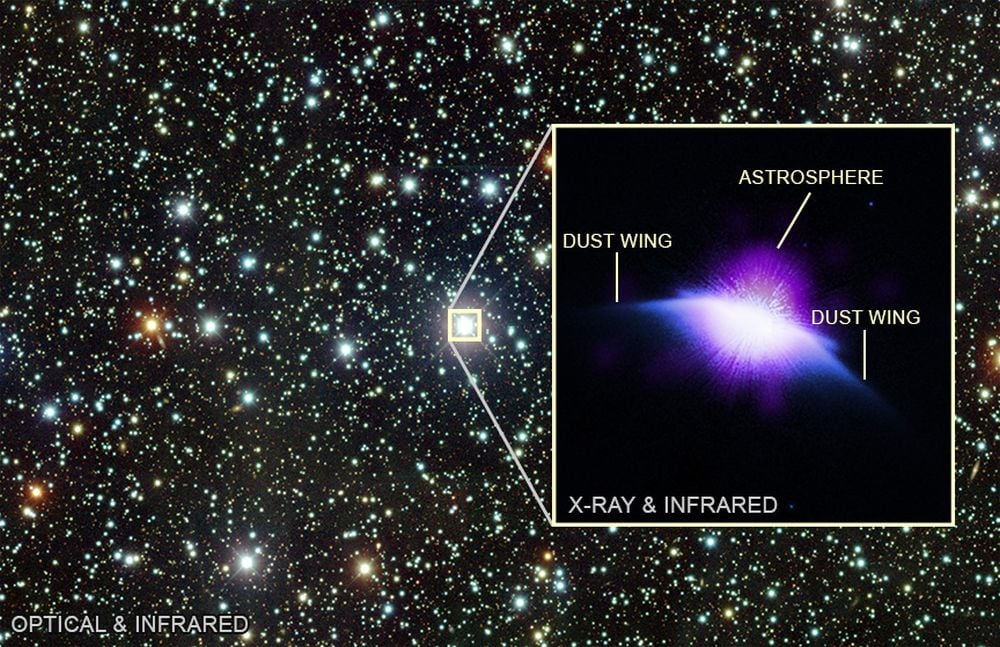
In new research, a group of scientists have imaged one of these inflated bubbles around another Sun-like star. It’s named HD 61005, and it’s much younger than the Sun. It’s just getting established as a main sequence star, and it’s giving astronomers an opportunity they’ve been hoping for. While we can see the Sun’s heliosphere, we’re inside it, limiting the observational potential. Observing one externally, and one so young, is an opportunity to trace how these features evolve.
The research is “First Resolution of a Main Sequence G-Star Astrosphere Using Chandra,” and it will be published in The Astrophysical Journal. The lead author is Carey Lisse. an astronomer in Applied Physics Laboratory at Johns Hopkins University. The research is currently available at arxiv.org.
“Stars shine in the x-ray due to photon emission from the hot collisional plasmas in their surrounding coronal atmospheres,” Lisse and his fellow researchers write. “However, stars also produce a low level of x-ray emission over a large volume, as the ionized, high pressure stellar winds flowing out from their coronae blow a bubble/cavity (termed an “astrosphere”) in the local galactic ISM.”
That means that there are two sources of x-rays. One is the plasmas in the star’s corona. The other is generated as the astrosphere expands. Its wind is slamming into the much cooler ISM. This is what produces observable x-rays.
Chandra ACIS-S imaging spectroscopy probed these x-ray emissions, and with some help from the Hubble’s infrared instrument, the astronomers were able to piece together the young star’s activity as it inflated its astrosphere.
Since stars are moving, their astrospheres aren’t true spheres. They’re more comet-shaped, with one side being spherical and the trailing side being shaped into a long tail.
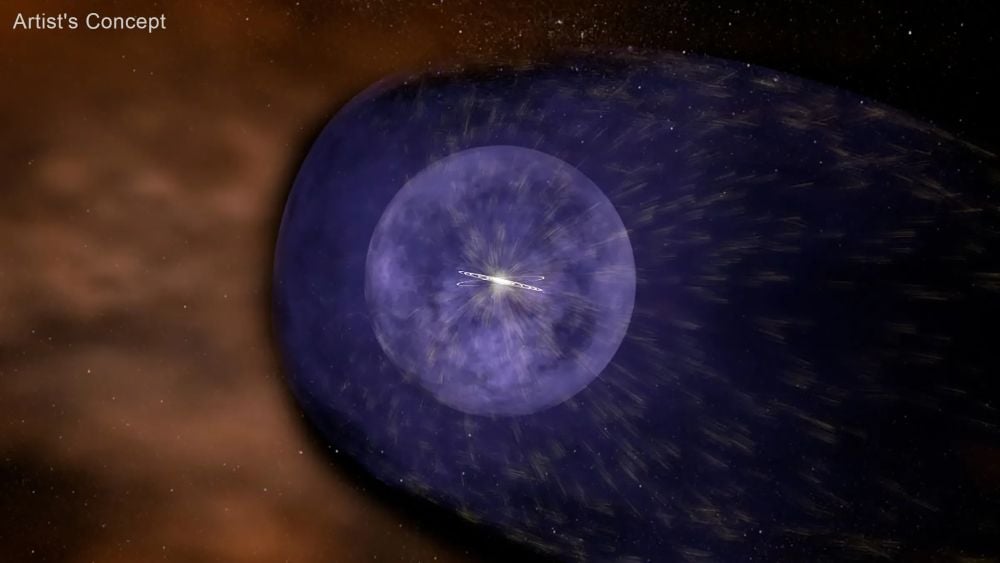 *This artist’s illustration shows the astrosphere around HD 61005. The bow shock is on the left, the direction of the star’s travel. The tail extends outward to the right. Image Credit: NASA/Goddard Space Flight Center, Conceptual Image Lab*
As a young star, HD 61005’s particle wind is about three times faster than the Sun’s, and is also 25 times more dense. Observing it as it inflates its bubble is like looking back in time to the Sun’s early days on the main sequence.
“We have been studying our Sun’s astrosphere for decades, but we can’t see it from the outside,” said Carey Lisse of Johns Hopkins University in Baltimore, who led the study, which published [day of week] in the Astrophysical Journal. “This new Chandra result about a similar star’s astrosphere teaches us about the shape of the Sun’s, and how it has changed over billions of years as the Sun evolves and moves through the galaxy.”
The Sun has helped shape life on Earth for billions of years. As humanity moves ever deeper into a technological age, the Sun is taking on new importance. It’s powerful weather can damage satellites and infrastructure here on Earth’s surface. The Sun’s astrosphere is a part of the complete system, so understanding it may help us understand how space weather affects us.
“We are impacted by the Sun every day, not only through the light it gives off, but also by the wind it sends out into space that can affect our satellites and potentially astronauts traveling to the Moon or Mars,” said co-author Scott Wolk of the Center for Astrophysics | Harvard & Smithsonian (CfA). “This image of the astrosphere around HD 61005 gives us important information about what the Sun’s wind may have been like early in its evolution.”
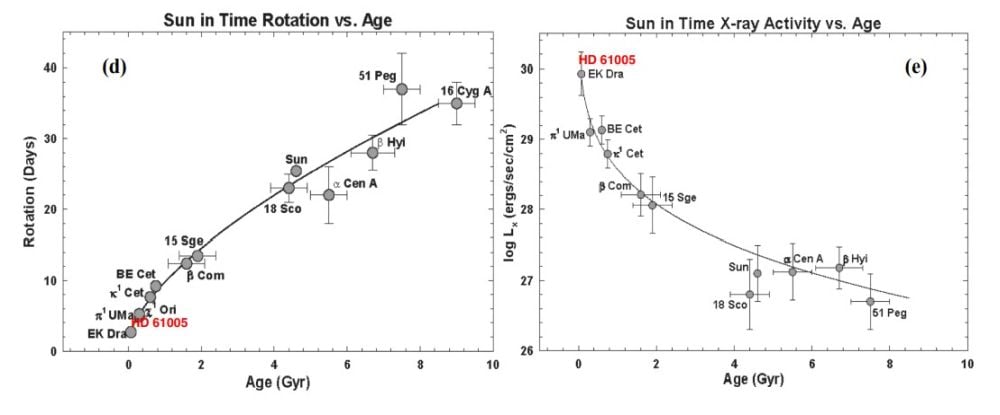 *These figures highlight how main sequence, Sun-like stars change over time. The left panel shows how a star’s rotation rate slows as it ages. The right panel shows how a star’s x-ray output decreases over time. “In general, younger stars with higher angular momentum are rotating much more rapidly and producing hotter coronae and non-thermal XUV radiation via more vigorous magnetic reconnection,” the authors explain. Image Credit: Lisse et al. 2026. ApJ*
This is not the first time astronomers have studied the star. Infrared observations of HD 61005 have led to astronomers nicknaming it “The Moth.” The star is surrounded by massive amounts of dust that look like moth wings. This material is akin to the Kuiper Belt in our Solar System. It’s made up of material leftover from the planet formation process. Observations show that the material is about one thousand times more dense than the material around the Sun.
We can see it as moth wings because of the viewing angle. “Because we are observing HD 61005 edge-on, we can see the wings in cross-section as swept-back structures and not projected flat onto the sky and the ecliptic disk, appearing only as extra edges outside an ellipsoidal main disk,” the researchers explain.
“There’s a saying about a moth being drawn to a flame,” said co-author Brad Snios, formerly of CfA and now at MITRE, a non-profit that participates in federally funded research. “In the case of HD 61005, the ‘Moth’ can’t easily escape from the flame because it was born around it and might be sustained by a disk around it.”
The wings could be a transient phenomena. They contain much smaller dust particles than the main disk, and it’s lifetime could be equal to how long it takes for those particles to be ground down. Or it could be more permanent or long-lasting, with the larger disk replenishing its dust supply.
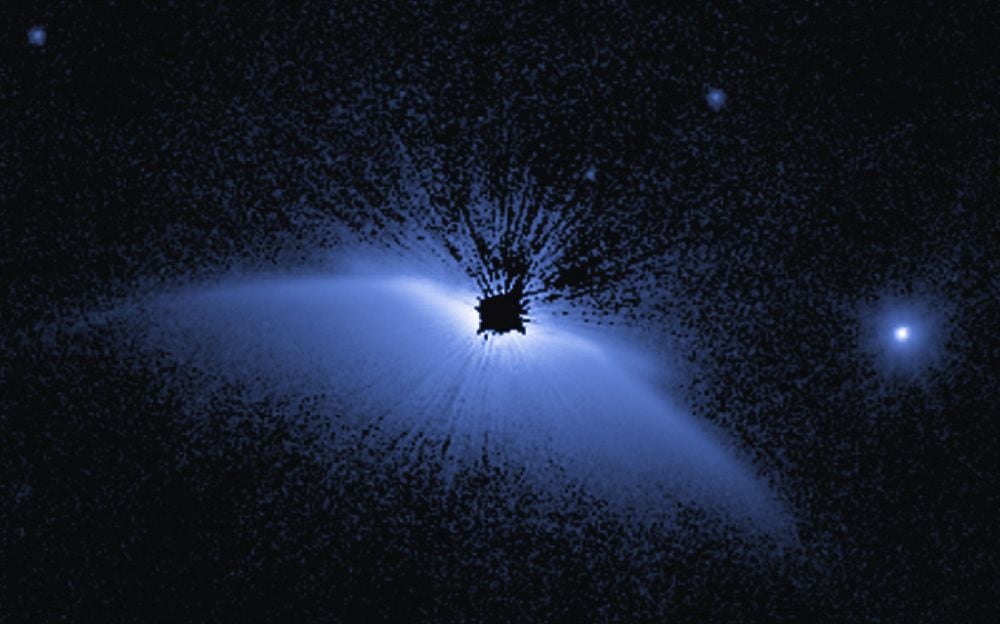 *The circumstellar disk around HD 61005 kind of looks like moth wings, and led to astronomers giving the young star the nickname The Moth. Image Credit: By NASA, ESA, G. Schneider (University of Arizona), and the HST/GO 12228 Team – https://hubblesite.org/contents/media/images/2014/44/3433-Image.html?news=true, Public Domain, https://commons.wikimedia.org/w/index.php?curid=152861650*
“We note that “Mothian” behavior should be common in young systems, and all young G-stars with fast, host-star rotations, strong stellar winds, and young and dynamically hot circumstellar dust disks should show disk with associated “dust wings,” the researchers explain. It’s only because of our increasingly powerful x-ray observations that we can see them. And even then, the astrosphere has to have high surface brightness.
The moth wings are an interesting artifact, but the astrosphere drives this research. The question is, when it comes to young, Sun-like stars, why can’t we find more of them with astrospheres like this?
“”Why don’t all young ZAMS (Zero-Age Main Sequence) stars show strong resolvable X-ray astrospheres like HD 61005’s?”, since we can expect all young, latetype stars to generate very strong stellar winds early in their lifetimes”” the authors write.
It comes down to the density in the local ISM.
“These stars have to be lying in a surrounding region of highly enhanced neutral density as well, and by the time they are on the main sequence, the required density enhancement can only be found via fortuitous location in one of the galaxy’s dense interstellar clouds,” the researchers explain. “The combination of a compact, high stellar wind flux impacting a dense local medium is why HD 61005’s astrosphere is detectable from Earth.”
The dense ISM that allowed HD 61005 to have x-ray astrospheres also lets them develop their wings. Research from 2009 said “We find that the asymmetries in color and morphology can plausibly be explained by … motion into a dense interstellar medium cloud.”
Our young Sun must have progressed through a very similar stage to the one HD 61005 is in now. It also passed through a region of denser ISM.
“Our Sun was likely in a similar state at one point in its young life, when it was ~10^8 yrs old and transiting through a dense part of the ISM,” the researchers write. This only buttresses the idea that observing HD 61005 can help us understand the Sun.
“Thus, models of our heliosphere that are informed by spacecraft measurements and drive the requirements for the future exploration of the heliosphere, can be used to study this system as well, and our new Chandra measurements can be used to test and calibrate these models,” the authors conclude.