
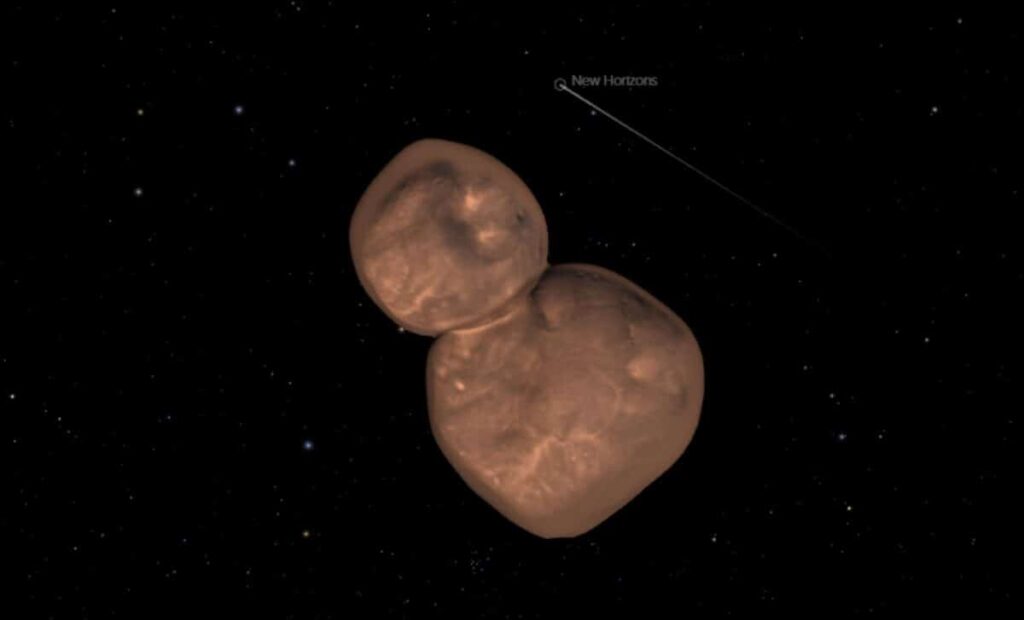
A peculiar peanut-shaped object in the Kuiper Belt, Arrokoth, has intrigued astronomers since NASA’s New Horizons spacecraft visited it in 2019. The latest study offers a new understanding of how this bizarre snowman-shaped rock formed.
Arrokoth is a contact binary, consisting of two distinct lobes that gently merged into one. Scientists have long wondered how this strange shape came to be. Was it a slow and gradual process over billions of years, or was there something more fundamental happening during the formation of the solar system? A new study published in the Monthly Notices of the Royal Astronomical Society suggests that contact binaries like Arrokoth could form directly through the gravitational collapse of small pebbles in the early solar system.
The Curious Shape of Arrokoth: A Cosmic Snowman
Located about a billion miles beyond Pluto, this object measures roughly 20 miles across and features two nearly identical lobes. These lobes share similar volatile ices and have relatively few craters.
The slow merging of these lobes led to the snowman-like appearance, and NASA’s New Horizons mission gave scientists a unique opportunity to study its surface in detail. Jackson Barnes, the lead author of the study and a graduate student at Michigan State University, said that:
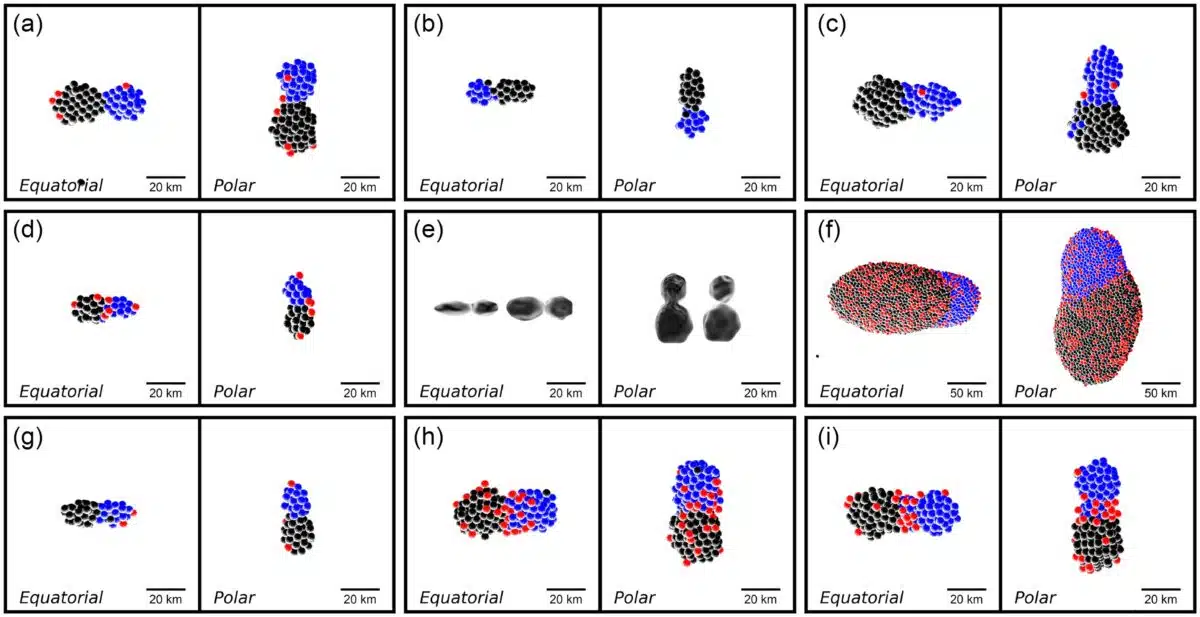 Different configurations of Arrokoth’s structure shown from equatorial and polar perspectives. Credit: Monthly Notices of the Royal Astronomical Society
“When we first saw the results of our simulations, we were very excited.” he added, “It was even more exciting to see that it was not unique, and we had in fact created many of these bilobed objects with different lobe shapes and sizes.”
Arrokoth’s lobes didn’t crash violently but rather drifted together over time at very low speeds,about 20 feet (6 meters) per second. This slow union, according to Barnes, might not be as rare as previously thought. The study shows that such formations could arise naturally during the early stages of the solar system.
Gravitational Collapse in Arrokoth’s Formation
Previous theories suggested that the formation of objects like Arrokoth might require external nudges, such as gravitational interactions or gas drag, to bring the lobes together. However, the new study argues that the process could be much simpler. Arrokoth and other contact binaries might have formed directly from the gravitational collapse of small pebbles in thesolar system’s protoplanetary disk.
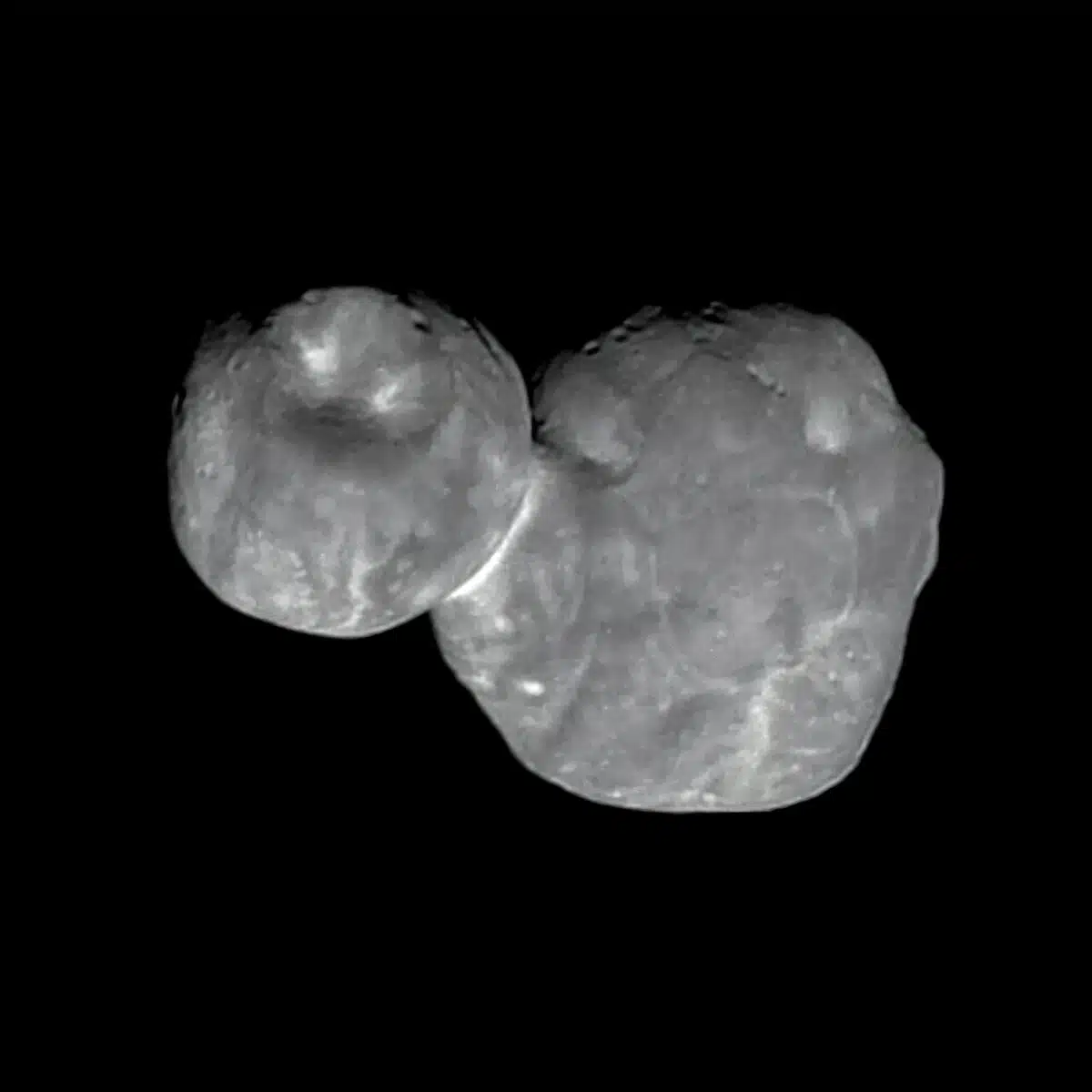 A close-up image of Arrokoth, the peanut-shaped object in the Kuiper Belt, captured by NASA’s New Horizons spacecraft. Credit: NASA
Barnes and his team conducted 54 numerical simulations to test this hypothesis, and their results were striking. Out of 834 resolved bodies in the simulations, 29 developed into contact binaries. Many of these objects had two lobes, similar to Arrokoth, and some even showed similar proportions. The researchers found that these contact binaries could form as natural outcomes of the collapsing clumps of small particles, avoiding the inefficient sticking stages seen in later formation stages.
The Mystery of the Kuiper Belt: How Common Are Contact Binaries?
While some surveys suggest that contact binaries might be more common than previously thought, their true numbers remain unclear. Because objects in the Kuiper Belt are so distant, astronomers usually rely on indirect methods, such as measuring the object’s brightness as it rotates, to infer its shape.
However, this technique has its drawbacks. If the object’srotation axis is tilted, the brightness pattern can give a misleading impression of its shape. Therefore, astronomers still have a long way to go before they can definitively say how many objects like Arrokoth exist in the far reaches of the solar system. What is clear, though, is that the formation of such objects can occur much more easily than expected, giving scientists a new lens through which to view the early stages of our solar system’s development.