
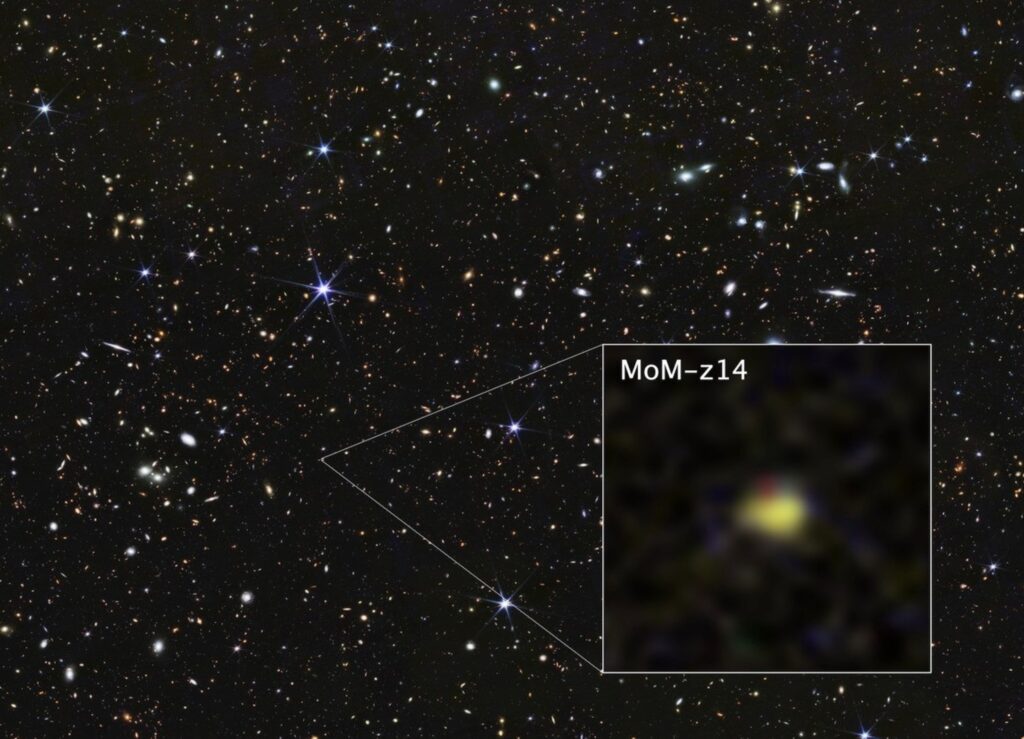
Astronomers have confirmed a bright galaxy called MoM-z14 that already existed just 280 million years after the Big Bang. In cosmic terms, that is infancy.
At that stage, the universe was dark, dense, and very different from what we see today. And this new galaxy is not behaving the way scientists expected.

“With Webb, we are able to see farther than humans ever have before, and it looks nothing like what we predicted, which is both challenging and exciting,” said Rohan Naidu of the MIT Kavli Institute for Astrophysics and Space Research.
Light that traveled 13.5 billion years
MoM-z14’s light has been stretched by the expansion of the universe. As space expands, it pulls light to longer, redder wavelengths. Astronomers call this redshift.
Using Webb’s Near-Infrared Spectrograph, or NIRSpec, the team measured a redshift of 14.44. That means the light we see today has been traveling for about 13.5 billion years.
Distance at this scale is not simple. The universe has been expanding the whole time that light was on its way to us.
When scientists say we are seeing something from 13.5 billion years ago, they are talking about how long the light has traveled – not a fixed mile marker in space.
“We can estimate the distance of galaxies from images, but it’s really important to follow up and confirm with more detailed spectroscopy so that we know exactly what we are seeing, and when,” said Pascal Oesch of the University of Geneva.
A galaxy in the early universe
Before Webb launched, many models predicted that only a small number of bright galaxies would exist this early.
Instead, MoM-z14 is part of a growing group of surprisingly luminous galaxies from the universe’s first few hundred million years.
According to the research team, these objects appear about 100 times more often than theoretical studies predicted before Webb began observing.
“There is a growing chasm between theory and observation related to the early universe, which presents compelling questions to be explored going forward,” said Jacob Shen, a postdoctoral researcher at MIT.
That gap matters. Astronomers build computer models to explain how matter clumped together after the Big Bang, how the first stars formed, and how galaxies assembled.
When real observations do not match those models, it signals that something important is missing from the story.
The nitrogen puzzle
MoM-z14 is not just bright. It also carries a chemical surprise. Webb’s data show strong signs of nitrogen. That may not sound dramatic, but nitrogen is usually produced inside stars and spread into space after those stars live and die.
The problem is timing. At just 280 million years after the big bang, there should not have been enough generations of stars to create such high levels of nitrogen in the usual way.
“We can take a page from archeology and look at these ancient stars in our own galaxy like fossils from the early universe, except in astronomy we are lucky enough to have Webb seeing so far that we also have direct information about galaxies during that time. It turns out we are seeing some of the same features, like this unusual nitrogen enrichment,” said Naidu.
A small fraction of very old stars in the Milky Way also show high nitrogen levels. That connection hints that something unusual happened in the first wave of star formation.
One idea is that the early universe, being denser than today, may have formed supermassive stars. Such stars could have burned hotter and produced more nitrogen than typical stars we see nearby.
Clearing the cosmic fog
MoM-z14 also seems to be carving out space around itself. In the early universe, thick hydrogen gas filled space. This gas absorbed high-energy light, making the cosmos murky.
Over time, the first stars and galaxies produced enough energetic light to clear that fog. Astronomers call this period reionization.
Webb was designed in part to help map when and how that clearing happened. MoM-z14 shows signs that it is already pushing away the surrounding hydrogen. That makes it another key data point for building a timeline of reionization.
Before Webb, scientists did not have the tools to see this era in such detail.
A pattern, not a fluke
Hints that the early universe was more active than expected appeared even before Webb.
NASA’s Hubble Space Telescope spotted a bright galaxy called GN-z11 that existed 400 million years after the Big Bang. Webb later confirmed its distance, making it the most distant known galaxy at the time.
Since then, Webb has kept pushing deeper into the past. It continues to find bright, compact galaxies packed with heavy elements far earlier than many models predicted. The pattern is clear. The first discoveries were not one-time surprises.
Astronomers are now looking ahead to NASA’s Nancy Grace Roman Space Telescope. Roman will combine sharp infrared vision with a very wide view of the sky. That means it could find thousands of these early galaxies instead of just a handful.
“To figure out what is going on in the early universe, we really need more information —more detailed observations with Webb, and more galaxies to see where the common features are, which Roman will be able to provide,” said Yijia Li, a graduate student at Pennsylvania State University.
“It’s an incredibly exciting time, with Webb revealing the early universe like never before and showing us how much there still is to discover.”
MoM-z14 is a single galaxy, but it carries big implications. It tells us that the universe grew up fast. It formed bright systems, complex chemistry, and powerful stars sooner than expected.
Each new observation forces scientists to adjust their understanding of how everything began. And with every new image from Webb, the early universe looks a little less simple and a lot more interesting.
—–
Like what you read? Subscribe to our newsletter for engaging articles, exclusive content, and the latest updates.
Check us out on EarthSnap, a free app brought to you by Eric Ralls and Earth.com.
—–