They have no charge and very little mass.
They are abundant – generated by fusion reactions in the sun, showering down when cosmic rays interact with Earth’s atmosphere and also racing across the cosmos, ejected from the most explosive events.
Neutrinos may seem like esoteric, subatomic minutiae, but they are connected to some of the most fundamental questions about our existence.
They govern how a supernova explodes, they play a role in our understanding of the Big Bang, and they can help answer basic questions about why we are made of matter, not antimatter.
Because of their ghostlike nature, neutrinos streak across great distances unperturbed and can provide a new kind of telescope into the cataclysms that shape the evolution of galaxies.
Until now, IceCube has largely been focused on trying to capture evidence of these extremely high-energy neutrinos.
The upgrade expands its capabilities, allowing scientists to ask even more basic questions about these particles, including how they morph from one flavour of neutrino into another, and providing an opportunity to study the most elusive neutrino of all – the tau neutrino.
![The IceCube Lab in 2025. Photo / Ilya Bodo, IceCube, National Science Foundation]() The IceCube Lab in 2025. Photo / Ilya Bodo, IceCube, National Science Foundation
The IceCube Lab in 2025. Photo / Ilya Bodo, IceCube, National Science Foundation
The newly completed upgrade will give the detector greater sensitivity to probe lower-energy neutrinos, allowing scientists to learn more about what happens as atmospheric neutrinos change from one type to another.
It will also help them to understand more about how light travels within the ice to improve all the data the observatory collects.
“I think it’s really cool – a totally new way to see things,” said Erin O’Sullivan, an associate professor of physics at Uppsala University in Sweden and a spokesperson for the project.
If human eyes saw neutrinos and not visible light, “the sun would be shining all the time, and it would be coming up through the floor and through our eyelids”.
IceCube can’t directly see these enigmatic particles, but its thousands of sensors can detect what happens after they interact with matter.
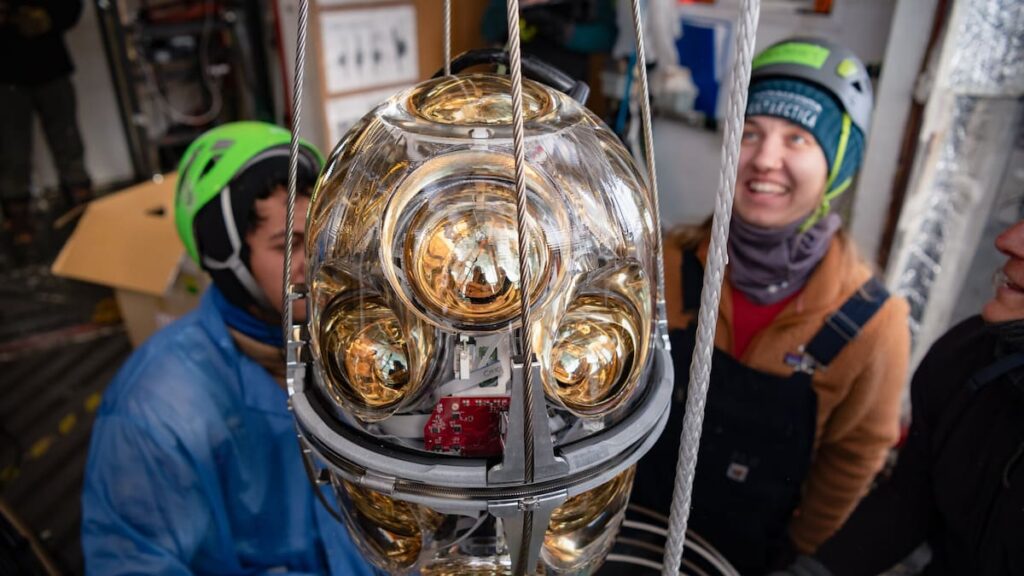
![Nine wavelength-shifting optical modules (WOMs) were installed in the IceCube upgrade. The WOM is a novel photosensor that aims for increased sensitivity to ultraviolet photons using a structure coated with wavelength-shifting paint. Photo / Delia Tosi, IceCube, National Science Foundation]() Nine wavelength-shifting optical modules (WOMs) were installed in the IceCube upgrade. The WOM is a novel photosensor that aims for increased sensitivity to ultraviolet photons using a structure coated with wavelength-shifting paint. Photo / Delia Tosi, IceCube, National Science Foundation
Nine wavelength-shifting optical modules (WOMs) were installed in the IceCube upgrade. The WOM is a novel photosensor that aims for increased sensitivity to ultraviolet photons using a structure coated with wavelength-shifting paint. Photo / Delia Tosi, IceCube, National Science Foundation![A light sensor that detects Cherenkov radiation — the blue glow created when a neutrino interacts with matter — is lowered into a borehole. Photo / Yuya Makino, IceCube, National Science Foundation]() A light sensor that detects Cherenkov radiation — the blue glow created when a neutrino interacts with matter — is lowered into a borehole. Photo / Yuya Makino, IceCube, National Science Foundation
A light sensor that detects Cherenkov radiation — the blue glow created when a neutrino interacts with matter — is lowered into a borehole. Photo / Yuya Makino, IceCube, National Science Foundation
When they do, the neutrinos produce charged particles that travel through the ice at nearly the speed of light, creating a blue glow called Cherenkov radiation.
In 2017, IceCube detected a high-energy neutrino from a blazar, a galaxy with a supermassive black hole at its centre, four billion light-years away off the left shoulder of the constellation Orion.
In 2022, scientists reported that an active galaxy called NGC 1068, in the constellation named after the sea monster Cetus, was spewing high-energy neutrinos our way from the supermassive black hole that powered it.
Most recently, scientists reported that neutrinos were coming from inside our own galaxy, the Milky Way.
In the United States Trump Administration’s budget request, the observatory’s National Science Foundation funding would have been cut in half, as part of a large reduction to the agency’s overall budget.
![Scientists pull a cable across the Antarctic ice. Photo / Colton Hill, IceCube, National Science Foundation]() Scientists pull a cable across the Antarctic ice. Photo / Colton Hill, IceCube, National Science Foundation
Scientists pull a cable across the Antarctic ice. Photo / Colton Hill, IceCube, National Science Foundation
Congress rejected the US President’s budget proposal for the NSF, funding the agency at nearly the same level as last year.
Albrecht Karle, principal investigator of the upgrade, has been making trips to Antarctica since the 1990s.
He works at the University of Wisconsin at Madison in the US, but he left home the day before Thanksgiving for the South Pole.
He arrived at the observatory in December, a week before drilling was to begin.
Most of the anticipation around IceCube is for the data it will collect for years to come, but the update of the observatory – in the planning for seven years – was a tense time for the scientists working on the ice.
“Drilling is never a piece of cake. … This drill is the most powerful hot-water drill on Earth of its kind. You can never leave it alone. It’s minus 30 degrees Celsius, and if water sits more than 45 minutes, it starts freezing,” Karle said.
![The Milky Way appears in the starry night sky over the IceCube Lab. Photo / Ilya Bodo, IceCube, National Science Foundation]() The Milky Way appears in the starry night sky over the IceCube Lab. Photo / Ilya Bodo, IceCube, National Science Foundation
The Milky Way appears in the starry night sky over the IceCube Lab. Photo / Ilya Bodo, IceCube, National Science Foundation
The team worked to melt holes in the ice quickly – but quick is relative. To drill holes 2.5km deep takes about 30 hours, and 18 more hours to return to the surface.
Then, the race begins because almost immediately, the hole starts to shrink as the water refreezes.
“If it takes too much time, the instruments don’t fit in anymore. That’s always a concern,” Karle said.
“So we do careful calculations to predict what we call the lifetime of the hole. If it takes us longer to get the instruments deployed into the hole, then we risk the strings [getting] stuck. That can be nerve-racking.”
The sixth hole was completed on January 20.
“Within the first couple years, we should be making much better measurements,” O’Sullivan said.
“There’s hope to expand the detector, by an order of magnitude in volume, so the important thing there is we’re not just seeing a few neutrino point sources, but we’re starting to be a true telescope … That’s really the dream.”
Sign up to Herald Premium Editor’s Picks, delivered straight to your inbox every Friday. Editor-in-Chief Murray Kirkness picks the week’s best features, interviews and investigations. Sign up for Herald Premium here.