
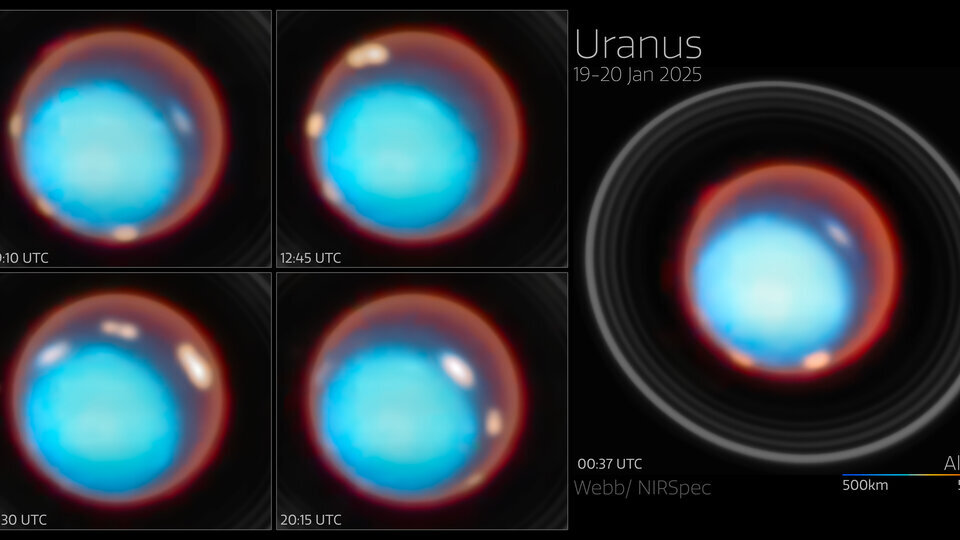
The European Space Agency announced Thursday that a study using the joint NASA/ESA-built James Webb Space Telescope has peered into Uranus’s upper atmosphere. It’s an important first step in revealing the nature of ice giants both here and elsewhere throughout the universe.
The study focused on the planet’s magnetosphere—specifically, the ionosphere, which extends up to 5,000 kilometers above Uranus’ cloud tops. Because the ionosphere is predictably full of ions, it is a charged field that interacts strongly with the planet’s magnetic field.
This allows the ionosphere to serve as a means of investigating the magnetic field, and, through that, the planet’s core and its spectacular auroras.
This study mapped the temperature and ion density across the planet, which should help us understand the atmospheres of our own ice giants and beyond.
Using the Near-Infrared Spectrograph (NIRSpec), the team was able to look at a full rotation of the planet. This helped them build a 3D map that can provide insight way beyond a single, flat image. They’ve compiled it in a rotation animation (above).
Uranus has been known for some time to have spectacular auroral events, particularly those that produce infrared glows.
“Uranus’s magnetosphere is one of the strangest in the solar system… It’s tilted and offset from the planet’s rotation axis, which means its auroras sweep across the surface in complex ways,” Northumbria University’s Paola Tiranti said.
The NIRSpec measurements found that the highest temperatures on the icy world were between 3,000 and 4,000 kilometers above the cloud tops, while the highest ion densities were much lower, at around 1,000 kilometers. If those heights seem very large, remember that Uranus has a diameter about four times that of Earth.
Uranus is still one of the more enigmatic members of our solar system. Voyager 2 laid the foundation for our understanding of Uranus when it completed a flyby more than 40 years ago, but new studies continue to expand on this understanding. Some have even called into question the planet’s status as uniformly cold.
We’ll just have to see what insights scientists can glean from this remarkably detailed new addition to the dataset.