
VODNJAN, Croatia–(BUSINESS WIRE)–Feb 24, 2026–
Global cloud communications platform, Infobip, has partnered with the European Space Agency (ESA) to improve the delivery of asteroid impact alerts via Infobip’s Voice API solutions. Using Infobip’s platform, ESA personnel now receive instant voice calls, enabling faster, 24/7 alerts for potential asteroid impacts.
This press release features multimedia. View the full release here: https://www.businesswire.com/news/home/20260224294384/en/
Understanding the trajectories of asteroids, particularly those approaching Earth, known as near-Earth objects (NEOs), is crucial and time sensitive. As single asteroid impact 65 million years ago wiped out most life on Earth, it is vital for the ESA to identify all hazardous asteroids to better understand their physical characteristics and the potential consequences of an impact.
Previously, ESA personnel were notified via email, often when they were offline and unavailable. By integrating Infobip’s Voice API solutions, ESA’s Meerkat Asteroid Guard, responsible for analysing and tracking NEOs can now send real-time voice call alerts, regardless of the time or location, greatly accelerating the process of alerting personnel with timely and invaluable data about potential asteroid impacts to prevent potential harm to Earth.
Richard Moissl, Head of European Space Agency’s Planetary Defence Office:“This new partnership allows us to respond faster and more effectively to potential imminent asteroid impacts, ensuring we collect critical data to better understand these natural threats. Receiving instant alerts has significantly improved our response times and our ability to study these events.”
Following a successful testing phase, it was found that the voice messaging system works in 100% of applicable cases, with key results revealing the following: rapid alerts, as two high-probability asteroid impact predictions resulted in voice call alerts sent within five minutes of the detection of the probable impacts; and timely data collection, while the event caused no damage due to the impactor being very small, ESA was able to collect valuable scientific data from the events. Importantly, the partntership has significantly improved communication, as Infobip’s solution ensures real-time alerts, allowing faster decision-making during critical asteroid follow-up situations.
Mirza Hadžić, Sales Director Europe at Infobip,said: “Infobip’s platform is built to ensure critical communications reach recipients without delay. By enabling ESA to receive instant voice calls, we’re helping them make faster decisions and gather crucial data for planetary defence. This partnership shows how mobile technology and instant messaging apps can support scientific and planetary protection goals.”
About Infobip
Infobip is a global cloud communications platform that enables businesses to build connected experiences across all stages of the customer journey. Accessed through a single platform, Infobip’s omnichannel engagement, identity, user authentication and contact centre solutions help businesses and partners overcome the complexity of consumer communications to grow business and increase loyalty. It offers natively built technology with the capacity to reach over seven billion mobile devices and ‘things’ in 6 continents connected to 10k+ connections of which 800+ are direct operator connections. Infobip was established in 2006 and is led by its co-founders, CEO Silvio Kutić and Izabel Jelenić.
About the European Space Agency (ESA)
The European Space Agency (ESA) is an intergovernmental organisation dedicated to space exploration and scientific research. Its Planetary Defence Office (PDO) works to protect Earth from potential asteroid and comet impacts through monitoring, research, and technological development.

European Space Agency partners with Infobip for asteroid impact alerts.
KYIV, Ukraine (AP) — More than a dozen senior European officials arrived in the Ukrainian capital on Tuesday in a show of support on the fourth anniversary of Russia’s all-out invasion of Ukraine — a grim anniversary in a war that has killed tens of thousands of people and put European leaders on edge about the scale of Moscow’s ambitions on the continent.
Ukrainian President Volodymyr Zelenskyy said his country has withstood the onslaught by Russia’s bigger and better equipped army, which over the past year of fighting captured just 0.79% of Ukraine’s territory, according to the Institute for the Study of War, a Washington-based think tank.
“Looking back at the beginning of the invasion and reflecting on today, we have every right to say: we have defended our independence, we have not lost our statehood,” Zelenskyy said on social media, adding that Russian President Vladimir Putin has “not achieved his goals.”
“He has not broken Ukrainians; he has not won this war,” Zelenskyy also said.
However, as the corrosive war of attrition enters its fifth year, a U.S.-led diplomatic push to end Europe’s biggest armed conflict since World War II appears no closer to finding compromises that might make a peace deal possible.
Negotiations are stuck on what happens to the Donbas, eastern Ukraine’s industrial heartland which Russian forces mostly occupy but have failed to seize completely, and the terms of a postwar security arrangement that Kyiv is demanding to deter any future Russian invasion.
The number of soldiers killed, injured or missing on both sides could reach 2 million by spring, with Russia sustaining the largest number of troop deaths for any major power in any conflict since World War II, a report last month from the Center for Strategic and International Studies estimated.
European leaders see their countries’ own security at stake in Ukraine amid concerns about Putin’s wider goals and has demanded its leaders be consulted in the ongoing U.S.-brokered talks.
German Chancellor Friedrich Merz wrote on X that “for four years, every day and every night has been a nightmare for the Ukrainians — and not just for them, but for us all. Because war is back in Europe.”
“We will only end it by being strong together, because the fate of Ukraine is our fate,” he added.
The war has drawn in countries far beyond Ukraine, giving the conflict a global dimension, and threatened to worsen shortages, hunger and political instability in developing countries.
While NATO countries have come to Ukraine’s aid, Russia has been helped by North Korea, which has sent troops and artillery shells; Iran, which has provided drone technology; and China, which the United States and analysts say has provided machine tools and chips.
Among the European officials visiting Kyiv on Tuesday were the President of the European Council, Antonio Costa, the President of the European Commission Ursula von der Leyen and Finnish President Alexander Stubb, as well as seven prime ministers and three foreign ministers.
With Ukraine unable to sustain its fight against Russia without foreign help, NATO countries are now providing military help, purchasing American weapons after the Trump administration broke with earlier Washington policy and stopped giving arms to Kyiv.
The European Union has also sent financial aid, but has sometimes met with reluctance from members Hungary and Slovakia.
British Armed Forces Minister Al Carns said Russia’s war on Ukraine was “the most defining conflict” in decades.
“I don’t think anyone of us would be able to guess (when the war started) the scale and size of what has taken place,” he said.
The cost of rebuilding war-battered Ukraine would amount to almost $588 billion over the next decade, according to World Bank, the European Commission, the United Nations and the Ukrainian government.
That is nearly three times the estimated nominal GDP of Ukraine for last year, they said in a report Monday.
Follow AP’s coverage of the war in Ukraine at https://apnews.com/hub/russia-ukraine
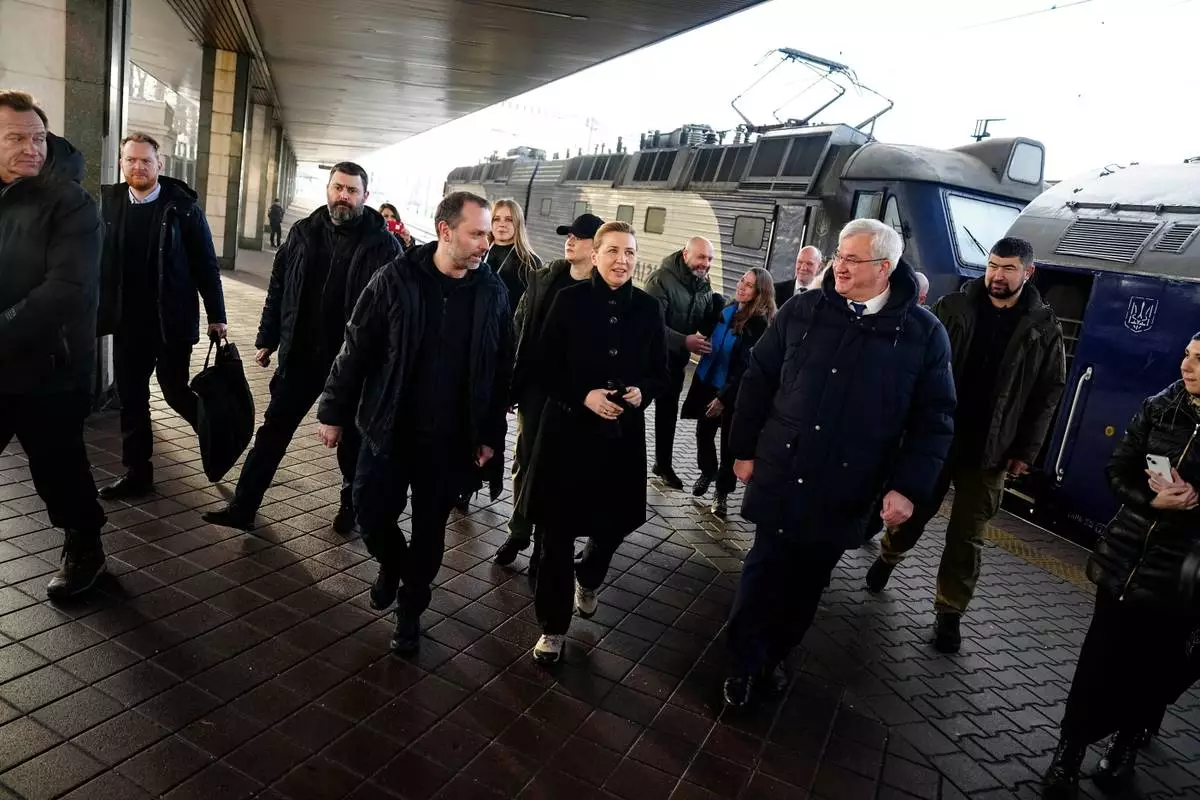
Denmark’s Prime Minister Mette Frederiksen, centre, is welcomed by Ukraine’s Foreign Minister Andrii Sybiha, centre right, as she arrives in Kyiv, Ukraine, Tuesday, Feb. 24, 2026. (Mads Claus Rasmussen/Ritzau Scanpix via AP)
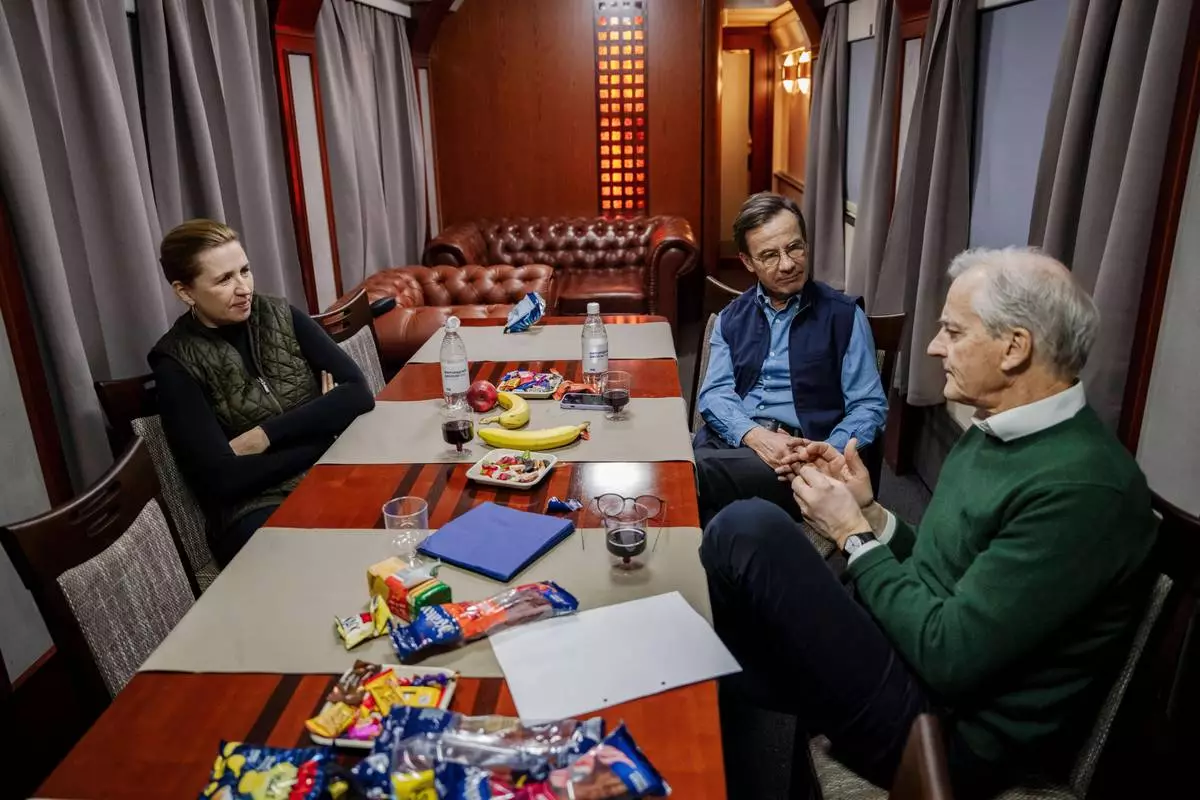
From left: Denmark’s Prime Minister Mette Frederiksen, Sweden’s Prime Minister Ulf Kristersson and Norway’s Prime Minister Jonas Gahr Stoere talk in the train during their journey from Poland’s Medyka to Kyiv, Ukraine, Tuesday, Feb. 24, 2026. (Mads Claus Rasmussen/Ritzau Scanpix via AP)
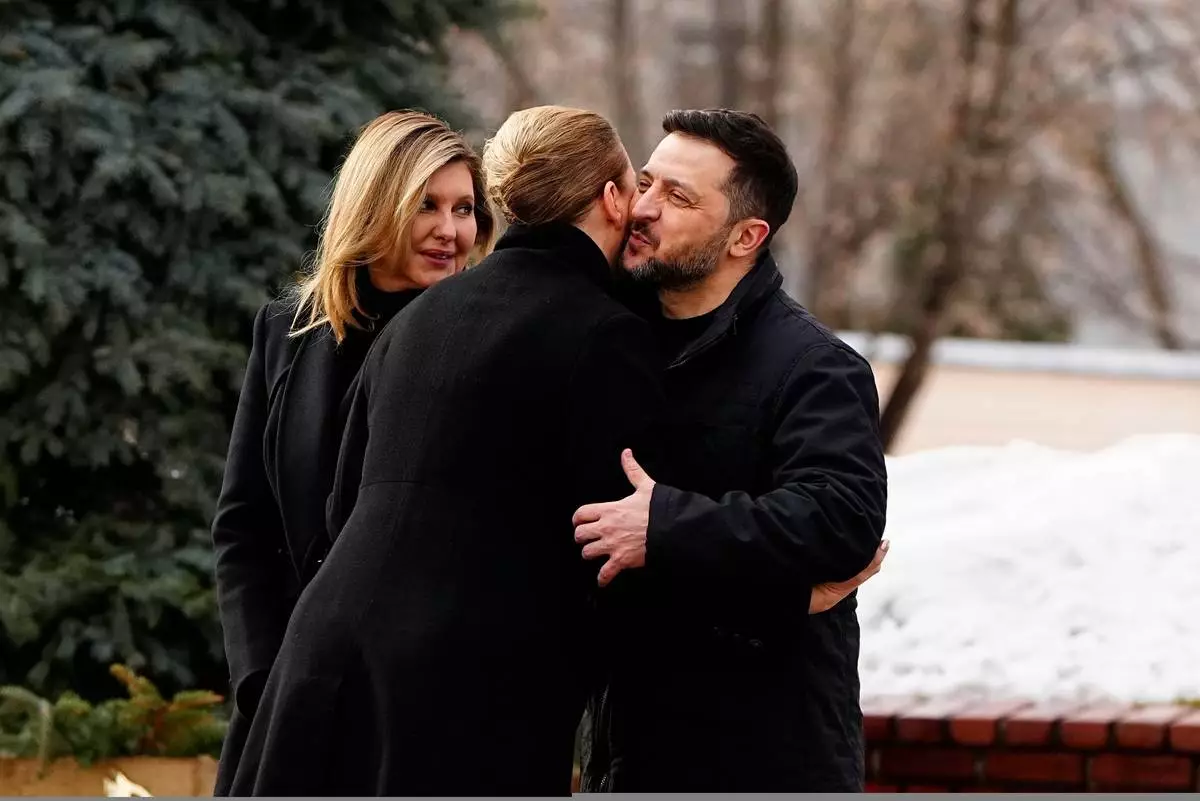
Denmark’s Prime Minister Mette Frederiksen, centre, is welcomed by Ukraine’s President Volodymyr Zelenskyy and his wife Olena Zelenska, left, before a service at St. Sophia Cathedral in Kyiv, Ukraine, on Tuesday, Feb. 24, 2026. (Mads Claus Rasmussen/Ritzau Scanpix via AP)