
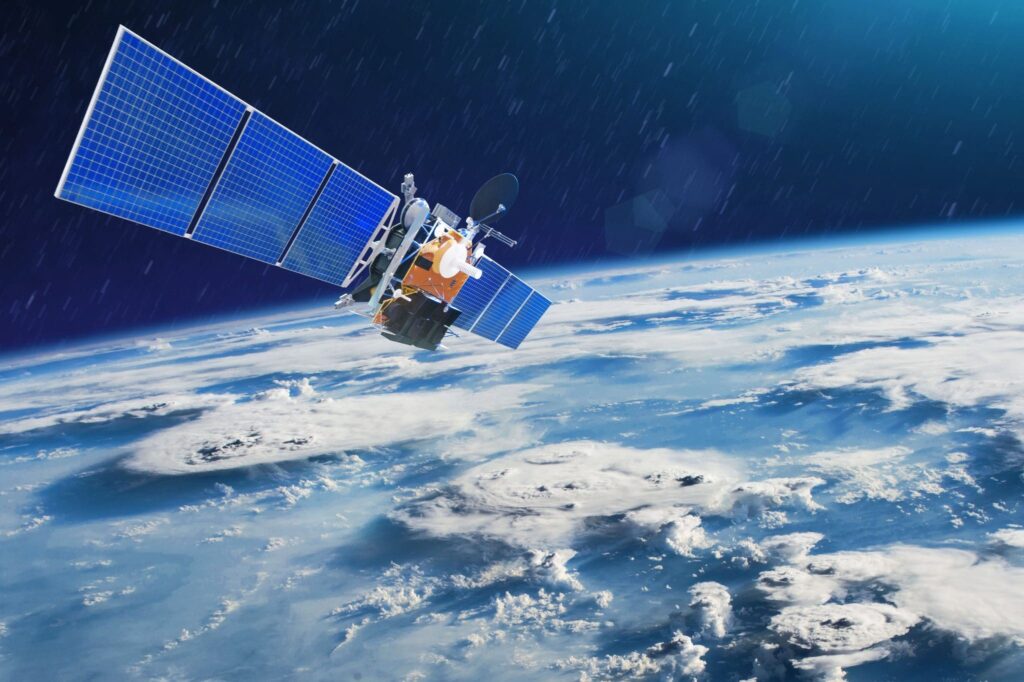
 image: ©aapsky | iStock
A landmark European-Chinese space mission with strong British leadership is on its way to its launch site in South America
SMILE begins launch
The Solar Wind Magnetosphere Ionosphere Link Explorer (SMILE) spacecraft has departed Europe for Kourou in French Guiana, where it is scheduled to launch between 8 April and 7 May 2026.
SMILE left ESA’s technical centre in the Netherlands on 11 February and travelled by road to the Port of Amsterdam. From there, it boarded the cargo ship Colibri for its transatlantic journey.
The vessel previously transported the James Webb Space Telescope in 2021 and is now carrying SMILE and its equipment across the Atlantic, with arrival expected before the end of February.
On its way south, the ship stopped in Saint-Nazaire, France, to collect the upper stage of the Vega-C rocket that will carry SMILE into orbit. Spacecraft and rocket components are now travelling together for the final leg of the journey.
Understanding space weather
Once launched, SMILE will provide the first complete global view of how Earth’s magnetic field responds to the solar wind.
Earth’s magnetosphere acts as a protective shield against this solar activity, but disturbances can trigger geomagnetic storms capable of disrupting satellite navigation, communications systems and even power grids on the ground.
By observing the boundary regions where solar wind interacts with Earth’s magnetic environment, SMILE aims to transform scientists’ understanding of space weather.
The spacecraft carries four scientific instruments, including ultraviolet and soft X-ray imagers, alongside particle and magnetic field detectors. Together, they will allow researchers to track the location, shape and motion of the magnetosphere’s boundaries and monitor how energy from the Sun is transferred into near-Earth space.
SMILE forms part of ESA’s Cosmic Vision programme, which supports space science projects designed to address fundamental questions about the Universe and our place within it.
UK leadership at the core
The UK has played an important role in SMILE’s development. British researchers are leading the soft X-ray imager, one of the mission’s key scientific tools, and co-leading the overall science programme. The instrument will capture global images of the magnetosphere in X-ray wavelengths, providing insights never before achieved.
The UK industry has also made significant contributions. Companies including Teledyne e2v and Photek Ltd have supplied critical hardware for the spacecraft, demonstrating the strength of Britain’s space technology sector.
Final preparation in French Guiana
During its sea voyage, SMILE is being carefully protected. Its container is continuously flushed with nitrogen to eliminate oxygen and moisture, while temperature, pressure and humidity are constantly monitored to ensure optimal conditions.
Once the ship arrives in Kourou, European and Chinese engineers will begin final launch preparations. These include unpacking and testing the spacecraft, fuelling it, and integrating it with the Vega-C rocket ahead of liftoff.