
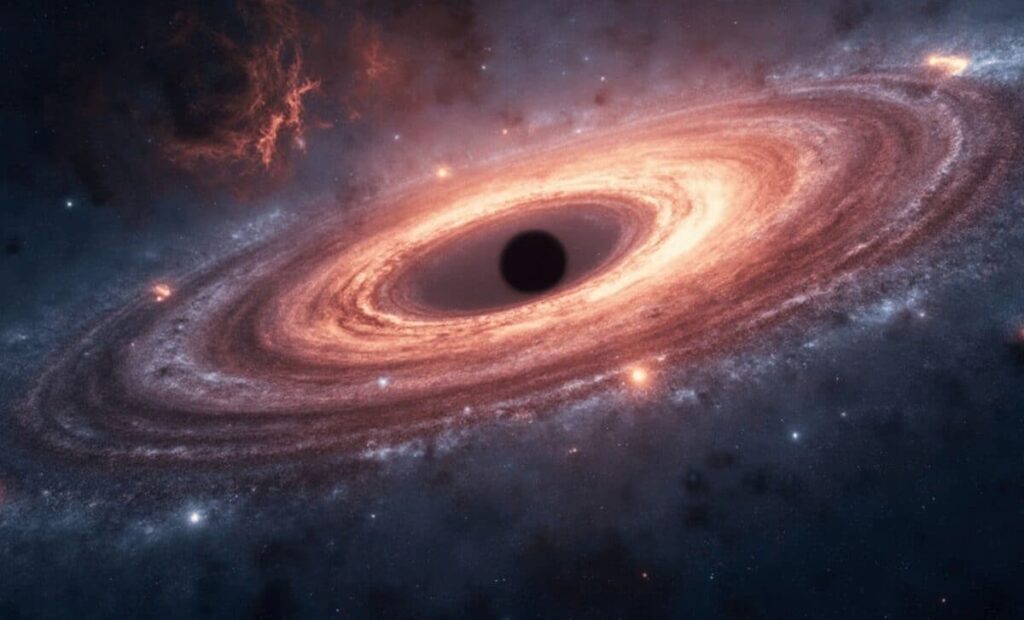
A distant quasar is defying two fundamental expectations of black hole physics. The object, known as ID830, is growing at 13 times its theoretical limit while simultaneously producing intense X-ray emissions and powerful radio jets, a pairing scientists did not expect to observe together.
Roughly 12 billion years ago, when the universe was just 15% of its current age, this already enormous supermassive black hole (SMBH) had reached 440 million times the mass of the Sun. That makes it more than 100 times heavier than Sagittarius A at the center of the Milky Way.
The findings, published Jan. 21 in The Astrophysical Journal, are based on multiwavelength observations designed to understand how such an early black hole could grow so quickly. According to the research team, the explanation may involve an extreme and short-lived phase of runaway feeding that pushes beyond long-standing theoretical limits.
A Black Hole Growing Beyond The Eddington Limit
Black holes feed through a rotating accretion disk of gas and dust. As matter spirals inward, it heats up and emits radiation. That radiation pushes outward, creating a natural cap on growth known as the Eddington limit, a balance between gravity pulling matter inward and radiation pressure pushing it away.
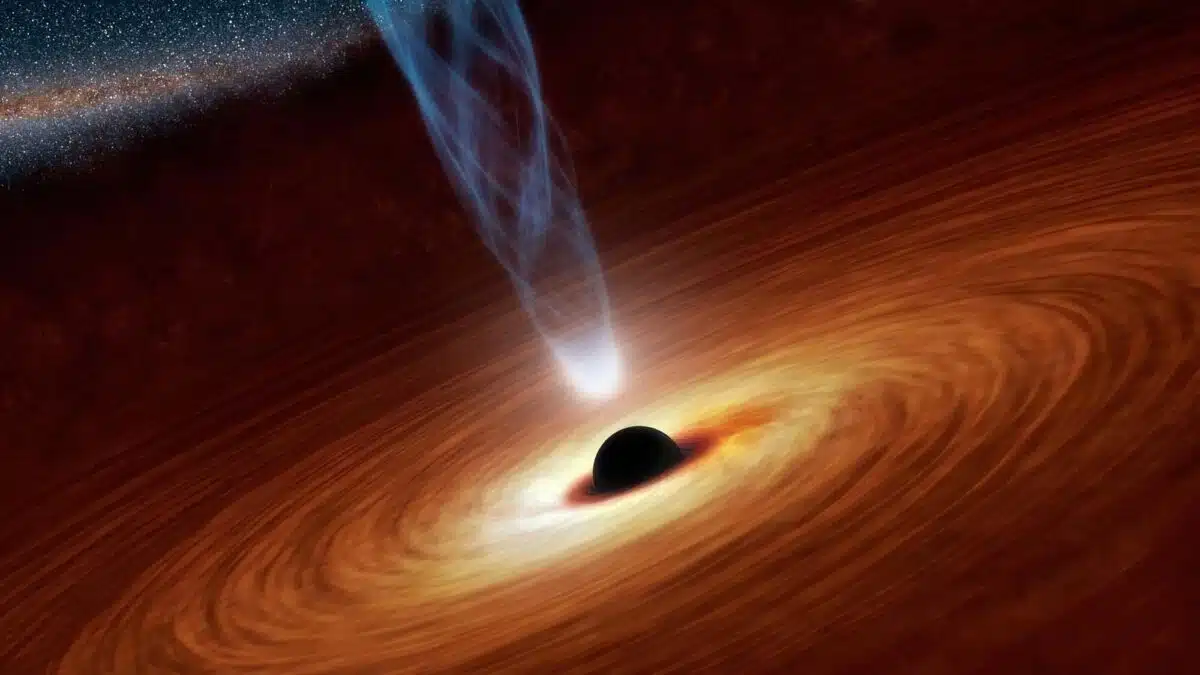 Artist’s view of a supermassive black hole with a bright accretion disk and energetic jets, similar to ID830. Credit: NASA/JPL-Caltech
Yet ID830 appears to be exceeding that cap dramatically. By measuring its brightness in ultraviolet (UV) and X-ray wavelengths, researchers calculated that the black hole is accreting mass at about 13 times the Eddington limit. According to the study, this surge may have been triggered by a sudden influx of gas, possibly after the black hole shredded a massive giant star or engulfed a huge gas cloud. Study co-author Sakiko Obuchi of Waseda University told Live Science that:
“For a SMBH as massive as ID830, this would require not a normal (main-sequence) star, but a more massive giant star or a huge gas cloud.”
She added that this transitional super-Eddington phase is expected to last roughly 300 years, a fleeting interval on cosmic timescales.
X-Rays Linked to Radio Jets
The surprise deepens with the quasar’s emissions. Standard models suggest that when a black hole is accreting at super-Eddington rates, the conditions should suppress the formation of strong radio jets. ID830, though, is producing both intense radio jets and powerful X-rays at the same time. As explained in the researchers’ statement:
“This unexpected combination hints at physical mechanisms not yet fully captured by current models of extreme accretion and jet launching.”
The X-rays are believed to originate from a structure called the corona, a thin, turbulent cloud of billion-degree particles generated by intense magnetic fields above the accretion disk.
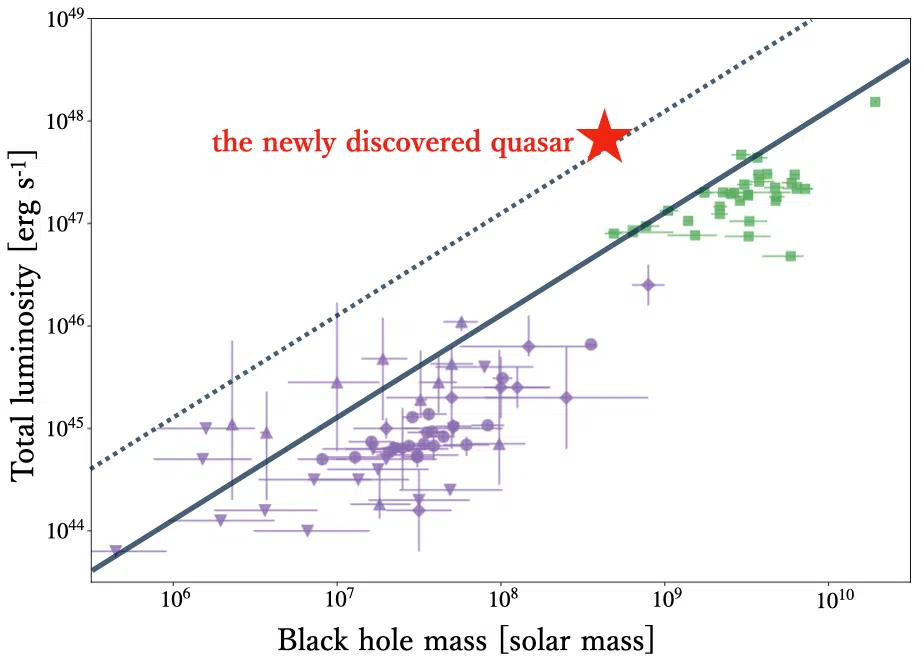 Graph showing the relationship between black hole mass and total luminosity. Credit: NAOJ
NASA has described such coronas as forming one of the most extreme physical environments in the universe, where particles orbit at nearly the speed of light. The coexistence of a bright corona and large-scale jets in ID830 challenges assumptions about how energy is distributed around rapidly feeding black holes.
Early Black Hole Growth Explained
Observations from the James Webb Space Telescope show that massive black holes formed earlier and grew faster than expected. Even if the first ones came from the collapse of massive Population III stars, creating seeds of about 1,000 solar masses, they would still need more than 650 million years of steady growth at the Eddington limit to reach the sizes now observed. Such sustained feeding would require vast amounts of gas, raising questions about how those conditions were maintained. Super-Eddington phases like the one identified in ID830 may help bridge the gap between theory and observation.
This extreme activity also affects the host galaxy. As the black hole accretes matter at high rates, the energy released through radiation and jets can heat and disperse gas in the interstellar medium, suppressing star formation. Early supermassive black holes such as ID830 may therefore have grown rapidly while simultaneously shaping and limiting the evolution of their surrounding galaxies.