
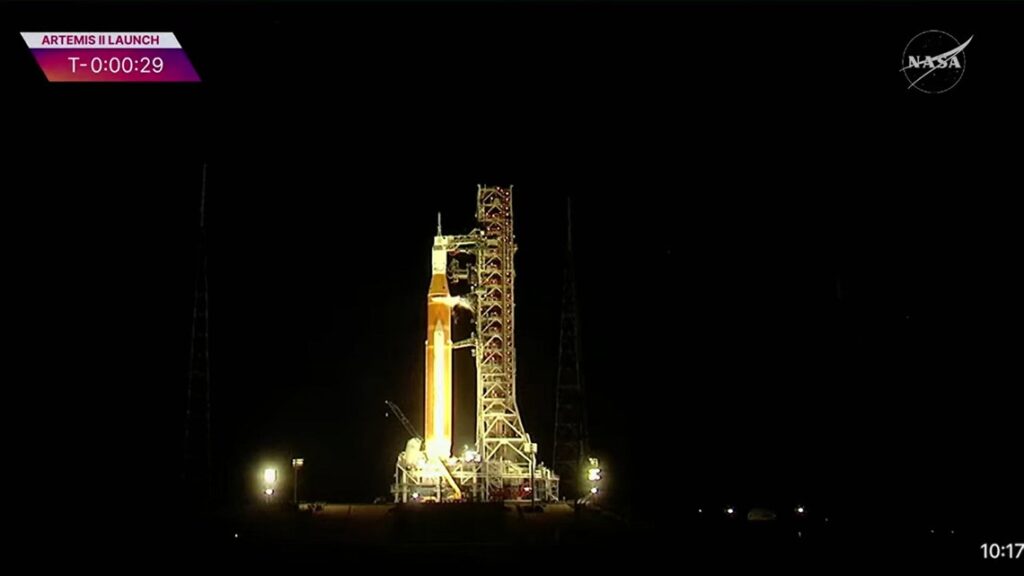
NASA’s Artemis II rocket rollback is postponed due to problematic weather. The helium issue must be resolved by April.
CAPE CANAVERAL, Fla. — NASA has pushed back the planned rollback of its Artemis II rocket to Wednesday, citing dangerous weather conditions that made the operation unsafe to begin Tuesday as originally planned.
Cold temperatures and high winds forecast for Tuesday at Florida’s Space Coast forced the schedule change. The extra day also gives ground teams time to complete launch pad preparations that were hampered Monday by gusty winds in the area.
The roughly 4-mile journey from Launch Complex 39B back to the Vehicle Assembly Building (VAB) at Kennedy Space Center is expected to take up to 12 hours, with the crawler moving at approximately 1 mph. Once the 525-foot stack arrives safely inside the VAB, technicians will immediately begin installing access platforms to reach the area affected by a helium flow issue in the rocket’s upper stage — the problem that triggered the rollback decision in the first place.
The issue was first detected during the overnight hours of Feb. 21, when engineers observed an interrupted flow of helium to the SLS rocket’s interim cryogenic propulsion stage. The upper stage relies on helium to purge its engines and to pressurize the liquid hydrogen and liquid oxygen propellant tanks. NASA Administrator Jared Isaacman confirmed the problem would “almost assuredly” knock out the March 6-11 launch window. The agency is now targeting the April 1–6 window as its next viable opportunity, though that timeline depends on how quickly engineers can diagnose and fix the issue.
The rollback effectively ends any chance of a March launch for Artemis II, which was set to carry Commander Reid Wiseman, Pilot Victor Glover, and Mission Specialist Christina Koch of NASA, along with Canadian Space Agency Mission Specialist Jeremy Hansen, on a 10-day flight around the Moon — the first crewed lunar mission since Apollo 17 in 1972. The crew has since left quarantine and returned to Houston.
Engineers are reviewing several potential causes, including the interface between ground and rocket helium lines, a valve in the upper stage, and a filter between ground and flight systems. A similar helium issue arose during the Artemis I campaign in 2022, also requiring a VAB rollback before it was resolved.
NASA says it plans to hold a media briefing in the coming days to provide further updates.