
The International Space Centre at The University of Western Australia is leading a cross-sector campaign seeking government support for a human spaceflight mission to help anchor Australia to the global space economy.
The campaign includes universities, industry associations, chief scientists, STEM organisations and senior political figures from across the country, reflecting rare cross-sector alignment around the strategic importance of space.
Last month, the group submitted a package of nearly 80 letters of support to the Prime Minister and senior Cabinet members, signalling Australia’s appetite to pursue deeper collaboration with the European Space Agency (ESA) – including the possibility of an Australian astronaut mission.
Professor Danail Obreschkow, Director of the International Space Centre said it was a once-in-a-generation opportunity to build a win–win partnership with the ESA – one that went beyond sending an astronaut to space – to deliver strong economic returns and inspire a new generation to pursue STEM.
“The window for Australia to secure a human spaceflight mission that delivers all of these continuing benefits to our economy is extraordinarily narrow,” Professor Obreschkow said.
The campaign group has indicated that the timing of the decision is critical. ESA member states are progressing mission allocations and contractual agreements over the coming months.
Human spaceflight participation is widely regarded as a catalyst for industry growth, research partnerships and STEM engagement.
Australia is one of the most space-dependent nations in the world, with satellite services underpinning banking, agriculture, logistics, telecommunications, disaster management and national security, and yet still remains in the early stages of developing sovereign space capability.
Professor Obreschkow said the proposal was not about sending one individual into orbit.
“It is about anchoring Australia to the global space economy,” he said. “Nations that participate in human spaceflight sit at the table where future space rules, supply chains and collaborations are shaped.”
A proposed mission could represent a strategic investment designed to generate downstream economic return through international contracts, advanced manufacturing opportunities, research access and expanded market integration with Europe.
“For a relatively modest contribution in federal terms, Australia gains credibility, capability and commercial leverage in a global industry now valued at nearly a trillion dollars,” he said.
“At a time when Australians are focused on cost-of-living pressures, we must also make strategic investments that grow future industries and create high-value jobs. Space capability underpins everyday life, from GPS to secure financial transactions.”
Dr Megan Clark AC, former Head of the Australian Space Agency and Chief Executive of CSIRO, contributed a letter of support to the campaign.
“Imagine Australians across the country counting down and holding their breath for lift off, wishing a fellow Australian a productive journey and safe return to Earth,” Dr Clark said.
“Imagine a generation of school children watching an Aussie performing their experiments in space. Human space flight demands Australians master the hardest things in front of the world.”
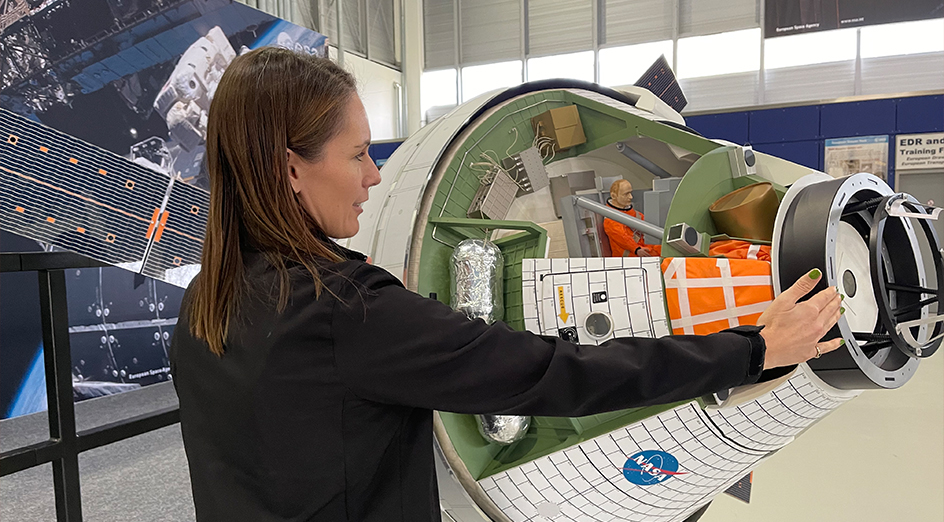
Image above: Katherine Bennell-Pegg at the European Astronaut Centre