
Scientists from Newcastle University in the United Kingdom have built a zero-gravity microscope capable of operating in zero- and microgravity environments, which have proven challenging for conventional microscopes designed for terrestrial use.
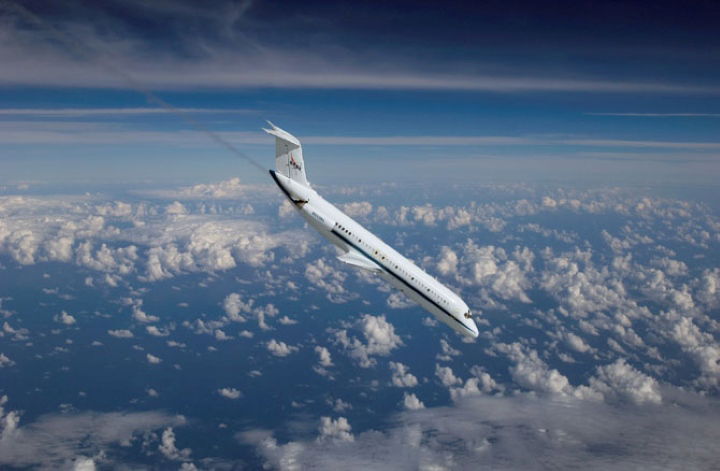
The researchers behind the zero-gravity microscope, dubbed FlightScope, also successfully tested the novel medical device in the intermittent microgravity environment of the European Space Agency’s parabolic flight platform nicknamed the ‘vomit comet’, confirming its performance expectations.
By providing a valuable, low-cost alternative to the specialized microscopes used on the International Space Station, the team behind the new zero-gravity microscope said tools like theirs will be critical for long-term space missions and planned habitats in lower-gravity environments like the Moon and Mars.
A ‘More Democratic’ Zero-Gravity Microscope
According to Newcastle University Assistant Professor and study author Adam Wollman, existing microscopes that function in micro- and zero-gravity environments are highly specialized tools that have limited their use to a handful of scientific endeavors. This motivated his team to develop a tool he described as “more democratic,” which could open microgravity microscopy to private space research and to Earth-based applications without large, government-backed budgets.
For example, previous studies have shown that microgravity environments affect cellular signal processing, such as insulin signaling, which can directly affect an astronaut’s health. However, the Newcastle professor explained, the simple tools needed to study this process outside of the ISS were simply not available.
“We wanted to watch a cell sensing and responding to a signal in zero gravity to see exactly what happens,” Wellman said, adding that the team based their design on an “open-source microscope from Stanford and made it lower cost and more accessible.”
The result of this effort was a zero-gravity tool the team named “FlightScope.”
Vomit Comet Experiments Demonstrate Value of FlightScope
After finishing the design and construction of the FlightScope prototype, it was selected for a test flight on the ESA’ parabolic ‘vomit comet’. Originally used in the early days of the space program, parabolic flights that involve extreme climbs and dives can create up to 20 seconds of weightlessness.
Because vomit comet flights can damage sensitive equipment, the research team reinforced their zero-gravity microscope with ruggedized mountings and vibration dampeners. As an added layer of protection, the team equipped the prototype FlightScope with a fluid handling system capable of rapidly switching between experiments during the aircraft’s shifting climb and dive cycles.
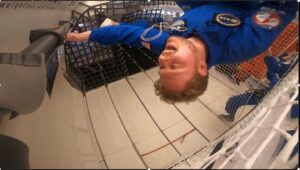 PhD student, Tom Wareing, floating in zero gravity during a parabolic flight on the European Space Agency’s ‘Vomit Comet’ aircraft. Image Credit: Image Courtesy of Adam Wollman.
For the vomit comet tests, the research team designed an experiment to monitor glucose uptake in cells. Instead of human cells, the experiments used a yeast model.
According to the team’s statement, during the flight, their zero-gravity microscope “successfully captured images of cells taking up fluorescently labeled glucose molecules in microgravity.” When examining the FlightScope data, the team also found that the glucose uptake process appeared to proceed more slowly in the zero-gravity portions of the parabolic flight than in normal gravity conditions.
Powering Deep-Space Life Support Systems and Aiding the Search For Life
Although FlightScope was designed to offer scientific value comparable to the specialized tools on the ISS, Wollman said his device’s unique capabilities and low cost make it a potentially valuable tool for a wide range of scientific endeavors. To prove his point, the Newcastle professor used FlightScope in an old British salt mine, Boulby, which is used as a scientific analogue to the environments of the Moon and Mars.
According to the team, this successful demonstration of a terrestrial application zero gravity microscope, which studied salt-tolerant organisms called archaea, “could inform the search for life on other planets.”
When discussing possible applications in space, the research team said that understanding how cells behave in zero gravity is critical for maintaining astronaut health. However, the team noted that such a tool is critical for studying the microorganisms that could power life support systems on long-duration, deep-space missions, “producing food, medicine, and other essential compounds.”
When discussing the team’s next steps, Wollman said they are seeking cheaper, more accessible ways to continue performing zero-gravity experiments beyond the vomit comet. That includes adapting the FlightScope for upcoming experiments aboard a ‘sounding rocket’.
“These are small rockets that fly up about 80 kilometers, then fall back to Earth, giving us about two minutes of microgravity,” Wollman said, before adding that the bigger goal is to use the FlightScope technology in zero gravity “for extended periods.”
The research was published in npj Microgravity. It will also be presented at the 70th Biophysical Society Annual Meeting in San Francisco from February 21–25, 2026.
Christopher Plain is a Science Fiction and Fantasy novelist and Head Science Writer at The Debrief. Follow and connect with him on X, learn about his books at plainfiction.com, or email him directly at christopher@thedebrief.org.