

The potential for exploring interstellar objects has captivated scientists for years, with a new mission plan aimed at intercepting the famous comet 3I/ATLAS. This risky but groundbreaking approach, proposed by space researchers, involves using an advanced technique called the Oberth effect. The mission could see a spacecraft travel a distance of over 700 astronomical units from the Sun, using a series of gravity-assist maneuvers, including a close flyby of the Sun itself.
The Oberth Effect: Powering Spacecraft Toward the Unknown
The Oberth effect, a concept developed by rocket scientist Hermann Oberth, is a key part of the strategy for this interstellar mission. The principle involves utilizing the gravitational field of a massive object, like the Sun, to propel a spacecraft to greater speeds. As the spacecraft approaches the Sun, it falls deeper into its gravitational pull, gaining velocity. At the point of closest approach, known as periapsis, the spacecraft would perform a powerful rocket burn to maximize its speed.
“Pretty much every launch uses the Oberth effect,” said T. Marshall Eubanks, a former NASA scientist and one of the authors of the mission paper. “It’s why, for example, missions such as Artemis 2 do their translunar injection burns at perigee, not apogee. That’s an Oberth maneuver. However, I cannot find a record of a straight-out Oberth maneuver of the type we propose, which is a major rocket burn at closest approach in a flyby.”
The mission, however, requires navigating extreme conditions. To achieve the necessary velocity for such an ambitious journey, the spacecraft would need to perform a solar Oberth maneuver at a distance of just 0.015 AU from the Sun, far closer than any spacecraft has ventured before. This would place it deep inside the Sun’s corona, where the temperatures could soar to over 2,500°F (1,370°C), similar to those experienced by NASA’s Parker Solar Probe. The spacecraft’s heat shield would need to be specially designed, likely utilizing advanced materials like carbon-composite and aerogel, similar to the technology used on the Parker probe.
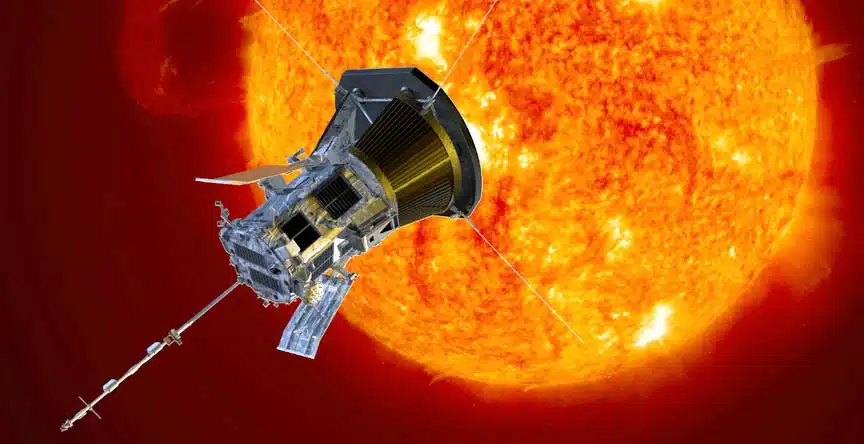 NASA’s Parker Solar Probe.
Credit: NASA
Achieving Speed and Precision: The Critical Role of Gravity Assists
One of the most critical aspects of this mission is the spacecraft’s ability to adjust its trajectory using gravity assists. Initially, the spacecraft would need to travel to Jupiter, where its gravity would be used to slow it down. While this sounds counterintuitive, it’s necessary because a spacecraft leaving Earth would be moving too fast to reach the Sun for a close flyby. By reducing speed with the help of Jupiter’s gravity, the spacecraft would be positioned to fall into a solar orbit at the correct speed.
Eubanks explained, “Pretty much every launch uses the Oberth effect,” underscoring how widely used this technique is in space missions. However, this mission proposes a bold application: a major rocket burn at closest approach in a flyby, which would allow the spacecraft to intercept 3I/ATLAS, a comet currently racing away from the Sun at more than 38 miles per second. Without this high-velocity boost, a mission to catch such a fast-moving object would be nearly impossible.
Once the spacecraft has completed its gravity assists and performed the solar Oberth maneuver, it would embark on a journey that could take decades to reach the comet. With the spacecraft traveling at unprecedented speeds, the mission could potentially make a flyby of 3I/ATLAS by 2085, which would be an extraordinary scientific achievement. The research supporting this endeavor is available on arXiv, shedding light on the technical aspects and ambitious goals of this proposed mission.
 Observations of Comet 3I/ATLAS taken using the Gemini South Observatory. (Image credit: International Gemini Observatory/NOIRLab/NSF/AURA/Shadow the ScientistImage Processing: J. Miller & M. Rodriguez (International Gemini Observatory/NSF NOIRLab), T.A. Rector (University of Alaska Anchorage/NSF NOIRLab), M. Zamani (NSF NOIRLab))
The Timeline and Challenges of the 3I/ATLAS Mission
The journey to 3I/ATLAS is a marathon, not a sprint. The spacecraft’s arrival at the comet would be decades in the making. Scientists have calculated that with a delta-V (change in velocity) of 5.1 miles per second, the spacecraft could reach the comet in 50 years. However, if the spacecraft gains even more velocity through the Oberth maneuver, it might shorten the journey to just 30 years.
Despite these technical achievements, many challenges lie ahead. As Eubanks pointed out,
“We’ll just have to see… maybe after 10 interstellar objects have been found, 3I will seem commonplace and it won’t seem worthwhile to mount an expedition to chase it.”
The nature of interstellar exploration means that what seems like a groundbreaking mission today could be considered routine in the future. The rapid pace of technological advancements could make future missions to interstellar objects easier and more efficient.
The Risks of the Solar Oberth Maneuver: Is It the Right Approach?
One significant drawback of this mission design is the risk involved in using the solar Oberth maneuver. The technique, while effective, is designed to intercept an object that is already moving away from the Sun. This means the spacecraft would be chasing the object long after it passed through the solar system’s most accessible regions.
“For future interstellar objects, a solar Oberth maneuver should be avoided if possible,” said Adam Hibberd, a leading researcher in the field. “It is designed to catch a specific interstellar object ‘after the bird has flown’ and it is heading away from the sun… there are better mission architectures, using a probe already in orbit in space, which would intercept an interstellar object around perihelion in much less time, rendering an Oberth unnecessary.”
Despite this, there is a strong belief that missions to explore interstellar objects will be highly desirable in the future. Eubanks remains optimistic, stating,
“I feel quite confident that when we develop the ability to reach these interstellar objects, there will be a strong desire to directly explore at least some of them.”
As the search for interstellar objects intensifies, missions like this one could serve as a stepping stone to even more advanced space exploration techniques.