

A prominent particle physicist believes the next layer of reality may already be within reach. Instead of waiting decades for a more powerful collider, he argues that ultra-rare particle decays could expose what lies in the so-called “zeptouniverse.”
Since confirming the Higgs boson in 2012, the Large Hadron Collider (LHC) has remained the world’s most advanced machine for probing the subatomic world. Many physicists expected that discovery to trigger a cascade of new particles capable of explaining dark matter or the imbalance between matter and antimatter. That wave of revelations never truly arrived.
Now, particle physicist Harry Cliff of the LHCb experiment points to a possible reason: the physics researchers are searching for may exist at scales the LHC cannot directly probe.
A Frontier Smaller Than the Lhc Can See
The LHC can thoroughly explore distances down to the attometer scale, one quintillionth of a meter. In practical terms, it can directly analyze particles down to about 50 zeptometers. The “zeptouniverse,” by contrast, refers to phenomena unfolding at roughly 10⁻²¹ meters.
According to Popular Mechanics, theoretical physicist Andrzej Buras of the Technical University of Munich argues that new particles could simply lie beyond the LHC’s detection limits. If so, direct discovery at current energies may not be possible.
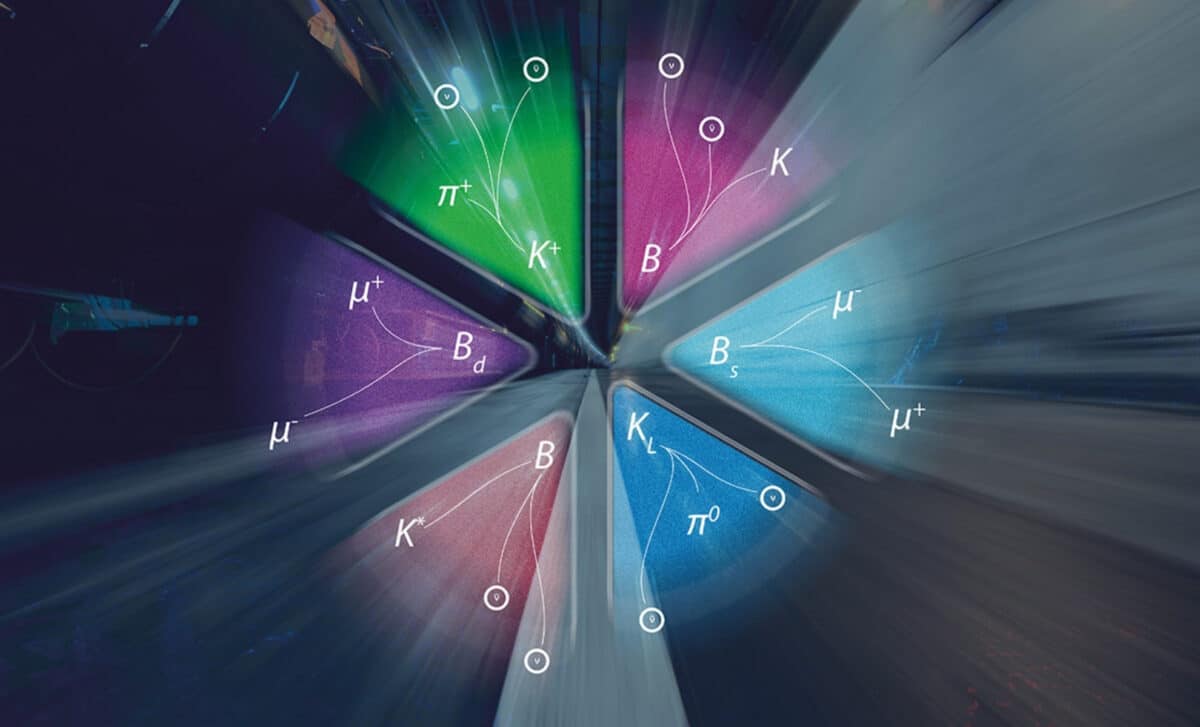 Six ultra-rare decays stand out for their potential to reveal ne physics this decade – CERN Courier
CERN completed a feasibility study in 2025 for the proposed Future Circular Collider (FCC), which would push particle collisions to far higher energies. Yet the FCC is not expected to conduct high-energy physics experiments until 2070. That timeline has prompted Buras to ask whether physicists can reach the zeptouniverse sooner, without building a new collider.
In a 2020 article for Physik Journal, Buras framed the question plainly: “Can we reach the Zeptouniverse, i.e., a resolution as high as 10–21m or energies as large as 200 TeV, by means of quark flavour physics and lepton flavour violating processes in this decade well before this will be possible by means of any collider built in this century?”
The “Magnificent Seven” and Their Rare Signals
Rather than relying on higher collision energies, Buras proposes studying extremely rare particle decays that might carry indirect traces of new physics. In a 2024 paper uploaded to the preprint server arXiv, he identified seven such processes, referring to them as the “magnificent seven,” according to New Scientist.
All seven involve rare decays of particles containing strange and bottom quarks. Harry Cliff describes them as “echoes from the zeptouniverse”, subtle signals that could reveal physics beyond the Standard Model.
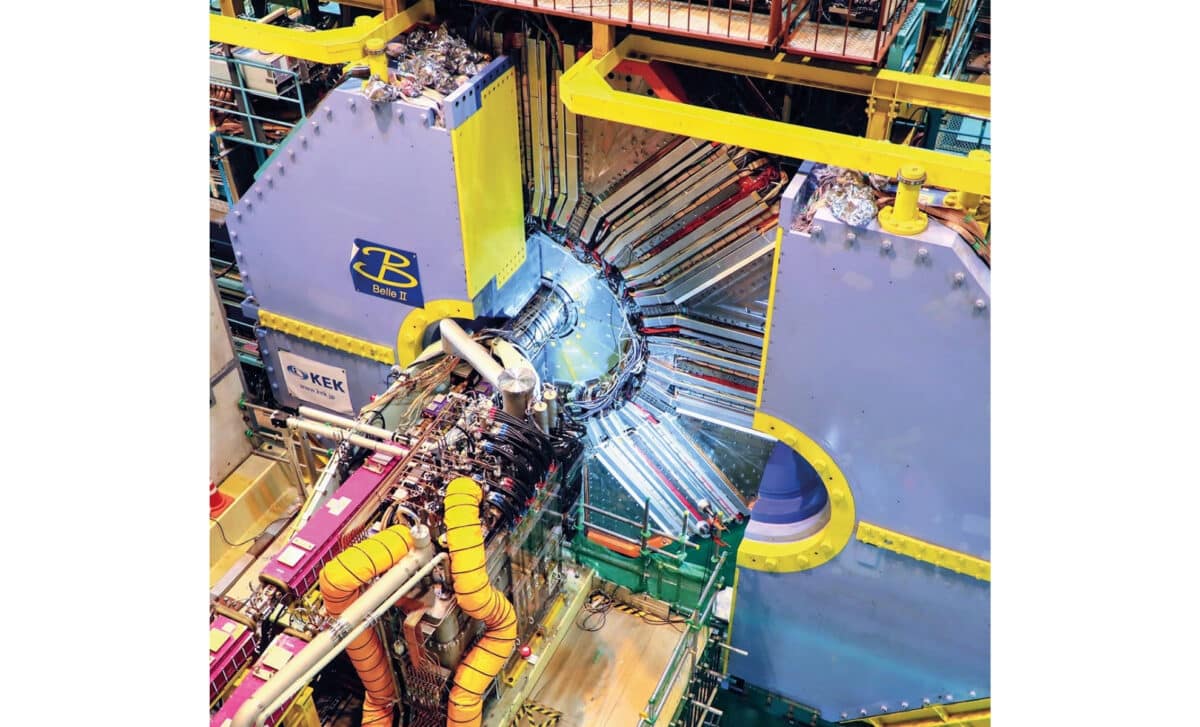 Belle II experiment at KEK – © CERN Courier
One example begins with a B meson, a composite particle made of different quarks. In 2023, Japan’s Belle II experiment observed a decay in which a B meson transformed into a kaon, or K meson, along with two neutrinos. The experiment was not configured to directly detect neutrinos, limiting the available information about them.
Another ultra-rare event was recorded in September 2024 by CERN’s NA62 experiment. It observed a positively charged kaon decaying into a pion and a matter–antimatter pair. Fewer than one in 10 billion kaons is expected to decay in this way. Because this process is sensitive to deviations from the Standard Model, it has become one of the prime targets in the search for new physics. The KOTO experiment in Japan is currently seeking a second confirmation of this kaon decay.
Why Indirect Searches Matter Now
The scientific motivation behind these efforts is clear. In the trade magazine CERN Courier, Buras wrote that the search for new particles and forces is driven by the need to explain dark matter, the enormous range of particle masses, from the tiny neutrino to the massive top quark, and the asymmetry between matter and antimatter that makes our existence possible.
He also noted that direct searches at the LHC have not yet provided clues about what those new particles or forces might be. As a result, indirect searches are gaining importance.
For now, these rare decays are the only available windows into the zeptouniverse. Until a next-generation collider begins operating, physicists are left examining faint, infrequent signals, hoping that within them lies the next major breakthrough in our understanding of the universe.