
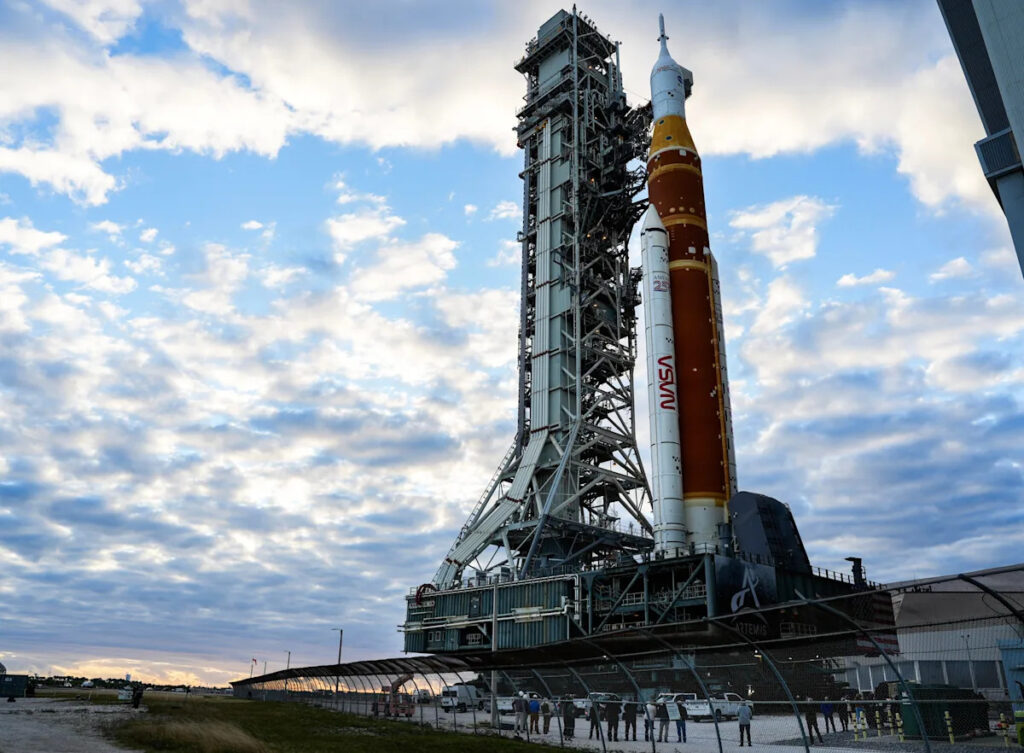
NASA’s historic Artemis 2 moon mission is in trouble yet again.
A successful prelaunch fueling test for the rocket due to propel four astronauts on their way gave the space agency cause to celebrate. But a day after the test ended, those spirits were dampened when ground teams discovered that not all was well with the towering Space Launch System rocket.
This time, it wasn’t a liquid helium leak that ailed the rocket, but not enough flow of helium at all to the spacecraft’s upper stage. The discovery of the issue marks the latest setback for NASA’s reinvigorated lunar program, which aims to return Americans to the moon’s surface for the first time since the Apollo era.
Artemis 2 – the first human spaceflight under NASA’s multibillion-dollar program – appeared on track for a March liftoff after the mission last slipped from February following the first preflight fueling test. Under the mission, three Americans and one Canadian are due to fly around the moon ahead of a future moon landing.
“This will almost assuredly impact the March launch window,” NASA Administrator Jared Isaacman said in a Feb. 21 post on social media site X.
2025 spaceflight in photos. See images of Blue Origin, SpaceX missions
1 of 13
Firefly’s Blue Ghost lunar lander captures its shadow on the moon’s surface after completing a successful landing March 2 near a volcanic feature on the moon called Mons Latreille. The vehicle became the first of two landers manufactured by a U.S. company to reach the moon is 2025 in crucial missions to lay the groundwork for NASA to return humans to the lunar surface in the years ahead.
If it’s been difficult to keep track of all the latest updates, delays and potential launch windows for Artemis 2, here’s everything to know.
When is the Artemis 2 rocket launch date?
Originally slated for liftoff in February, NASA officials initially delayed the Artemis 2 moon launch from the Kennedy Space Center near Cape Canaveral, Florida, by about a month. The Artemis 2 mission slipped to no earlier than March 6 after NASA’s first elaborate launch day rehearsal ended with the discovery of a hydrogen leak within the 322-foot Space Launch System (SLS) rocket’s core stage.
Now, though, NASA simply hopes to preserve launch opportunities in April since it’s apparent engineers have more work to do on the SLS.
“I understand people are disappointed by this development,” Isaacman said in a follow-up online post with more information. “That disappointment is felt most by the team at NASA, who have been working tirelessly to prepare for this great endeavor.”
Helium flow issue marks latest issue for Artemis 2 moon rocket
Ground teams at NASA observed “interrupted flow of helium” Saturday, Feb. 21, to the rocket’s interim cryogenic propulsion stage.
Helium flow is required for launch, as the upper stage uses it to maintain “proper environmental conditions” for the engine and to pressurize propellant tanks. While the system worked during the most recent fueling test, known as a wet dress rehearsal, “teams were not able to properly flow helium during normal operations and reconfigurations,” NASA said in a blog post.
NASA conducted successful 2nd fueling test
The discovery came on the heels of an otherwise successful wet dress rehearsal in which the SLS was fueled with and later drained of 700,000 gallons of liquid oxygen and liquid hydrogen.
The test, meant to simulate launch day operations, ended Friday, Feb. 20, on a high note after NASA teams didn’t encounter the hydrogen leaks that plagued the first such demonstration earlier in the month.
Will the Space Launch System rocket need to be rolled from launch pad?
The Space Launch System will soon be departing the launch pad, where it’s been vertical since mid-January, as NASA is planning to roll the giant rocket back to the agency’s Vehicle Assembly Building where spacecraft are prepared for launch.
The rollback could happen as soon as Tuesday, Feb. 24, NASA said. An exact time to conduct the 4-mile, daylong trek has not been announced.
While a number of factors could be causing the problem with the rocket, “accessing and remediating any of these issues can only be performed in the VAB,” Isaacman said.
When will NASA say more about what’s next for Artemis 2?
NASA officials have indicated plans to host a new conference “in the coming days” to discuss the status of Artemis 2, though a date has not been announced.
“Please expect a more extensive briefing later this week as we outline the path forward, not just for Artemis II, but for subsequent missions, to ensure NASA meets the President’s vision to return to the Moon and, this time, to stay,” Isaacman concluded in his online statement.
Who will be on the Artemis 2 mission? Astronauts exit quarantine againNASA’s Artemis 2 mission to fly 4 astronauts around moon. Photos of crew
1 of 11
NASA Administrator Jared Isaacman stands with the Artemis II crew during an SLS rollout press briefing.
The crew of Artemis 2 includes NASA astronauts Reid Wiseman, Victor Glover and Christina Koch, as well as the Canadian Space Agency’s Jeremy Hansen.
Following the successful prelaunch fueling test, the astronauts had re-entered quarantine Friday, Feb. 20, at the Johnson Space Center in Houston to avoid exposure to any illnesses, NASA said. But amid the latest setback, the crew members once again exited quarantine and will remain in Houston until a new target launch date is about two weeks away.
What are NASA’s Artemis missions?
NASA’s Artemis program is the agency’s ambitious campaign to return Americans to the surface of the moon for the first time since the Apollo era came to an end in 1972. Ultimately, Artemis reflects NASA’s moon-to-Mars approach to getting the first humans to the Red Planet.
In the years ahead, NASA’s Artemis campaign aims to launch a series of crewed missions to establish a continuous human presence on the moon with a lunar settlement on the south pole. That’s where water ice thought to be abundant in the region could be extracted and used for drinking, breathing and as a source of hydrogen and oxygen for rocket fuel.
Artemis 2 not landing on the moon, but circling it
The Artemis 2 astronauts won’t be landing, but will instead circle the moon on a 10-day trip to test systems and hardware for future expeditions to the surface. The Orion capsule the crew will pilot – built by Lockheed Martin – is due to travel about 4,700 miles beyond the far side of the moon, taking its passengers the farthest humans have ever ventured in space before returning to Earth.
While NASA tested its spacecraft during the Artemis 1 mission in 2022, Artemis 2 will be the first time that the giant, 322-foot-tall SLS rocket and the Orion capsule will fly with humans aboard.
When would a moon landing happen? What to know about Artemis 3
A moon landing would take place during Artemis 3, which President Donald Trump has signaled he wants to see happen before the end of his second term. The astronauts for that mission have not yet been selected.
Eric Lagatta is the Space Connect reporter for the USA TODAY Network. Reach him at elagatta@usatodayco.com
This article originally appeared on USA TODAY: NASA Artemis mission in trouble again. What to know about latest delay