

Following the successful launch of Ariane 6 in 2025, Europe’s access to space ambitions gain momentum. The launch of the reusable launcher first stage demonstrator Themis T1H under the SALTO project represents a decisive step towards sustainable and autonomous access to space. Other EU-backed initiatives – including the ENLIGHTEN project and an upcoming €20 million call for game-changing technologies – aim to further accelerate Europe’s progress in access to space.
EU-backed space research activities advance Europe’s access to space
The recent flight of Europe’s Ariane 6 flagship launcher, in its most powerful 4-booster configuration, marked the renewal of European autonomous access to space, and its capacity to deliver high-performance service for both institutional and commercial customers. Ariane 6 together with Vega C, with an important launch schedule manifest in 2026, provides Europe’s launcher family with a complementary capability covering heavy and medium lift missions.
Over the past decades, the European Commission significantly increased investment in space research and innovation. Under Horizon Europe, the EU Space Research and Innovation (R&I) Programme specifically tackles access to space to strengthen critical technologies developments and support ground facilities with the objectives to enhance competitiveness and reinforce the European access to space. The space research projects are directly managed by the Space Research Unit of the European Commission’s Executive Agency HaDEA and have been delivering tangible results.
Access to space is a strategic capability for the EU to enable it to deploy fully independently its missions and constellations such as Galileo, Copernicus and Iris2. The EU supports non-dependence and strategic autonomy in this field and €120 million have been invested for access to space research activities so far in the Horizon Europe framework programme.
Europe’s first reusable launcher flight campaign
Having its own reusable launcher is a cornerstone of Europe’s ambition to enhance its autonomous and sustainable access to space capability by increasing maximum achievable launch rate. Europe is committed to mastering launcher reusability, both through ESA’s and European Commission’s efforts.
The SALTO project is a large endeavour and it brings together 26 important EU industry players working on reusable launchers technologies and operations. It builds on the first phase of the European Space Agency’s (ESA) endeavour to develop a reusable rocket, using the launcher first stage prototype “Themis T1H” manufactured under the ESA’s Future Launchers Preparatory Programme (FLPP) with ArianeGroup as prime contractor.
The Themis T1H prototype included the development of a flight test demonstrator for low-cost rocket recovery and reuse technologies, at a scale representative of a medium-sized launcher. It notably embarks the high-power, variable-thrust, reusable engine Prometheus®, also developed by ArianeGroup.
The SALTO project’s main activity is the T1H flight test campaign, targeting three low-altitude flights (vertical take-off and landing), with the goal of demonstrating the vehicle’s ability to lift off, land, be recovered, refurbished and prepared for the next flight. The Themis development and the SALTO flight test campaign also represent a shift in the European space R&D mindset, embracing greater risk-taking through a “test and learn” approach. This involves building prototypes, conducting test flights with calculated risks, and learning from each step of the process. Real-life testing will show critical issues that are difficult to simulate. This approach aims at accelerating innovation, substantially reducing costs and achieving a constantly improving system.
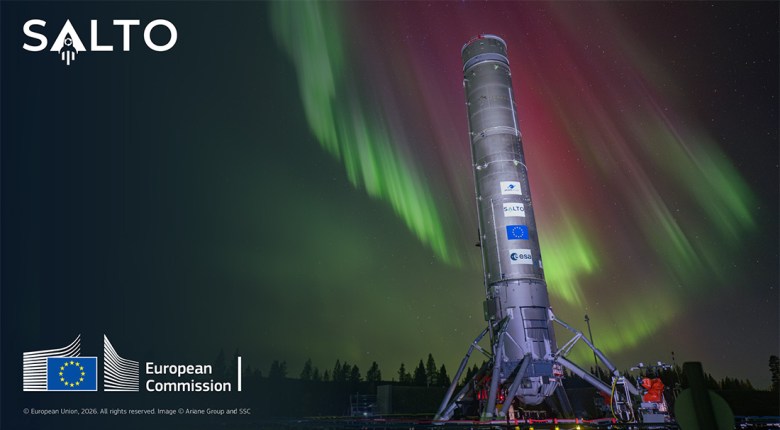
Themis T1H will be operated from the Swedish Space Corporation’s ESRANGE Space Centre in northern Sweden, and the first low-altitude “hop” – a vertical takeoff and landing manoeuvre – is planned for 2026.
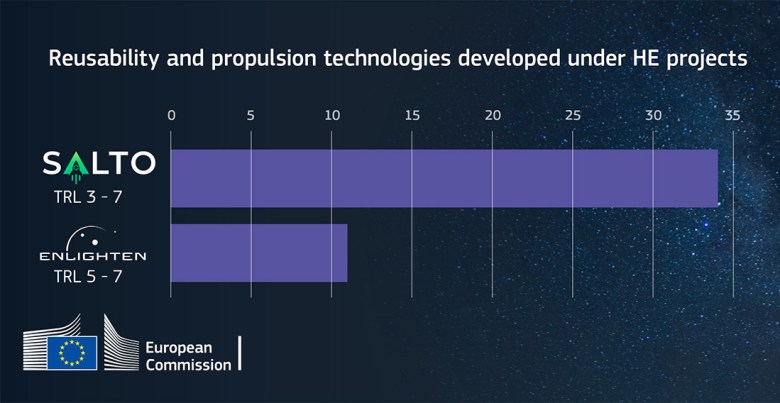
SALTO enables the maturation of 34 key technologies for reusability, some of which will be directly tested on the T1H demonstrator flight while others are targeting future launchers. These technologies span the full spectrum of reusable launch subsystems, including aerodynamics and aerothermodynamics, lightweight and high-performance structures, advanced landing systems, and thermal protection solutions. The project is also advancing system monitoring and safety capabilities, such as autonomous flight termination systems, alongside avionics and integrated guidance, navigation and control technologies.
Next generation propulsion technologies for European launchers
The European Commission is also enabling advances into new propulsion technologies. With the ENLIGHTEN and ENLIGHTEN-ED projects (European iNitiative for Low cost, Innovative & Green High Thrust ENgine – Engine Demonstration) the European industry is moving beyond early-stage research to the concrete development and maturation of critical propulsion equipment aimed at reshaping Europe’s launch economics. The initiative focuses on high-thrust cryogenic engines designed to lower production and operational costs while improving sustainability and performance for future European space transportation systems.
ENLIGHTEN builds on earlier and ongoing propulsion work conducted under the Prometheus programme within the European Space Agency’s Future Launcher Preparatory Programme. While Prometheus laid the groundwork for low-cost methane or hydrogen propulsion, ENLIGHTEN broadens the effort by accelerating subsystem maturation and integrating cost-driven design approaches.
ENLIGHTEN is managed by a consortium regrouping key European actors in the access to space systems and technologies.
At the core of the project is the development of an integrated propulsion ecosystem that combines advanced additive manufacturing, digital engineering tools and artificial intelligence–driven diagnostics. By using large-scale 3D printing for complex engine components, ENLIGHTEN aims to significantly reduce part counts, shorten manufacturing cycles and simplify supply chains. In parallel, AI-based health monitoring and performance assessment tools are being developed to optimise engine reliability and maintenance, supporting future reusable architectures.
The project also targets key subsystems including high-pressure turbomachinery components, electric regulation valves, innovative ignition systems and advanced nozzle technologies. Together, these elements are intended to increase engine efficiency while enhancing operational flexibility.
The project supports Europe’s transition toward cryogenic propulsion systems using liquid oxygen combined with methane or hydrogen. By advancing these technologies toward higher readiness levels over the coming years, the ENLIGHTEN developments aim to be used directly as upgrades for current launchers as well as future reusable, modular launchers.
All activities are structured around an Engine Demonstration Platform that will progressively integrate and validate these technologies under representative conditions. By coupling subsystem innovation with system-level integration and testing, ENLIGHTEN aims to deliver propulsion solutions that will transition from laboratory development directly to operational launch systems.
Game changing innovations: a new call for proposals
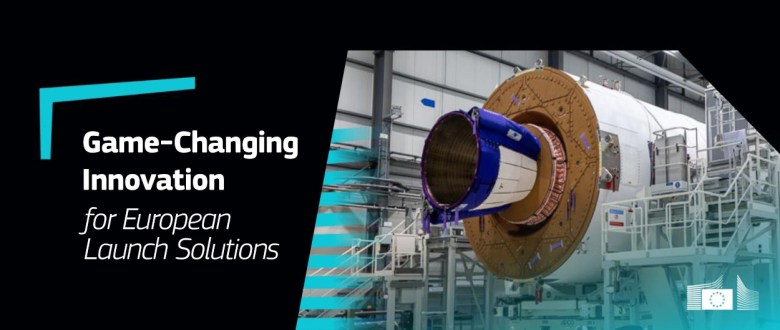
Complementing technology development efforts like SALTO and ENLIGHTEN, the European Commission has also invested in a €5 million “Prize for Game-Changing Innovation for European Launch Solutions,” designed to reward low-maturity innovation concepts that could transform access to space and strengthen the EU strategic autonomy. Five winning teams received a prize for their disruptive innovations in areas ranging from autonomous flight termination to new propulsion materials. Building on that initiative, the European Commission and European Parliament announced larger actions for 2026: a call of €20 million under the name “Game-Changing Innovation for European Launch Solutions” (PPPA-2026-LAUNCHERS-GAMECHANGING). Managed by the space research unit of the Executive Agency HaDEA, the call is inviting proposals focused on disruptive propulsion technologies with an eye toward demonstrating operational capability by 2035. The call was published on 29 January 2026 and is open for applications until 29 April 2026 17:00:00 (Brussels time). These initiatives represent the EU’s long-term vision to accelerate innovation and cement Europe’s leadership in access to space. In addition, the Horizon Europe Space R&I Work programme 2026 includes a dedicated topic aimed at “Reinforcing EU autonomous access to space through EU-based spaceport” with a budget of €23 million.
The European Commission is supporting Europe’s access to space as a cornerstone of Europe’ strategic autonomy, resilience and competitiveness. This shall be achieved by targeted investments covering a wide spectrum of activities in critical space technologies that shall accelerate the development of competitive launch capabilities and a competitive European industry in a rapidly evolving global launch market.
Related