
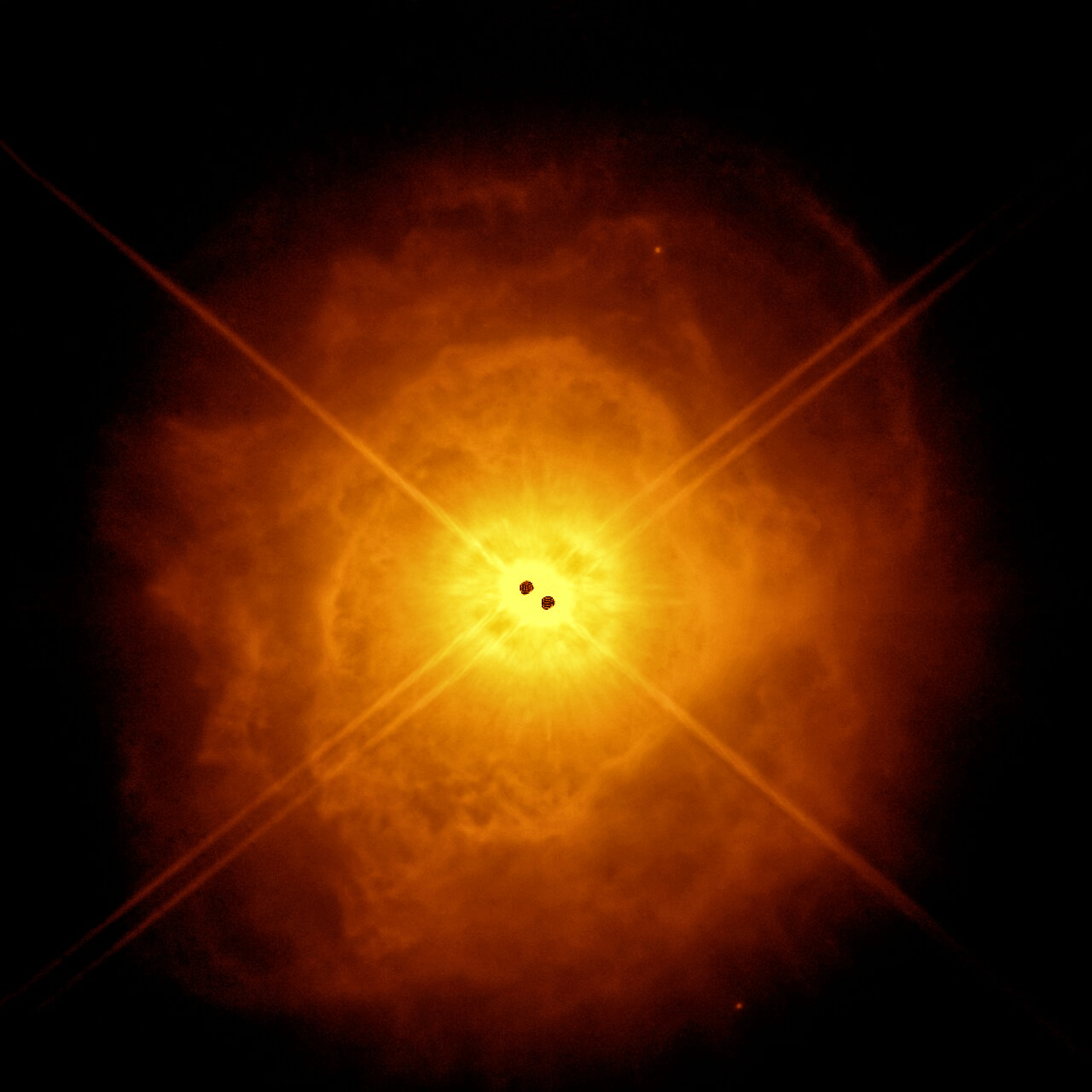
Credit: ESO/G. Tomassini et al.
https://www.eso.org/public/images/potw2608a/
https://www.aanda.org/articles/aa/full_html/2026/02/aa57705-25/aa57705-25.html
by Neaterntal
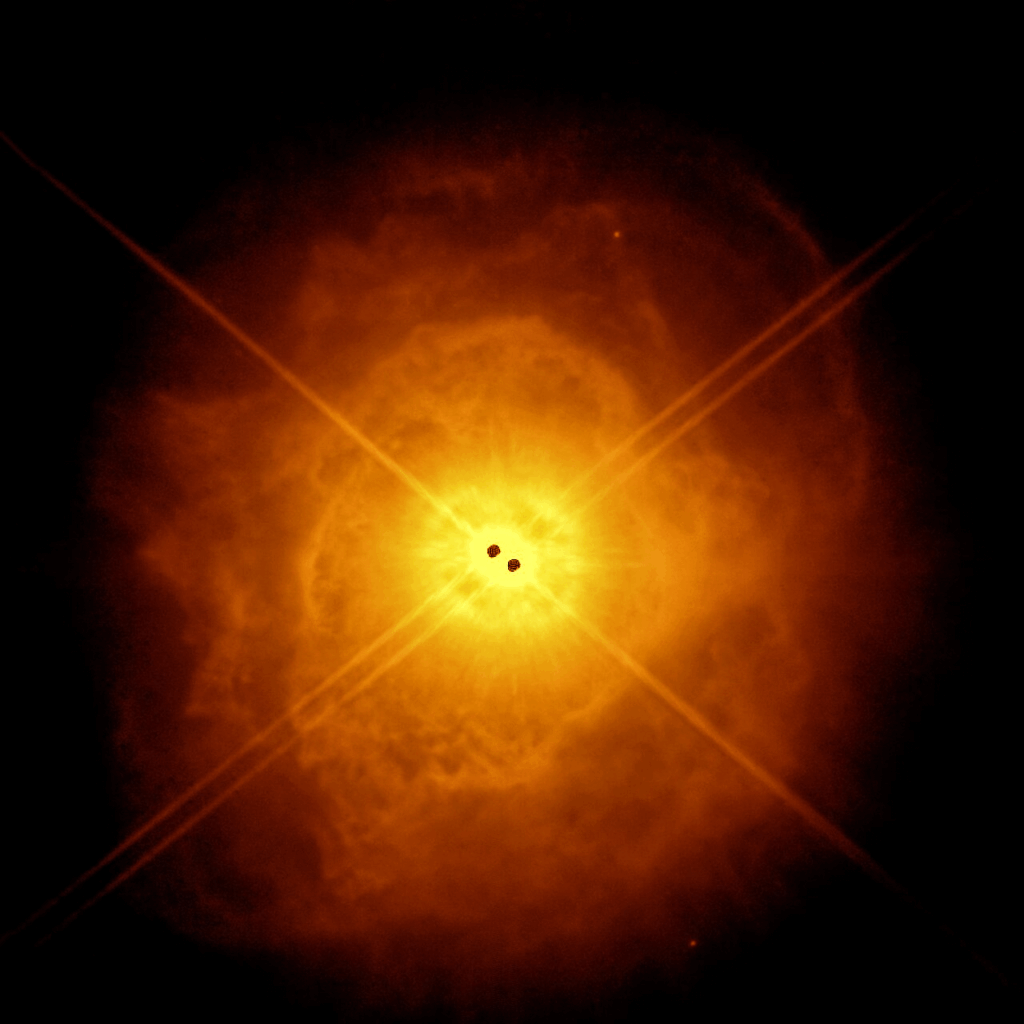
Credit: ESO/G. Tomassini et al.
https://www.eso.org/public/images/potw2608a/
https://www.aanda.org/articles/aa/full_html/2026/02/aa57705-25/aa57705-25.html
by Neaterntal
2 Comments
We humans are strongly influenced by the presence of companions over the course of our lives, shaping each other emotionally, culturally, or intellectually. This shaping effect is made literal in the case of stellar companions, which is the topic of today’s Picture of the Week. The pair of points at the centre of the image, taken with ESO’s Very Large Telescope (VLT), are an old stellar couple — a binary system officially called AFGL 4106. As most stars are born in pairs, a big question for astronomers is how does being in a couple impact a star’s death?
Before dying, stars expel huge amounts of gas and dust, ingredients for a growing nebula. The massive stars shown here are at close yet distinct late stages of their lifecycles, with one having blown off enough mass to produce a dusty surrounding envelope. In a new paper led by Gabriel Tomassini, a PhD student at the Université Côte d’Azur (France), researchers have mapped this debris, shown here in orange, and precisely characterised the central stars (marked in black).
Imaging astronomical objects close to stars poses a challenge due to the overpowering effect of a star’s brightness and, in fact, the stars themselves appear in black as their brightness saturated the detector of the instrument used to make this image. Fortunately, the SPHERE instrument on the VLT is well equipped to deal with large contrasts in light levels, enabling a detailed study of both the high luminosity stars and the faint surrounding nebula for the first time. Moreover, it can correct the blur caused by atmospheric turbulence, delivering very sharp images.
The shape of the nebula reveals the significant impact the companion is having on the gas ejection of the dying star, introducing asymmetries and shifting the clouds of gas and dust away from a perfectly spherical shape. Further observations of star systems like this one allow scientists to better understand how the presence of companions affects the death of stars.
Zoomable version https://www.eso.org/public/images/potw2608a/zoomable/