
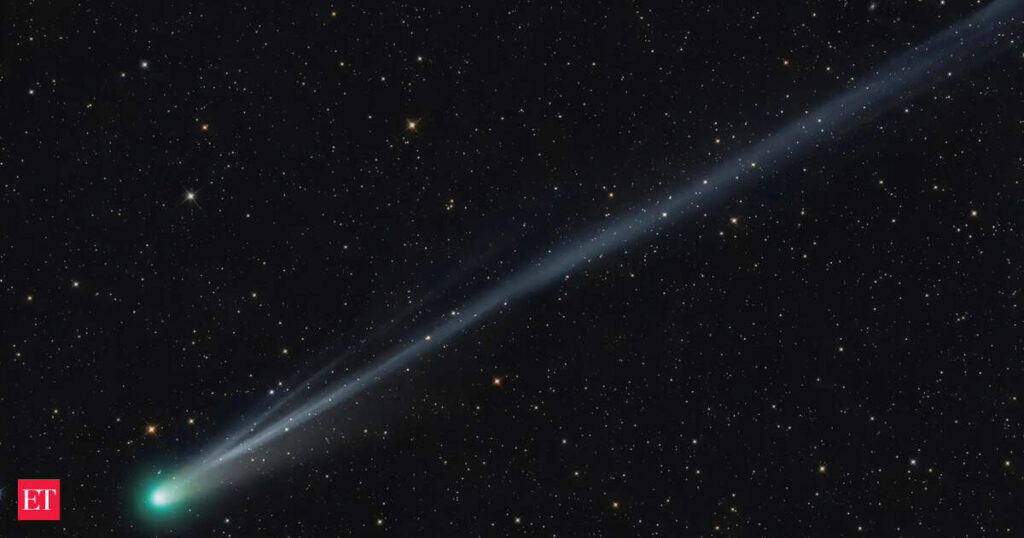
A newly discovered comet is drawing excitement among astronomers, with scientists saying it could become bright enough to be visible to the naked eye by April 2026, if it survives a perilous close encounter with the Sun.
The comet, C/2026 A1 (MAPS), was spotted on January 13 by a team of four amateur astronomers using a remotely operated telescope in the Atacama Desert. Early observations quickly identified it as part of the Kreutz sungrazing comet family, a group known for producing some of the brightest comets ever recorded.
What has particularly excited astronomers is how far from the Sun the comet was when first detected. At discovery, C/2026 A1 (MAPS) was 2.056 astronomical units, more than 300 million kilometers, from the Sun, a record distance for a sungrazing comet. Despite shining faintly at magnitude +17.8, the early detection suggests the comet may have a relatively large nucleus, potentially around 2.4 kilometers wide.
Also Read: Mars organic molecule discovery is difficult to explain without life, NASA study suggests
That size will be tested during a dramatic perihelion passage. Based on more than 150 observations, the comet is expected to pass the Sun on April 4, 2026, at a distance of just 118,681 miles (191,000 kilometers) above the Sun’s surface, deep within the solar corona. For comparison, the famous sungrazer C/2011 W3 (Lovejoy) passed slightly closer in 2011 and narrowly survived, becoming as bright as the planet Venus.
 Live Events
Such close approaches often cause sungrazing comets to fragment or disintegrate. However, if C/2026 A1 (MAPS) holds together or breaks apart late, it could brighten suddenly, potentially becoming visible without a telescope, and possibly even in daylight near perihelion. Afterward, it is expected to move into the evening sky, where it would be easier to observe from the Southern Hemisphere.
Even if the comet does not survive intact, solar observatories such as SOHO are expected to capture detailed imagery of its fiery passage. For now, astronomers say it remains one of the most promising sungrazing comets in years, with the potential to deliver a rare and dramatic celestial display in 2026.
Add  as a Reliable and Trusted News Source