
 A newly discovered comet has astronomers excited, with the potential to be a spectacular sight in early April. C/2026 A1 (MAPS) was spotted by four amateur astronomers with a remotely operated telescope in the Atacama desert on Jan 13. It quickly became apparent the comet was a member of a group called the Kreutz sungrazing comets, which include many of the brightest and most spectacular comets ever seen. MAPS is an acronym based on the last names of the astronomers who discovered it — Alain Maury, Georges Attard, Daniel Parrott and Florian Signoret.The comet is diving towards a fiery date with our star. In early April it will pass within just 1,20,000km of the Sun’s surface.
.
If MAPS survives, it could become a spectacular sight in the evening sky in early April. It may even become visible during the day as it swings closest to the Sun — unless it falls apart before then.So what makes these sungrazers so exciting, and what can we expect?Fragments of a mega cometOver the past 2,000 years, a series of spectacular comets have graced our skies. They appear seemingly from nowhere, shining remarkably close to the Sun in the sky. Some even become bright enough to be seen in daytime.Historically, the brightest comets often become known as “Great Comets”. The Great Comet of 1965 — C/1965 S1 (Ikeya-Seki) — was the brightest comet of the 20th century. Discovered just one month before its closest approach to the Sun, it got as bright as the full Moon, easily visible with the naked eye during the day. 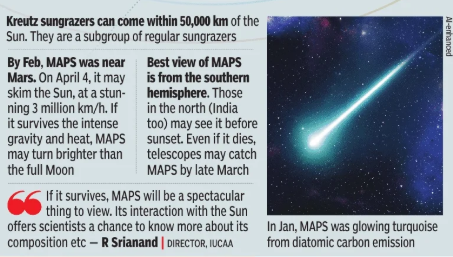
.
The Great Comet of 1882, C/1882 R1, was even more impressive. At its brightest, it was a hundred times brighter than the full Moon, dazzling in the sky for several months.We now know that all these bright comets from the last two millennia — the Kreutz sungrazing family — share a common origin. At some point in the past (in the 3rd or 4th century BCE), a giant cometary nucleus, over 100km in diameter, came very close to the Sun. Some time after that, far from the Sun, that comet split into two major fragments and shed lots of smaller pieces.Several hundred years later, in the 3rd century CE, those pieces returned as they journeyed on their long orbit around the Sun. Reports from 363 CE suggest there may even have been multiple comets visible with the naked eye in broad daylight at the same time. Those returning pieces again fragmented. In the 11th century, the two largest remaining pieces of the ancient mega comet swung by again, becoming the Great Comets of 1106 and 1138. Once again, the pieces fragmented — and the products of those fragmentations have been seen as a series of comets through the past two centuries.We’ve been due for a big oneToday, the Kreutz family contains a vast number of smaller comets which fall apart en route towards the Sun, as well as larger pieces that can put on a fantastic show.The most recent larger Kreutz sungrazer was visible in 2011. Discovered by astronomer Terry Lovejoy, the comet barely survived its close approach to the Sun, becoming as bright as Venus in late Dec 2011. 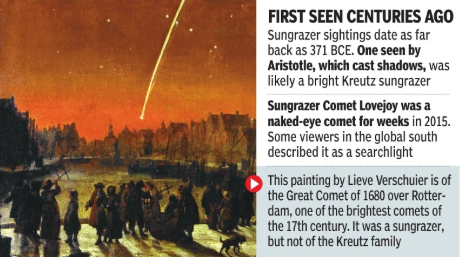
.
Predictions state we could see two large sungrazers in the coming decades, with one potentially arriving in the next couple of years. That comet would be a sibling to the Great Comets of 1965 and 1882, and a fragment of the Great Comet seen by Chinese observers in 1138.Enter comet MAPSC/2026 A1 (MAPS) already holds one record. At the time of its discovery, it was farther from the Sun than any previous sungrazer.That suggests it might be a larger-than-usual fragment — perhaps.The previous holder of this record was Ikeya-Seki in 1965, which proved to be the brightest of the 20th century. But technology has moved on in the past 70 years, and it seems very unlikely the nucleus of comet MAPS is as large as that of IkeyaSeki. In turn, that makes it unlikely comet MAPS will be as bright.Nevertheless, the fact we’ve caught it so early means it’s either a reasonably large Kreutz fragment, or it’s currently in outburst — already falling apart. Recent observations have shown it steadily brightening, which points to the former theory.