
With a doctorate in astrophysics – the study of stars, galaxies and the vast mechanics of the universe – and another in theology, Rev Prof David Wilkinson inhabits two worlds that many assume are in conflict.
So it is little wonder that when people discover his credentials, their questions drift beyond the ordinary.
On a recent visit to Singapore, the 62-year-old fielded questions that stretched from the philosophical to the personal: Who created God? If there are aliens elsewhere in the universe, did Jesus die for them too? When should belief rest on faith, and when must it be shaped by evidence? And how, in an age of science, can the resurrection be understood?
Here were his responses.
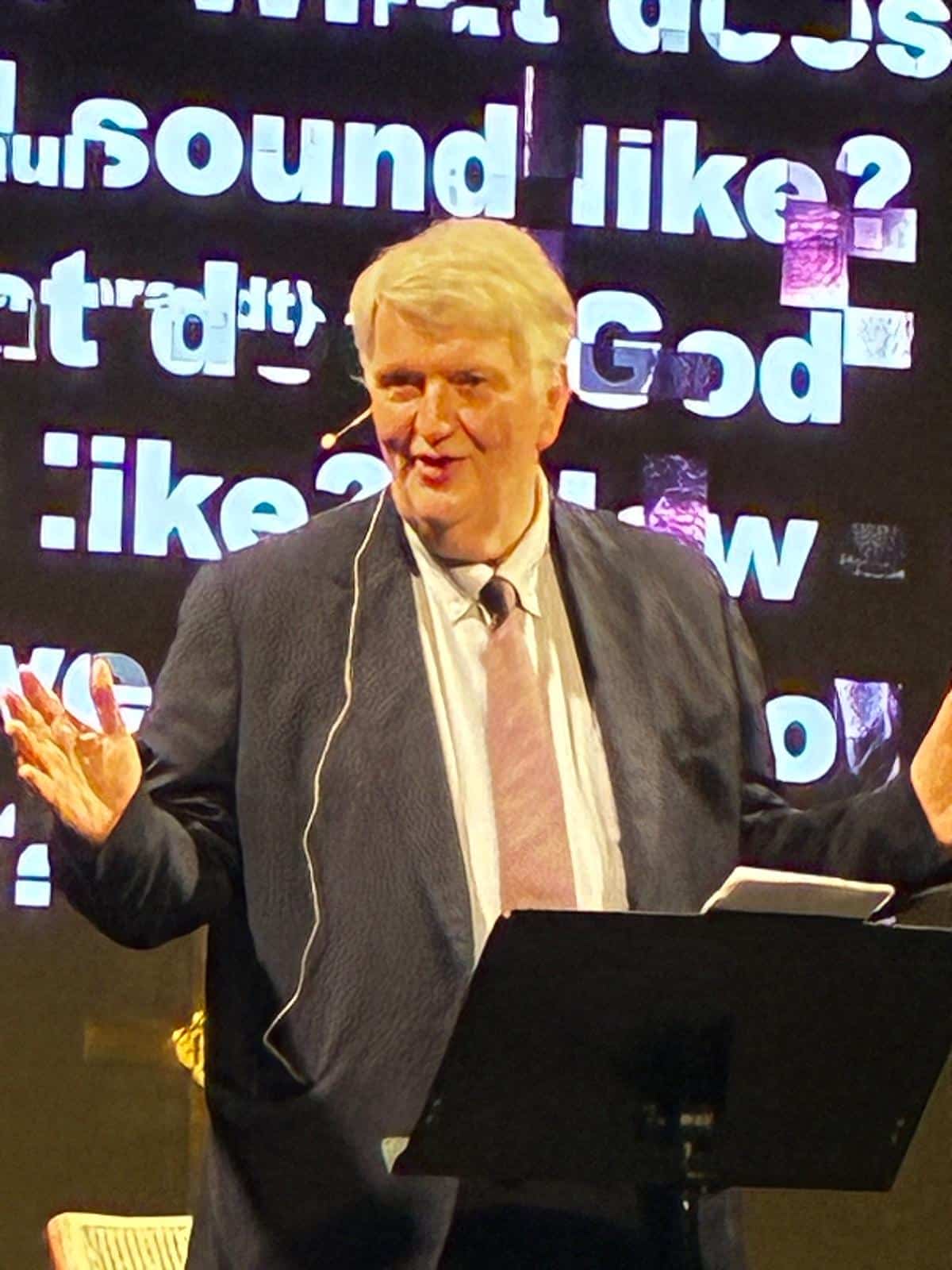
Rev Prof Wilkinson is a Professor in the Department of Theology and Religion at Durham University, a Director of Equipping Christian Leadership in an Age of Science (ECLAS), an international initiative based at St John’s College, and a Fellow of the Royal Astronomical Society.
If God created the universe, who created God?
Rev Prof Wilkinson: There is no answer to that question because God does not have a beginning. We only talk about “created” if things have a beginning.
If your only definition of God is the One who caused something else, then you can ask the question: “Who created God?” You can take that cause and effect further back.
But Christians say: “Hold on a moment. God’s more than just a first cause.” And in fact, God’s more than a God who simply starts off the universe and then goes for a cup of coffee, not to have anything more to do with it.

Remember in Colossians 1:17, it says “in Him, all things hold together”? It’s almost as if God is like the hull of a ship, keeping the whole thing afloat, keeping it in existence, moment by moment.
So God’s not a God who starts off the universe. God is a God who is sustaining every moment of the universe’s history. God is a different kind of cause than just the first cause.
Is there alien life elsewhere in the universe? If so, did Jesus die for them too?
Rev Prof Wilkinson: As some of you know, we’ve discovered lots of planets outside our solar system called exoplanets. And I talked about the universe being very, very large.
People then say: “Well, if most stars have planets, there must be another earth out there. Surely, there must be other life.”
Scientifically, you’ve got to be careful of that argument because things have to be very, very right for intelligent life.
To put it another way, it’s a long way from an amoeba to an accountant. You can have lots of primitive life throughout the universe, but it may be that it’s very rare to have intelligent life.
One of the big questions is: How does the Jesus event relate to other intelligent life elsewhere in the universe?
But let’s say we do think that there’s intelligent life out there. One of the big questions is: How does the Jesus event relate to other intelligent life elsewhere in the universe?
Well, the Jesus event for Christians has two aspects to it. The first is that Jesus came to show us what God is like. Secondly, Jesus came to save us because we’ve separated ourselves from God in sin.
The question then is: If there is intelligent life, will it have sinned in the same way that human beings have?
We don’t know. And if any of you have read the science fiction of a writer called CS Lewis (in The Space Trilogy), you’ll know that CS Lewis explores exactly that question – whether intelligent alien life forms have sinned.
And then there’s the question of: If God became incarnate in human flesh on this earth, would He become incarnate if there were little green women and little green men in little green flesh on another planet?
This is a really complicated question, and a number of us at the moment in theology are working with it and trying to figure out some of these issues.
I think all I can say is that the God that I see in Jesus would do what is necessary. And if there was another intelligent civilisation, and if they had sinned and were in need of salvation, the God that I see in Jesus would do what’s necessary to bring about salvation.
When is a belief held by faith, and when must it be informed by evidence?
Rev Prof Wilkinson: Those who are research scientists will know that faith is involved in the very scientific method itself.
If I do some observations on distant galaxies, I get the evidence, the data. Then I have to create a model which explains the data, and I have to get enough trust in that model to do something about it. I write a paper and I submit it to a scientific journal, and the peers within the scientific community judge the evidence. So there is evidence, trust, action.
When it comes to big scientific models, we rarely – if ever – use the word “proof”. So, when I’m working on the Big Bang, for example, I don’t talk about proving the Big Bang. All I do is say is: “There is good evidence, and this is the best model to interpret the evidence.”
“Signs and wonders are when God does unusual things to give us pictures about how He’s at work.”
There is always a degree of uncertainty about models in science. That’s because scientific models always are provisional. They always improve.
Do you remember some of the models of the atom that you did at school? These little billiard balls of electrons going around a nucleus. I’m sorry to tell you, folks, they’re not right. The atom is nothing like that at all. It’s all fuzzy because of quantum theory.
When we start by doing a science experiment, we always do a hypothesis, and we end with an experiment. We try to find out something which has already been created. It takes a lot of faith to actually believe in them. Therefore, we need to be open in science to evidence, which then affects our trust in models.
Faith is involved in both science and Christian discipleship. In biblical faith, when Jesus encountered people, they had evidence. They looked at what He did, at what He spoke about, His very character. They then were called to trust in Him, and also to act or follow Him.
You see, faith is not just an intellectual belief. It’s actually taking trust and doing something about it.
And so, a number of people over the past few decades have talked about the process of evidence, trust, action in science having some parallels to evidence, trust, action in Christian discipleship.
How can the resurrection be explained?
Rev Prof Wilkinson: God is not constrained by the laws of thermodynamics. The second law of thermodynamics is, bluntly put: Things fall apart in the universe. Disorder increases in the universe.
“Faith is not just an intellectual belief. It’s actually taking trust and doing something about it.”
But God, in the bodily resurrection of Jesus, does something that goes beyond the falling apart of a body in death. God actually brings about resurrection. For me, that is both the evidence and the picture of what God can do.
The evidence is very strong for the bodily resurrection of Jesus – the empty tomb, the appearances to the disciples, the growth of the early Church. Now, if I’ve got the evidence for something, even if I can’t understand how it works, as a scientist, I’m trained to trust the evidence.
Paul in 1 Corinthians says that the resurrection of Jesus is the first fruits of that which is to come (1 Corinthians 15:20). It’s a picture of what God can do in the universe that is not constrained by scientific laws.
Scientific laws are His usual ways of working. Miracles – or signs and wonders, as the New Testament better puts it – are when God does unusual things, where He goes beyond His normal ways of working to give us pictures of how He’s at work, or what the Kingdom is about, or who Jesus is.
RELATED STORIES:
Where is God in science? A scientist speaks up
Is Science anti-God? A scientist weighs in
“There is no conflict between science and faith,” say Singapore tech entrepreneur and US astronaut