
Sources
https://sdo.gsfc.nasa.gov/data/
https://spaceweather.com/archive.php?view=1&day=22&month=02&year=2026
https:// x. com/JAtanackotv/status/2025572032025436288
by Neaterntal
Sources
https://sdo.gsfc.nasa.gov/data/
https://spaceweather.com/archive.php?view=1&day=22&month=02&year=2026
https:// x. com/JAtanackotv/status/2025572032025436288
by Neaterntal
11 Comments
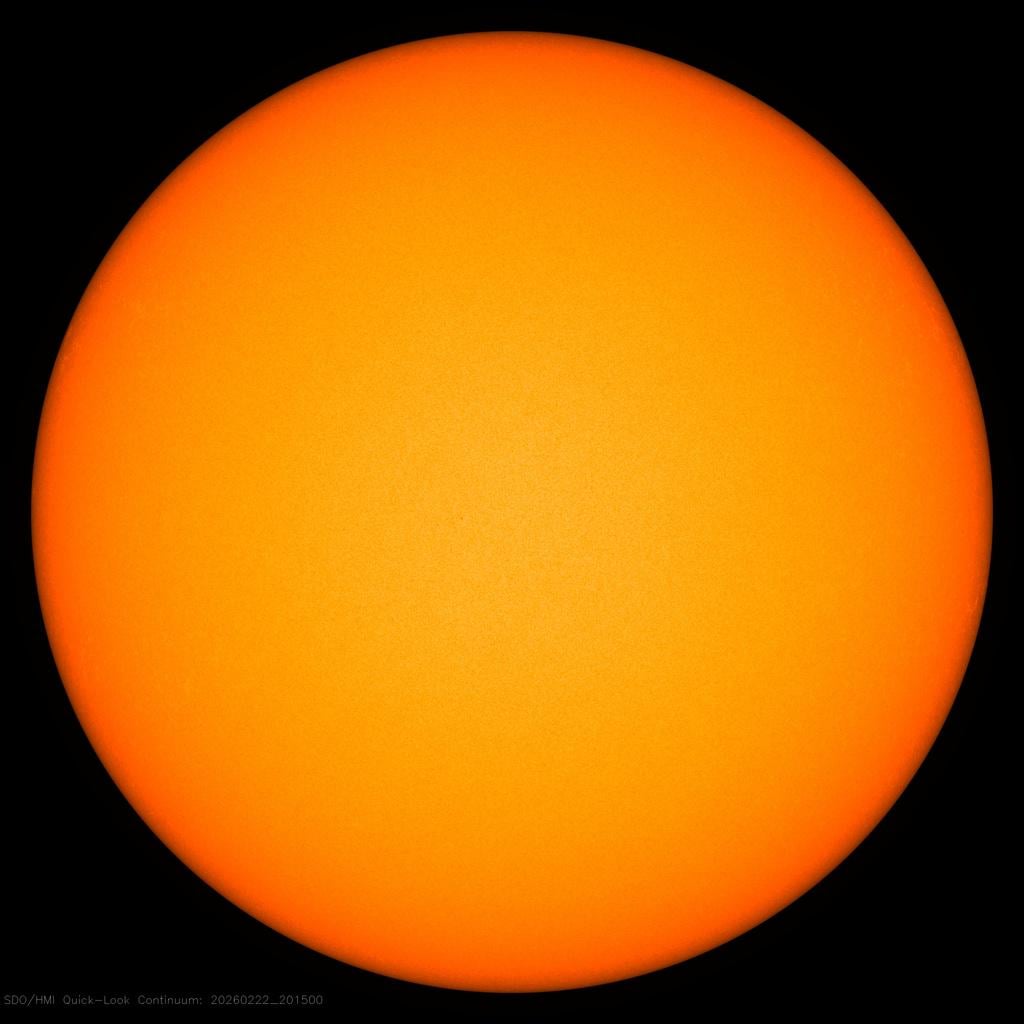
This is the first spotless day on the Sun since 2022, when we were rapidly climbing out of solar minimum (2019) towards solar maximum (2024). Does the spotless day signify the solar minimum is coming? Yes and no.
A single spotless day can occur even during relatively high activity – we had one in 2014, during the peak of Solar Cycle 24.
But that was a weak cycle. Spotless days usually begin during the declining phase of a solar cycle, some 4-5 years before solar minimum.
On the other hand, the first spotless days of SC23, a much stronger cycle than SC24, began when the cycle had declined more than SC25 has so far – 2004 had smoothed sunspot number values between about 55 and 80, while we are likely still >100 right now (unless the cycle really crashes in the next 6 months). Certainly an interesting situation.
Is it a fluke and we will not see more spotless days in 2026, or is it a sign of the trend? We will likely see in a month when the low-activity solar longitude interval that has been present for about 6 months now again rotates into view. And it’s still a long way to the solar minimum, but it may already be visible far, far in the distance.
.
.
Spotless days are a key indicator the solar cycle. During years around Solar Minimum, whole months can go by without a single sunspot, racking up dozens of spotless days in a row. Between 2018-2020 (the last Solar Minimum) there were more than 700 spotless days!
Today’s blank sun does not mean Solar Minimum has arrived. On the contrary, it is still years away. However, it does tell us that Solar Cycle 25 is waning. Sunspots will be back–probably tomorrow–but today is a preview of things to come.
The dust spot number on my monitor today is 4.
Neat, I’ll go take a look
This is the hottest thing I’ve read about today.
Its acne is finally gone (for now)

Bruh I didn’t even know it did this… i just assumed it always had spots
Eternal Sunshine of the Spotless Sun
I bet there’s still a big ole crack in the back
There’s no little black spot on the sun, to-daay
What cleaning product they used? I’d like to buy some