
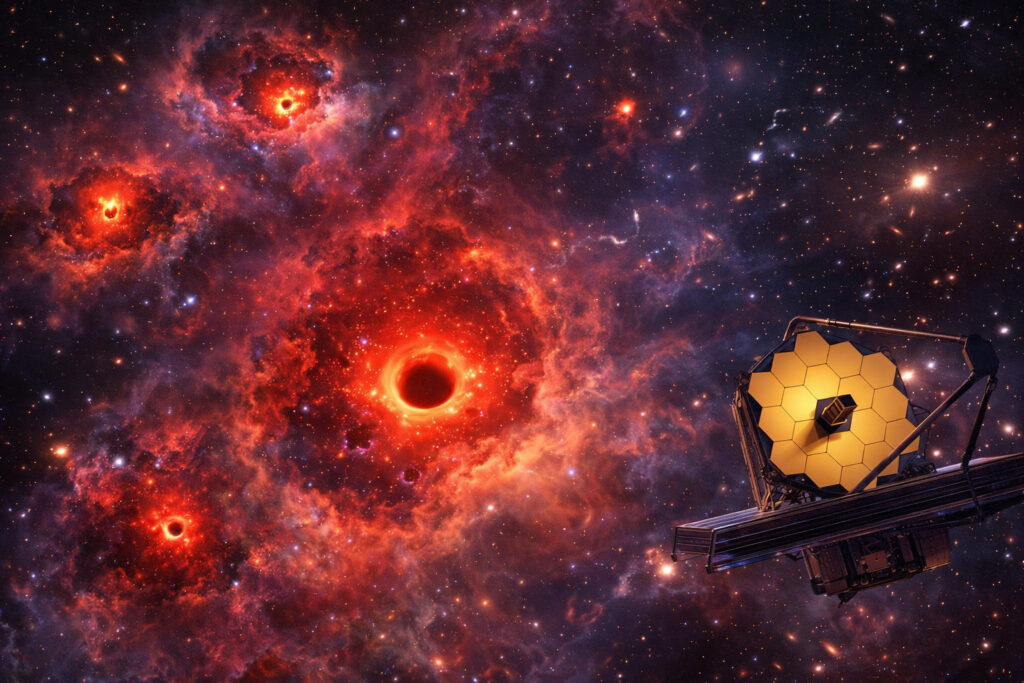
Scientists explain that the mysterious red dots captured by the James Webb telescope are black holes in formation, hidden in clouds of gas, changing our understanding of the early universe.
For months, astronomers around the world have been trying to understand an intriguing phenomenon. Images from the James Webb Space Telescope showed small “red dots” scattered across the deep sky….objects that didn’t fit traditional models of galaxies or young stars. Now, scientists have finally arrived at an explanation.
According to a study released in January 2026 on ScienceDaily, these red dots are, in fact, young and extremely active black holesstill in the early stages of growth, enveloped by dense clouds of gas and dust. The discovery offers a new perspective on How the early universe evolved shortly after the Big Bang..
Furthermore, the finding helps answer a long-standing question in astronomy: How did supermassive black holes manage to grow so rapidly in the first billion years of the cosmos?.
— ARTICLE CONTINUES BELOW —

What were the red dots observed by the James Webb Space Telescope?
Since the beginning of scientific operations do James Webb Space TelescopeLaunched to observe the universe in infrared, researchers noticed unusual objects. They appeared as small, intensely red, and very bright points, even at great distances.
However, these objects did not exhibit typical characteristics of known galaxies. Nor did they behave like stars in formation. For this reason, scientists informally began to call them “strange red dots.”
Over time, more detailed analyses showed that the red coloration did not come solely from the distance. It was also linked to the large amount of dust and gas surrounding these objects.which blocks visible light and allows only infrared light to pass through.
Young and voracious black holes in the early universe
According to the researchers, the red dots represent black holes growing at an accelerated pace, feeding intensely on the material around it. This process releases enormous amounts of energy, which explains the brightness captured by the James Webb Space Telescope.
Unlike the supermassive black holes observed at the center of current galaxies, these objects are still in formation. Even so, They already consume matter at a very rapid rate., which surprised astronomers.
According to the study, this indicates that Black holes can emerge and grow even before their galaxies are fully formed., reversing the logic adopted by many classic models.
Why the discovery changes what we know about the beginning of the universe.
For decades, scientists believed that galaxies formed first and only later gave rise to central black holes. However, data from the James Webb Space Telescope suggest a different scenario.
Now, the hypothesis is growing that Young black holes may have played a central role in the formation of the first galaxies.By consuming gas and releasing energy, they may have influenced the birth of stars and the initial structure of these galaxies.
According to researchers cited by ScienceDaily, this behavior helps explain why they already existed. supermassive black holes when the universe was still very young, something that previously seemed difficult to justify using only gradual growth.
The importance of infrared for this discovery.
This discovery was only possible thanks to James Webb’s ability to observe the universe in infrared. Unlike previous telescopes, it can “see” through thick clouds of cosmic dust.
Furthermore, infrared allows us to observe extremely distant objects, whose light has been stretched by the expansion of the universe over billions of years.
In this way, the telescope acts as a time Machine, revealing events that occurred when the universe was only a fraction of its current age.
Historical context of the search for the first black holes.
Since the late 20th century, astronomers have been trying to understand the origin of supermassive black holes. Observations made with the Hubble telescope already indicated that they existed very early in the history of the cosmos.
However, the instruments available at the time were unable to capture sufficient detail. Data on the early stages of these objects was lacking.
With the launch of the James Webb, in partnership between NASAWith the advent of the European Space Agency and the Canadian Space Agency, this scenario began to change. For the first time, it was possible to observe directly black holes forming in the primitive universe.
What scientists still want to discover
Despite the progress, many questions remain unanswered. Researchers now want to understand… What was the origin of these young black holes?They may have arisen from the direct collapse of large gas clouds or from the death of extremely massive stars.
Furthermore, scientists are investigating how these objects interact with their surrounding environment and how they influence the rate of star formation.
According to the study’s authors, new observations from the James Webb Space Telescope should help clarify these points in the coming years.
A new chapter in understanding the cosmos.
The explanation of the red dots marks another important step in the exploration of the deep universe. What once seemed a mystery is now revealed as a key piece of cosmic history..
The discovery reinforces the idea that the early universe was more dynamic and complex than previously thought. It also shows that black holes are not just the end result of galactic evolution, but… central actors from the earliest moments of the cosmos.
Thus, the “red dots” cease to be a visual curiosity and come to occupy a fundamental place in the narrative about How the universe was born, evolved, and transformed..