
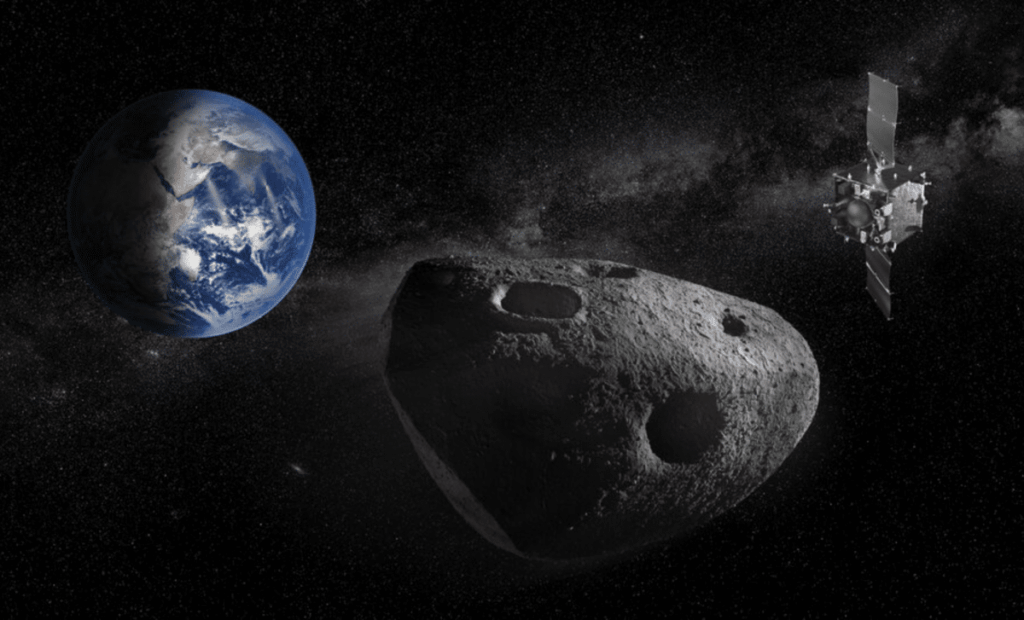
On February 10, 2026, the European Space Agency (ESA) awarded a significant contract to OHB Italia for the development of the Rapid Apophis Mission for Space Safety (Ramses). This mission, slated for launch in 2028, aims to study asteroid Apophis before its close flyby of Earth in 2029. With the mission promising valuable insights into the nature of asteroids, the collaboration between ESA, OHB Italia, and other international partners marks a major step in advancing planetary defense technologies.
The Ramses Mission: Unlocking the Mysteries of Apophis
ESA’s Ramses mission is not just another space exploration project, it represents a once-in-a-lifetime opportunity to study asteroid Apophis, which has captured the attention of the scientific community for years due to its rare and potentially hazardous flyby of Earth in April 2029. According to Orson Sutherland, ESA’s Mars & Beyond Projects Group Leader,
“With Ramses, ESA is seizing a once-in-a-lifetime opportunity to study asteroid Apophis as it swings past Earth, deepening our understanding of near-Earth objects and advancing our capabilities to protect our planet.”
The mission’s significance lies in its ability to collect detailed data on Apophis’s physical properties, including its shape, rotation, and internal composition. These insights will be crucial for developing future strategies to protect Earth from potential asteroid impacts. As Apophis makes its closest approach to Earth, within just 32,000 km, which is closer than the Moon’s distance, the Ramses mission will be in an optimal position to capture real-time data on the asteroid’s behavior, providing a rare opportunity for study.
A Strong European and International Partnership
The Ramses mission demonstrates the strength of European collaboration in space exploration, with OHB Italia playing a key role in the spacecraft’s development.
“We are proud to be entrusted by ESA with the Ramses mission,” said Roberto Aceti, CEO of OHB Italia. “This contract reflects the confidence placed in our team’s expertise and decades-long heritage in delivering complex space systems. We look forward to working with ESA and our partners to deliver this truly ambitious mission for planetary defense.”
Additionally, ESA has partnered with the Japan Aerospace Exploration Agency (JAXA), which will contribute important components such as solar arrays and a thermal infrared imager, among other technological contributions. This collaboration highlights the international nature of the mission, showcasing how countries across the globe are coming together to enhance planetary safety.
The Role of CubeSats in the Ramses Mission
A significant feature of the Ramses mission is the use of deployable CubeSats, which will extend the mission’s scientific reach. These small but powerful satellites are designed to gather additional data once the spacecraft arrives at Apophis. Tyvak International, an Italian company, is responsible for building one of the CubeSats named “Farinella,” after the late Italian planetary scientist Paolo Farinella. As Fabio Nichele, CEO of Tyvak International, notes, “We are excited to take on the challenge of delivering a small spacecraft that can make a big contribution to the study of the asteroid Apophis during its historic close Earth flyby.”
These CubeSats will allow scientists to gather data from different perspectives, enhancing the overall understanding of Apophis and its behavior as it passes near Earth. The use of small satellites in this mission highlights how innovative space technologies can play a key role in planetary defense.