
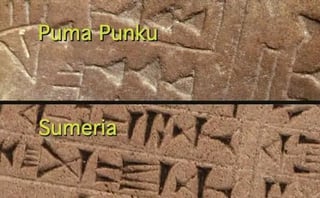
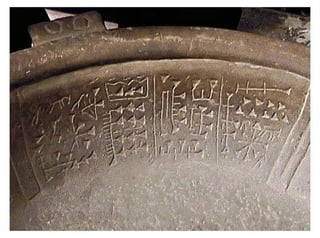
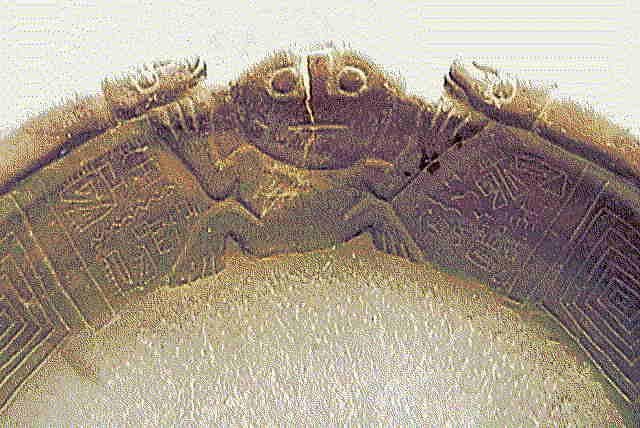
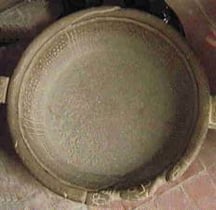
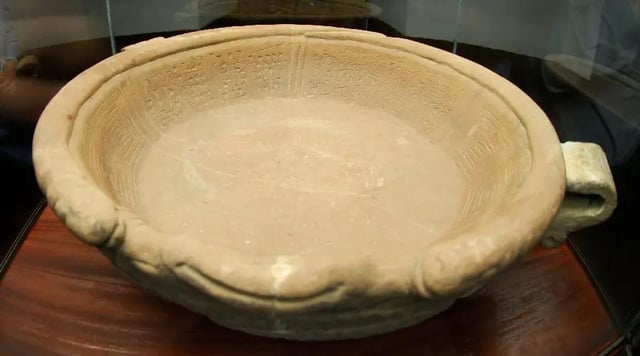
Located at the Precious Metals Museum in La Paz Bolivia, we find the famous Fuente Magna bowl, a unique piece of ceramic that contains what some believe is one of the biggest secrets of ancient mankind. The Fuente Magna Bowl was discovered near Tiahuanaco (Tiahuanaco is probably the greatest Native American civilization that many people haven’t heard of) and Lake Titicaca by a local farmer in the 1950’s. Researchers worldwide believe that this ceramic bowl provides proof of Sumerian contact at Puma Punku.
Clyde Ahmed Winters, an expert in ancient inscriptions, meticulously examined the vase and noted its characters bore resemblance to not only Sumerian script but also ancient Indian Dravidian, Iranian Elodite, and Libyan Berber. Bolivian archaeologist Max Portugal Zamora estimated the vase’s age at a minimum of 5,000 years. This dating poses a significant question: how did a vessel bearing Sumerian inscriptions end up in Bolivia, thousands of kilometers from its origin?
by PristineHearing5955
4 Comments
The writings on the Fuente Magna Bowl have been somewhat controversial with different researchers providing different explanations. Dr. Alberto Marini translated the writings carved onto the Fuente Magna Bowl and reported that they were Sumerian, while Dr. Clyde A. Winters determined that it was probably Proto-Sumerian which is found on many artifacts in Mesopotamia.
Dr. Winters performed several studies on the Fuente Magna Bowl with very interesting results. He compared the writing to the Libyco-Berber writing used in the Sahara 5000 years ago, according to research this writing was used by the Proto-Dravidians, Proto-Mande, Proto-Elamites, and Proto-Sumerians.
“Some of its inner engraving superficially resembles non-Sumerian Mesopotamian cuneiform writing. Alexander H. Joffe has suggested that “the inscription is simply geometric filler or deliberate gibberish. And if anything, the face on the interior looks more like something produced by the local Tiwanaku culture (ca. 200-1000 CE)”
Straight from the Wikipedia page
>Fuente Magna inscription
> The problem however is that the object was not found in an archaeological excavation; it simply appeared. Another problem is that the bowl is utterly unlike any Sumerian object of the third millennium BCE, or the millennia before and after. The inscription is comprised of triangles and lines, reminiscent of Mesopotamian [cuneiform writing](http://etcsl.orinst.ox.ac.uk/edition2/cuneiformwriting.php), although not of the Sumerian period. But a closer look suggests the inscription is simply geometric filler or deliberate gibberish. And if anything, the face on the interior looks more like something produced by the local Tiwanaku culture (ca. 200-1000 CE).
[Alex Joffe via ASOR](https://www.asor.org/anetoday/2016/09/ask-near-eastern-professional)
If it’s cuneiform, it should be decipherable. What does it say?