
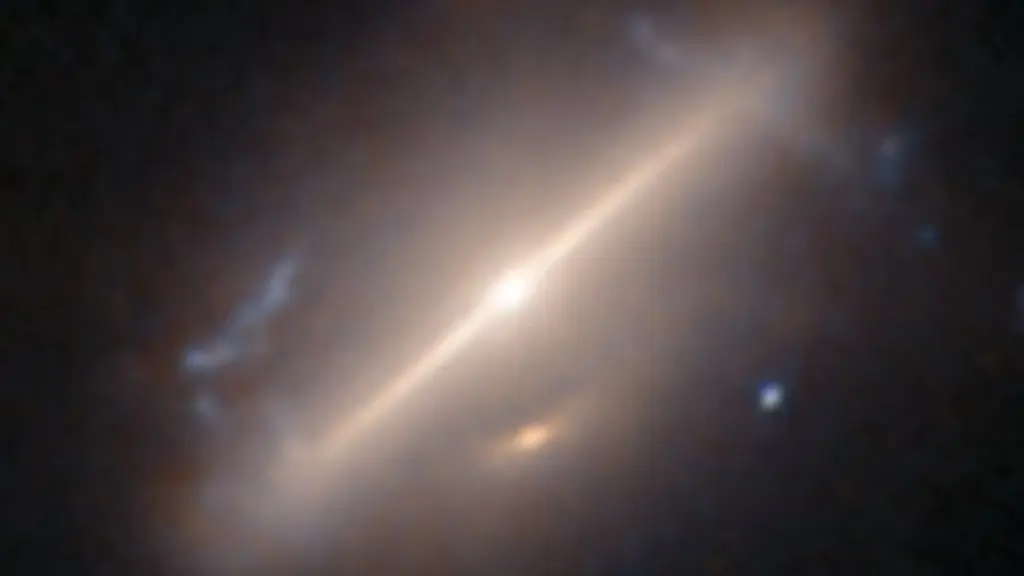
ESA astronomers have used a machine-learning system called AnomalyMatch to search the Hubble Legacy Archive for rare and anomalous objects, marking the first systematic survey of its kind.
The AI sifted through nearly 100 million individual image cutouts in just two and a half days, a task that would have taken human researchers months or years, and flagged about 1 400 sources as potential anomalies. After manual verification, more than 800 of these objects were confirmed as previously undocumented in the scientific literature.
Developed by ESA researchers David O’Ryan and Pablo Gómez, AnomalyMatch uses a neural-network architecture trained to recognize rare galactic forms such as gravitational lenses, ring galaxies, and jellyfish galaxies with gas tails.
“Archival observations from the Hubble Space Telescope now stretch back 35 years, providing a treasure trove of data in which astrophysical anomalies might be found,” says David O’Ryan, lead author of the research paper published in the journal Astronomy & Astrophysics.
The algorithm learns from known examples to detect outliers in the vast Hubble archive, which now contains data spanning more than 35 years of space observations.
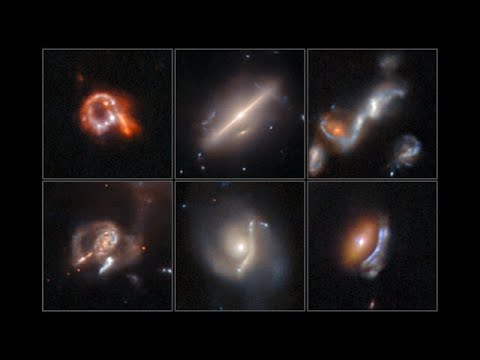
Among the confirmed anomalies were galaxies in various stages of interaction and merger, systems with unusual stellar tails, and numerous examples of gravitational lensing where the light of a distant galaxy is warped by a foreground mass.
The AI also flagged galaxies with large clumps of stars and edge-on planet-forming disks that appear as hamburger- or butterfly-shaped structures, along with several dozen objects that did not fit any known morphological class even after expert review.
According to ESA, the unclassified sources are among the most intriguing, possibly representing complex mergers or rare lensing systems that will require detailed follow-up observations.
While AI can flag outliers, the final step in determining their physical nature still requires human interpretation and follow-up observation. The team is preparing to re-examine the unclassified subset with the James Webb Space Telescope and the Euclid, whose infrared and wide-field capabilities could resolve whether these objects are multi-component galaxies or previously unrecognised lensing systems.
This work shows the evolving relationship between automation and human analysis in astronomy. Citizen-science programmes can extend visual classification, but cannot keep pace with petabyte-scale archives.
“This is a fantastic use of AI to maximise the scientific output of the Hubble archive,” says study co-author Pablo Gómez. “Finding so many anomalous objects in Hubble data, where you might expect many to have already been found, is a great result. It also shows how useful this tool will be for other large datasets.”
Neural networks such as AnomalyMatch offer a way to triage that data, filtering out statistical outliers for scientists to investigate. By exposing objects that defy its own training, AI effectively maps the edges of its knowledge and points to where human curiosity must take over.
Future observatories, including the NSF–DOE Vera C. Rubin Observatory and NASA’s Nancy Grace Roman Space Telescope, to which ESA contributes as a Mission of Opportunity, will generate tens of petabytes of images each year. Tools like AnomalyMatch are becoming essential for detecting rare structures within this flood of data, helping scientists find both expected and unimagined forms in the Universe.
References:
1 O’Ryan, D., & Gómez, P. (2025). Identifying astrophysical anomalies in 99.6 million source cutouts from the Hubble Legacy Archive using AnomalyMatch. Astronomy & Astrophysics, 704, A227. https://doi.org/10.1051/0004-6361/202555512
2 Researchers discover hundreds of cosmic anomalies with help from AI – ESA Hubble – January 27, 2026