
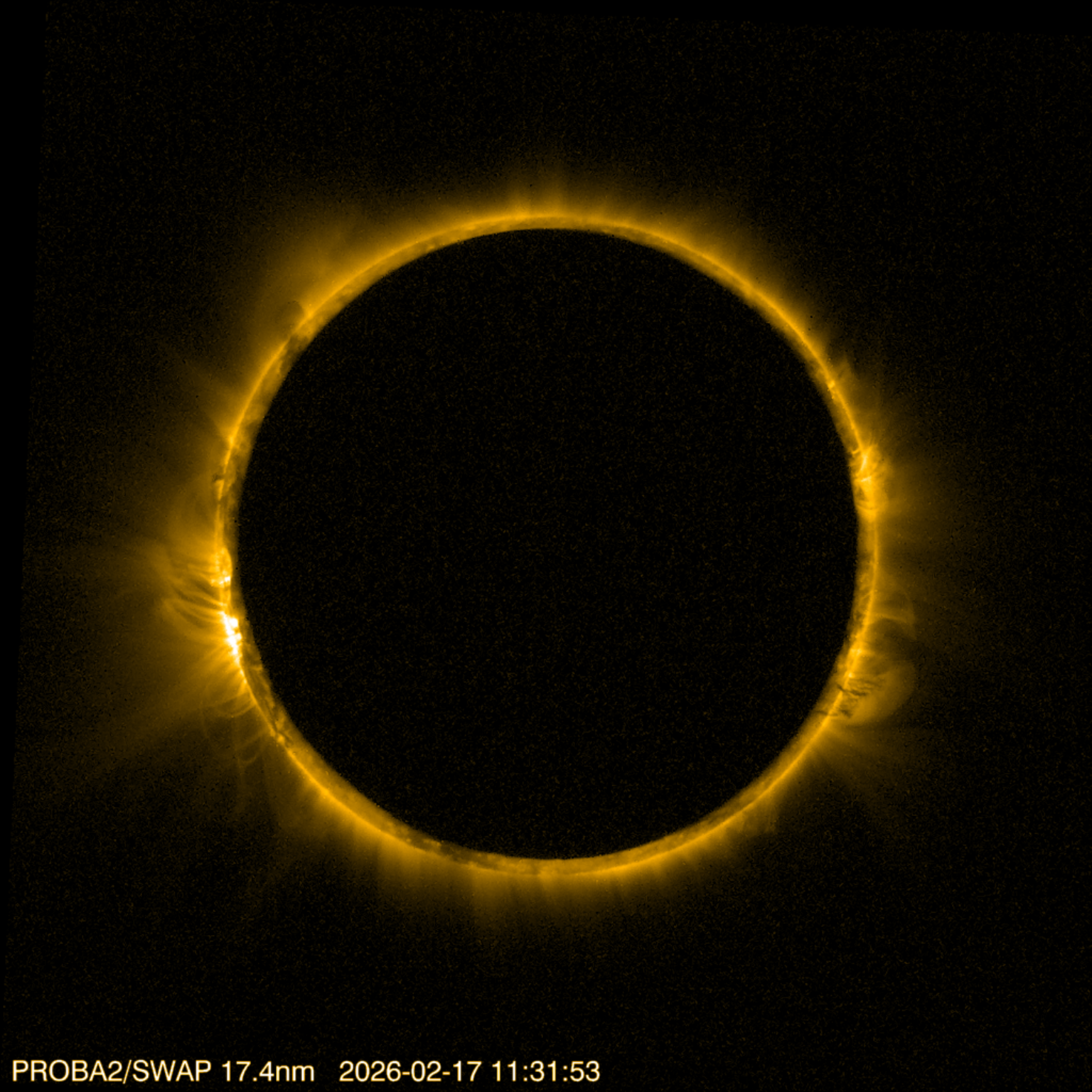
The Moon passed directly between the Sun and Earth on 17 February 2026, creating an annular solar eclipse. Because the Moon was at a more distant point along its elliptical orbit around Earth, it didn’t entirely cover the Sun and left a ‘ring of fire’.
The European Space Agency’s (ESA) Proba-2 satellite captured this ring from its viewpoint in space. Flying around Earth, the spacecraft witnessed the same solar eclipse no less than four times, including this perfect ring of fire at 11:31 Universal Time. The images were taken by the spacecraft’s SWAP extreme ultraviolet imager, at a wavelength of 17.4 nanometres. Read the Proba-2 Science Center blog post about the eclipse here.
On Earth, this rare treat was only visible from Antarctica. A partial solar eclipse could be seen from the southern tip of Chile and Argentina, as well as southern Africa.
Upcoming solar eclipses will be visible from more populated regions. ESA is looking forward to three ‘European eclipses’ in the next two years: a total solar eclipse on 12 August 2026 (totality visible from Greenland, Iceland, Spain); a total solar eclipse on 2 August 2027 (southern tip of Spain, northern Africa & the Middle East); and an annular eclipse on 26 January 2028 (South America, Portugal, Spain).
Remember: never look directly at the Sun, even when partially eclipsed, without proper eye protection such as special solar eclipse glasses, or you risk permanent eye damage.