
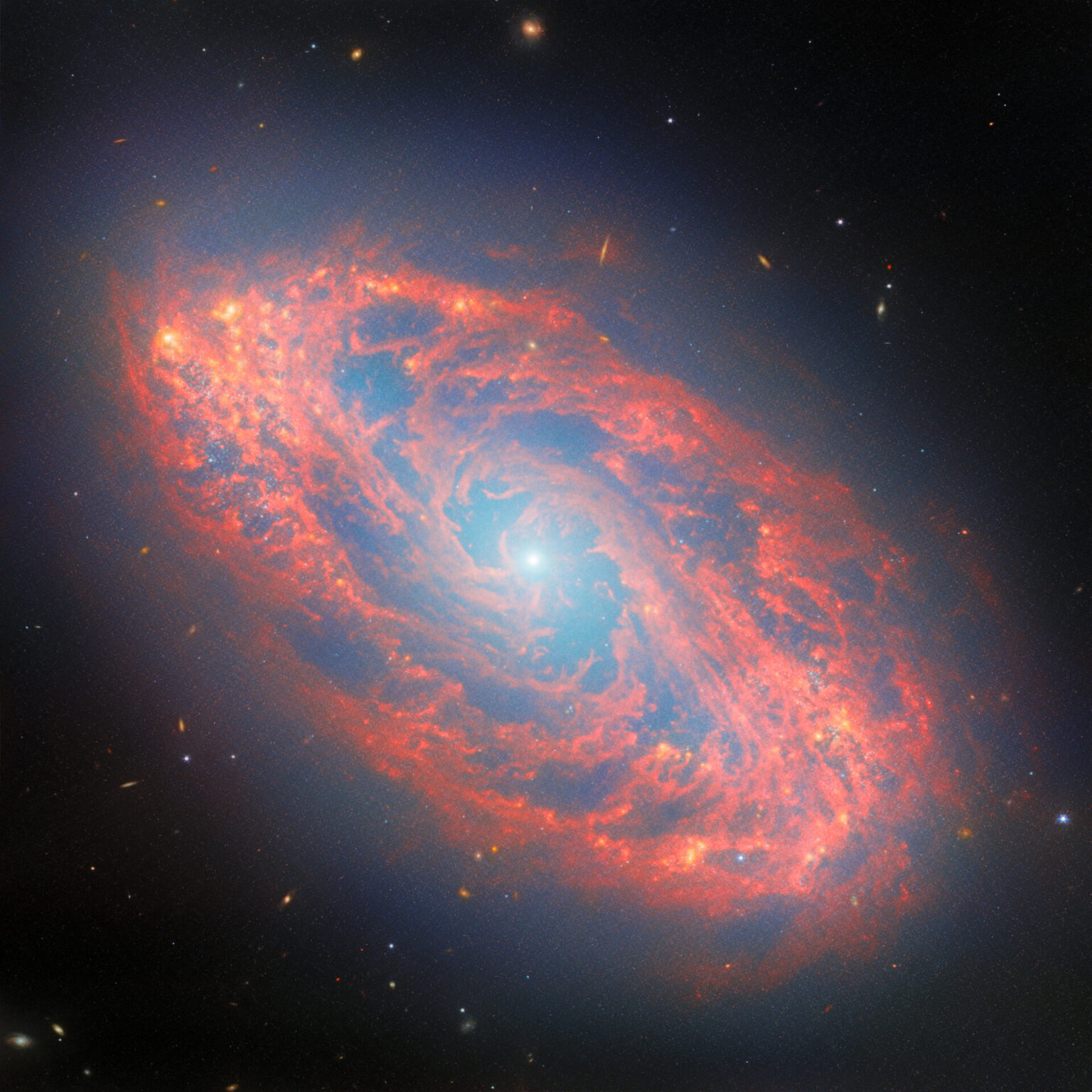
Two powerful instruments of the NASA/ESA/CSA James Webb Space Telescope joined forces to create this scenic galaxy view for today’s Picture of the Month. This spiral galaxy is named NGC 5134, and it’s located 65 million light-years away in the constellation Virgo.
Though 65 million light-years may seem like a huge distance – the light that Webb collected to create this image has been journeying to us from NGC 5134 since soon after Tyrannosaurus rex went extinct – NGC 5134 is fairly close by as far as galaxies go. Because of the galaxy’s relative proximity, Webb can spot incredible details in its tightly wound spiral arms.
Webb’s Mid-InfraRed Instrument (MIRI) collects the mid-infrared light emitted by the warm dust that speckles NGC 5134’s interstellar clouds, tracing clumps and strands of dusty gas. Some of the dust is composed of complex organic molecules called polycyclic aromatic hydrocarbons, which feature interconnected rings of carbon atoms and provide a way for astronomers to study the chemistry happening in interstellar clouds. Webb’s Near-InfraRed Camera (NIRCam) records shorter-wavelength near-infrared light, mostly from the stars and star clusters that dot the galaxy’s spiral arms.
Together, the MIRI and NIRCam data paint a portrait of a galaxy in constant ebb and flow. The gas clouds that billow along NGC 5134’s spiral arms are the sites of star formation, and each star that forms chips away at the galaxy’s supply of star-forming gas. When stars die, they recycle some of that gas back into the galaxy. Massive stars more than about eight times the mass of the Sun do so spectacularly, in cataclysmic supernova explosions that spread stellar material across hundreds of light-years.
Stars like the Sun give back some of their material as well, though more gently; these stars will balloon into bubbling red giants before shrugging off their atmospheres and sending them into space. Whether expelled by explosive supernovae or gentle red giants, this gas can then be incorporated into new stars.
By using Webb to study the infrared light nearby galaxies like NGC 5134 whose stars and gas can be seen in detail, astronomers can apply their knowledge to galaxies too distant to be observed so closely – like those that are scattered in the background of this image, barely more than points of light.
[Image Description: A spiral galaxy, seen tilted diagonally. It has a blue-white, glowing spot at its core. Its oval-shaped disc glows faintly blue throughout with light from its many stars. The disc is filled with waves and strands of bright red dust that swirl around the core. At places there are holes torn in the dust, while elsewhere it forms dense clumps that glow orange. Several tiny, distant galaxies appear across the background.]